

Many Los Angeles residents treat "multi-family" and "apartment building" as interchangeable terms, but the reality is far more nuanced. Whether you're a renter weighing your next move, a homeowner thinking about adding units, or a first-time investor trying to make sense of LA's housing landscape, understanding what multi-family housing actually means changes how you see your options. This guide walks you through the definitions, design principles, local regulations, financial trade-offs, and current market conditions that shape multi-family living in Los Angeles today.
Table of Contents
- What is multi-family housing?
- Key features of multi-family homes
- Regulations and planning considerations in Los Angeles
- Community benefits and resident experience
- Multi-family vs. single-family homes: Cost, financing, and ownership
- Current trends and market data for multi-family housing in Los Angeles
- Explore your multi-family options with FO Studio
- Frequently asked questions
Key Takeaways
| Point | Details |
|---|---|
| Multi-family defined | Multi-family housing means two or more private homes on one property, each with kitchen and bath. |
| LA regulations matter | Los Angeles has unique zoning and design rules for multi-family developments, shaping what’s possible. |
| Design for belonging | Features like shared courtyards and amenities create both privacy and community in modern buildings. |
| Home type impacts costs | Multi-family homes offer diversified income and scalable living, but require specialized financing and management. |
| Market remains strong | Low vacancy, modest rent growth, and thousands of new units suggest stability in LA’s multi-family sector. |
What is multi-family housing?
Let's start with the clearest possible definition. Multi-family housing is a residential property containing two or more separate living units under one roof or on one parcel, each self-contained with its own kitchen, bathroom, and entrance. That last part matters: every unit functions independently, which is what separates a duplex from a large single-family home with a guest room.
The classification system breaks down by scale. Properties with 2 to 4 units are generally treated as residential for financing and regulatory purposes. Once you hit 5 or more units, the property crosses into commercial territory, which changes everything from how you borrow money to how the city reviews your permits. Understanding this threshold early saves a lot of confusion later.
Here are the most common types of multi-family dwellings you'll encounter in Los Angeles:
- Duplex: Two units, side by side or stacked, on one lot
- Triplex: Three independent units on one parcel
- Fourplex: Four units, still eligible for residential financing
- Apartment building: Five or more units, commercially financed
- Condominium: Individually owned units within a shared structure
| Feature | Single-family home | Multi-family home |
|---|---|---|
| Number of units | 1 | 2 or more |
| Financing type | Residential mortgage | Residential (2-4) or commercial (5+) |
| Ownership model | One owner, one household | One or multiple owners, multiple households |
| Income potential | None (unless renting) | Rental income from additional units |
| Regulatory complexity | Lower | Higher, especially in LA |
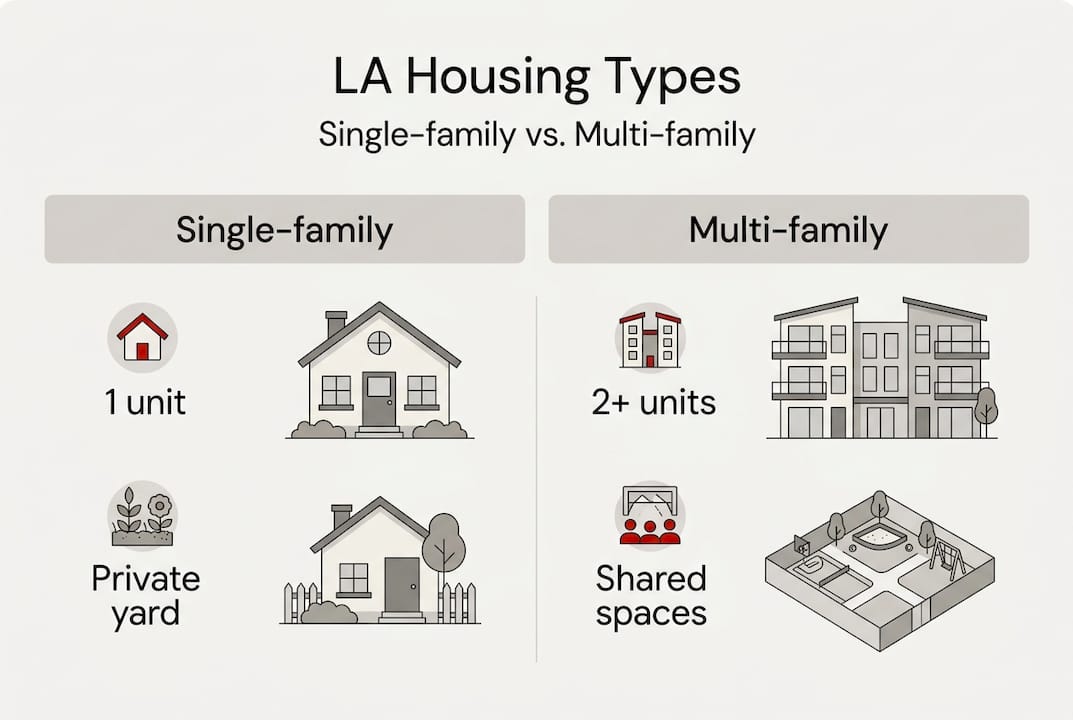
The construction approaches used for multi-family buildings also differ significantly from single-family homes, affecting everything from structural systems to fire separation requirements.
Key features of multi-family homes
Numbers alone don't tell the full story. What makes modern multi-family housing genuinely livable, especially in a dense city like Los Angeles, comes down to design. Good multi-family design balances two things that seem to pull in opposite directions: community connection and personal privacy.
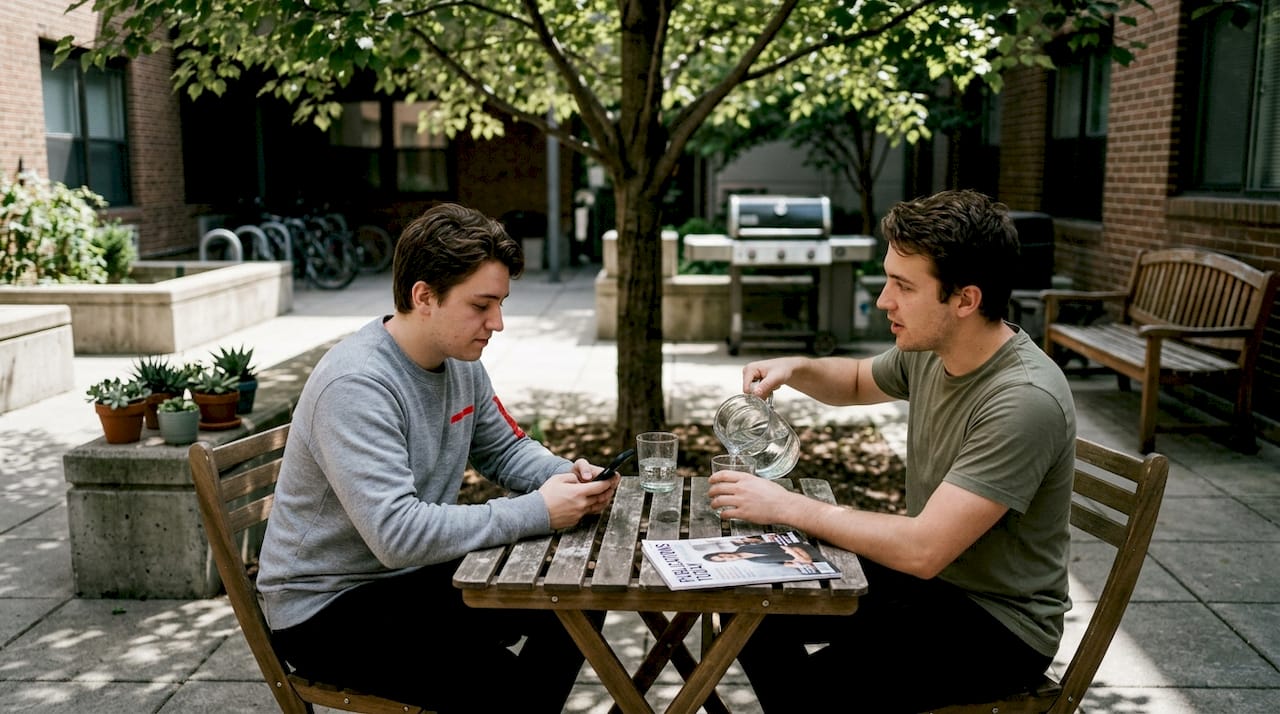
Design methodologies for well-built multi-family projects prioritize shared courtyards, gathering spaces along circulation paths, amenity variety for year-round use, acoustic privacy that still allows for social interaction, safety lighting, accessibility features like 36-inch doors, and neighborhood integration through varied facades and rooflines. That's a long list, but each element serves a real purpose.
Here's what you'll typically find in a thoughtfully designed multi-family building:
- Shared courtyards that create natural gathering points without forcing interaction
- Acoustic separation between units using insulated walls, staggered floor plans, or buffer zones
- Accessible entrances with 36-inch minimum door widths and step-free paths
- Varied rooflines and facades so the building fits into the neighborhood rather than dominating it
- Amenity spaces scaled to actual resident use, not just marketing appeal
"Central courtyards function as social anchors in multi-family buildings, giving residents a reason to step outside their unit and encounter their neighbors organically. That sense of casual connection is one of the strongest predictors of resident satisfaction and long-term community cohesion."
Pro Tip: Bigger amenities aren't always better. A well-designed 800-square-foot courtyard that gets used daily beats a 3,000-square-foot rooftop deck that sits empty. Right-sized amenities are more sustainable, cheaper to maintain, and more likely to actually build community. The future of multifamily design is moving firmly in this direction.
When design supports shared amenities without sacrificing individual comfort, residents get the best of both worlds: the social richness of a neighborhood and the privacy of their own home.
Regulations and planning considerations in Los Angeles
Los Angeles has some of the most layered housing regulations in the country, and multi-family development sits right at the center of that complexity. If you're planning to build, buy, or invest, knowing the key rules upfront saves time and money.
LA multi-family housing must comply with specific regulations including the Small Lot Subdivision Ordinance, single-stair building standards for climate-adaptive design, fair housing requirements, and replacement housing mandates. Here's a breakdown of the most important policies:
- Small Lot Subdivision Ordinance: Allows smaller parcels to be developed with attached or detached units, opening up small lot development opportunities in neighborhoods that previously couldn't support multi-family projects.
- Fair housing requirements: Units must be comparable in size and quality regardless of income level. No clustering affordable units in less desirable locations within the same building.
- 99-year affordability covenants: Affordable units in subsidized projects must remain affordable for 99 years, not just the initial financing period.
- Replacement housing mandates: If existing affordable units are demolished, they must be replaced at the same or lower rent levels.
- Accessibility standards: Minimum 36-inch door widths, accessible routes, and mixed-income unit distribution throughout the building.
| Aspect | Traditional multi-family | LA hybrid models (small lot, single-stair) |
|---|---|---|
| Lot size requirement | Larger parcels | Smaller infill lots allowed |
| Stair configuration | Multiple exit stairs | Single-stair design rules now permitted |
| Unit mix | Market rate dominant | Mixed-income required in many cases |
| Design flexibility | Moderate | Higher, with more facade variation encouraged |
Single-stair buildings, now permitted under newer LA-specific ordinances, allow for more efficient floor plans and better unit layouts. They also serve 92% fewer occupants per exit compared to traditional multi-stair configurations, which actually improves evacuation clarity in smaller buildings.
Pro Tip: Before you commit to any multi-family project in LA, check both the zoning designation and the specific overlay districts that apply to your parcel. Two lots on the same block can have very different development potential.
Community benefits and resident experience
Beyond codes and construction, what does multi-family living feel like for real Los Angeles residents? The research is more positive than most people expect.
Empirical evidence supports measurable community benefits: redevelopments boost cohesion through integration spaces, co-ops enhance health and wellbeing, and there is no property value drag from mixed-income housing. That last point surprises a lot of people, but it holds up consistently across studies.
Here's what residents in well-designed multi-family buildings actually report:
- Lower per-unit costs for shared maintenance, landscaping, and utilities
- Stronger social ties from proximity and shared spaces
- Access to amenities that would be unaffordable in a single-family home
- Greater sense of security from having neighbors nearby
- Reduced isolation, especially for seniors and single-person households
"When residents have meaningful spaces to gather, whether it's a shared garden, a laundry room with seating, or a courtyard with shade, they form the kind of low-key relationships that make a building feel like a neighborhood. That's not an accident. It's the result of intentional design."
The privacy concern is real but manageable. Acoustic separation, thoughtful unit orientation, and private outdoor spaces like balconies or patios go a long way. Duplex ADU plans that incorporate these features show how privacy and community can coexist in the same structure.
The mixed-income property values research consistently shows that well-managed affordable housing does not harm surrounding home prices. The quality of management and design matters far more than the income mix.
Multi-family vs. single-family homes: Cost, financing, and ownership
To make an informed decision, see how multi-family stacks up against single-family homes on the issues that impact your finances and lifestyle most.
Multi-family offers diversified income, scale, and community amenities but comes with higher management complexity and commercial financing requirements for 5+ units (typically requiring a debt service coverage ratio of 1.20 or higher). Single-family homes provide privacy and appreciation potential but carry 100% vacancy risk and less cash flow scalability.
| Factor | Multi-family (2-4 units) | Multi-family (5+ units) | Single-family |
|---|---|---|---|
| Financing | Residential mortgage | Commercial loan (DSCR 1.20+) | Residential mortgage |
| Vacancy risk | Spread across units | Spread across units | 100% if vacant |
| Rental income | Yes, from additional units | Yes, at scale | Only if renting entire home |
| Management intensity | Moderate | High | Low |
| Appreciation pattern | Steady, income-driven | Income and market driven | Market driven |
| Privacy | Moderate | Lower | High |
Building a duplex or fourplex lets you use standard residential financing while generating rental income that can offset your mortgage. That's a meaningful financial advantage, especially in a high-cost market like Los Angeles. The multi-family vs. single-family comparison ultimately comes down to your priorities: cash flow and community versus simplicity and privacy.
Current trends and market data for multi-family housing in Los Angeles
All these factors play out in the real world, so let's look at how the LA multi-family market is performing right now.
| Metric | Current figure |
|---|---|
| Vacancy rate | 4.9% to 5.5% |
| Rent growth | 0.6% to 0.9% annually |
| Average metro rent | $2,619/month |
| Occupancy rate | ~96% |
| Units under construction | 20,000 to 31,000 |
| New supply as % of inventory | ~2.9% |
LA multifamily benchmarks show vacancy around 4.9 to 5.5%, rent growth of 0.6 to 0.9%, and between 20,000 and 31,000 units under construction representing 2.9% of existing inventory. Average rents sit at $2,619 for the metro area, with occupancy holding near 96%.
What does this mean practically? Low vacancy tells you demand is strong. Modest rent growth suggests the market is stable rather than overheated. And the construction pipeline, while significant, is not large enough to dramatically shift the supply-demand balance in the near term. For renters, this means competition for units remains real. For owners and investors, it signals that current LA market data supports long-term confidence in well-located, well-designed projects.
Average LA rent of $2,619/month puts pressure on affordability, which is exactly why mixed-income and community-oriented multi-family development matters so much right now. Buildings that combine thoughtful design with accessible pricing serve a genuine need in this market.
Explore your multi-family options with FO Studio
Whether you're ready to make a move or just exploring options, having expert guidance makes all the difference in Los Angeles' unique multi-family landscape. Navigating zoning rules, design standards, and financing structures on your own is genuinely difficult, and small missteps early in the process can cost significant time and money.
FO Studio specializes in exactly this kind of work. From modern ADU plans to full duplex ADU plans designed for LA's regulatory environment, the firm brings local expertise and a community-first design philosophy to every project. If you're thinking about adding units to an existing property, developing a small lot, or simply want to understand what's possible on your parcel, explore ADU solutions and connect with a team that knows how to make multi-family housing work in Los Angeles.
Frequently asked questions
What types of buildings count as multi-family housing in Los Angeles?
Any building with two or more self-contained living units counts as multi-family, including duplexes, triplexes, fourplexes, condos, and apartment buildings.
Do multi-family homes have special design or accessibility rules in LA?
Yes. Los Angeles sets specific design standards covering accessibility, community amenities, acoustic separation, and mixed-income unit distribution throughout the building.
Is it true that mixed-income or affordable multi-family housing lowers property values?
No. Research consistently finds no property value drag from mixed-income or affordable multi-family projects in surrounding neighborhoods.
How does financing differ between small and large multi-family buildings?
Properties with 2 to 4 units qualify for residential loan programs, while buildings with 5 or more units require commercial financing with stricter debt coverage requirements.
What are the current trends for LA multi-family housing in 2026?
Vacancy rates sit around 5%, rent growth is modest but steady, and 20,000 to 31,000 units are currently under construction across the metro area.