

Your home should work for you, not against you. Yet many Los Angeles homeowners live in spaces that feel cramped, disconnected from neighbors, or simply out of sync with how they actually spend their days. LA's dense neighborhoods, diverse lifestyles, and strict zoning rules make layout optimization more complex here than almost anywhere else in the country. This guide walks you through the exact steps to redesign your residential layout so it fits your life, meets local standards, and strengthens your connection to the community around you.
Table of Contents
- Understanding LA residential layout challenges
- Preparing for layout optimization: What you need to know
- Step-by-step: Optimizing your residential layout
- Advanced strategies: Sustainability and resilient design
- Common mistakes and how to verify your layout success
- Get expert help with optimizing your LA home layout
- Frequently asked questions
Key Takeaways
| Point | Details |
|---|---|
| LA design standards matter | Los Angeles zoning and design rules shape how you can optimize your residential layout. |
| Minimum space maximizes comfort | Empirical spatial benchmarks ensure homes function without stress or overcrowding. |
| Community engagement is crucial | Consulting neighbors and stakeholders can boost acceptance and improve your layout's success. |
| Sustainable design boosts value | Solar, efficiency, and resilient features future-proof your LA home for changing demands. |
| Avoid common mistakes | Check standards, avoid cramped spaces, and verify all changes enhance lifestyle and community. |
Understanding LA residential layout challenges
Los Angeles is not a one-size-fits-all city. From Silver Lake bungalows to Boyle Heights duplexes, every neighborhood carries its own rhythm, culture, and set of rules. Getting your layout right means understanding all three.
Zoning in LA is notoriously layered. The city's residential standards require small lot developments to include front orientation, articulated entryways, varied facades and rooflines, pedestrian paths, and landscaped open spaces. These are not just aesthetic preferences. They are enforceable design requirements that shape how your home interacts with the street and your neighbors.
Beyond code, lifestyle demands are shifting. More Angelenos are working from home, hosting multigenerational families, or running small businesses out of their residences. A layout designed for a 1990s nuclear family simply does not serve a 2026 household that needs a home office, a guest suite, and an outdoor gathering space all at once.
Here is what makes LA layouts uniquely challenging:
- Lot sizes are often small, especially in older neighborhoods, limiting square footage
- Setback requirements reduce usable outdoor and indoor space
- Neighborhood compatibility rules restrict how dramatically you can alter a facade
- Community expectations vary block by block, requiring sensitivity to local character
- Fire and seismic codes add structural requirements that affect floor plan flexibility
Understanding these constraints is not discouraging. It is actually clarifying. When you know the rules, you can design within them creatively and confidently.
Preparing for layout optimization: What you need to know
Before you move a single wall or sketch a floor plan, preparation is everything. Skipping this phase is the single biggest reason layout projects stall or go over budget.
Start with your zoning classification. Los Angeles uses a tiered system (R1, R2, RD, etc.) that determines what you can build, how tall, and how close to property lines. Pull your parcel data from the LA City Planning portal and confirm your current zoning before making any assumptions. Good house planning basics always start with what the land allows, not what you wish it allowed.
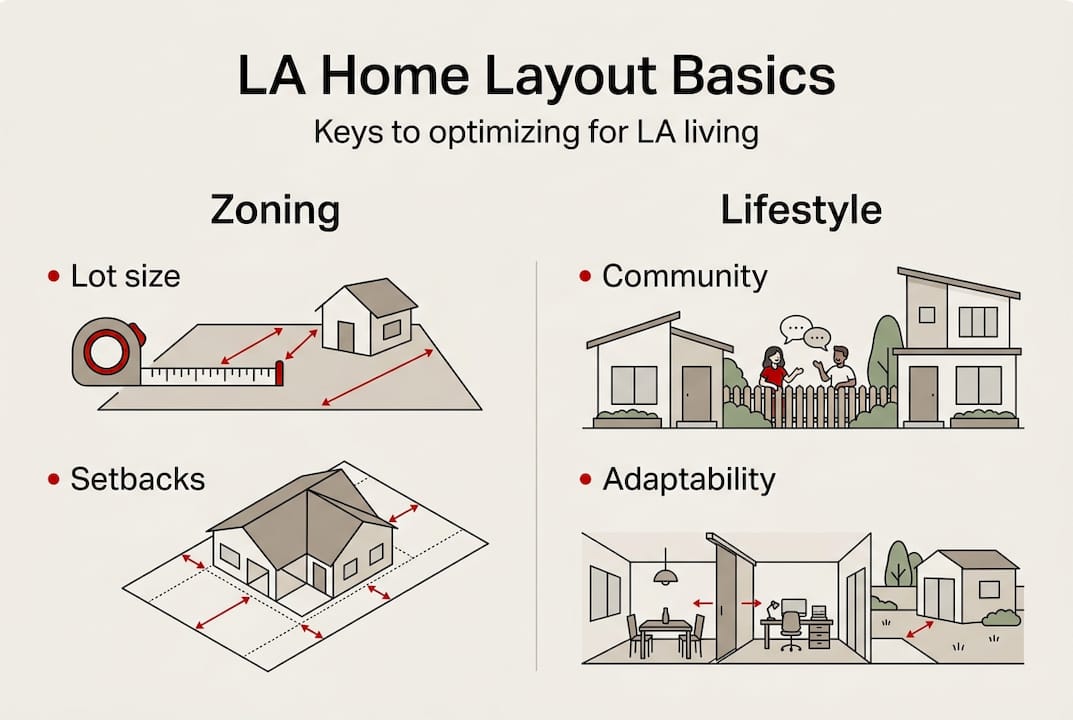
Next, measure your actual usable space against empirical benchmarks. Research on minimum space for human flourishing shows that a one-person household needs at least 30 square meters, a two-person household needs 45 square meters, and a three-person household needs 60 square meters to support daily functions without stress. If your current layout falls below these thresholds, optimization is not optional. It is essential.
Here is a preparation checklist to work through before you begin:
- Confirm zoning classification and allowable uses
- Measure all rooms and calculate total usable floor area
- Identify load-bearing walls and structural constraints
- Review HOA rules if applicable
- Gather utility maps (gas, electrical, plumbing)
- Document natural light patterns throughout the day
- Note noise sources inside and outside the home
| Household size | Minimum floor area | Recommended floor area |
|---|---|---|
| 1 person | 30 sqm (323 sqft) | 45 sqm (484 sqft) |
| 2 people | 45 sqm (484 sqft) | 65 sqm (700 sqft) |
| 3 people | 60 sqm (646 sqft) | 85 sqm (915 sqft) |
Pro Tip: Before finalizing any layout plan, talk to two or three neighbors about what they value most about the block. Community workshops and informal consultations consistently show that layouts reflecting resident input gain faster approval and create stronger neighborhood bonds. A five-minute conversation now can save months of friction later.
Step-by-step: Optimizing your residential layout
Now the real work begins. Follow these steps in order and you will avoid the most common mistakes LA homeowners make when redesigning their spaces.
- Audit your current layout. Walk every room and ask: does this space serve how I actually live? Note underused areas, bottlenecks, and rooms that feel disconnected from the rest of the home.
- Define your lifestyle priorities. Do you need more communal space or more private space? Do you entertain often? Do you need a dedicated workspace? Write these down before touching a floor plan.
- Apply front orientation principles. Per LA design standards, your home's primary entrance should face the street with a clear, welcoming path. This is not just code. It signals belonging and openness to the neighborhood.
- Vary your facades and rooflines. Flat, monotonous exteriors read as institutional. Small variations in material, depth, or roofline angle make a home feel intentional and human-scaled.
- Plan for pedestrian connectivity. Landscaped paths from the sidewalk to your entry, and from your entry to any rear unit or ADU, improve both usability and curb appeal.
- Explore ADU integration. If your lot allows it, adding an ADU plan can dramatically increase your home's functionality and value without altering the primary structure.
- Engage your neighbors and local planners early. Community engagement through workshops and consultations ensures your layout reflects real needs and builds local acceptance before permits are filed.
Here is a quick comparison of common layout approaches:
| Layout approach | Best for | Key trade-off |
|---|---|---|
| Open plan | Entertaining, families | Less acoustic privacy |
| Zoned layout | Work-from-home, multigenerational | Requires more square footage |
| Courtyard-centered | Community connection, natural light | Reduces interior square footage |
| ADU addition | Rental income, extended family | Requires permit and zoning review |
"The best residential layouts do not just organize space. They organize life. Every door, window, and threshold is a decision about how people will move, gather, and feel at home."
Once you have a draft layout, run it against the LA Small Lot Design Standards checklist. Front orientation, articulated entryways, varied facades, pedestrian paths, and landscaped open spaces are all required for neighborhood compatibility. If your plan checks all five boxes, you are in strong shape for permit approval.
Advanced strategies: Sustainability and resilient design
A layout that works today but cannot withstand tomorrow's challenges is only half-optimized. Los Angeles faces real threats from wildfires, earthquakes, and extreme heat. Your layout should address all three.

The AIA/LA award trends for 2025 and 2026 consistently highlight solar integration, efficient materials, and resilient structural design as the defining features of award-winning LA homes. These are not luxury add-ons. They are becoming baseline expectations for thoughtful residential design.
Key sustainability features worth prioritizing:
- Solar panel placement oriented to maximize southern exposure without compromising roof form
- Cool roof materials that reflect heat and reduce cooling loads during LA summers
- Cross-ventilation corridors designed into the floor plan to reduce reliance on air conditioning
- Fire-resistant cladding on exterior walls, especially for homes near hillside or brush zones
- Seismic retrofitting integrated into any structural changes, not added as an afterthought
- Drought-tolerant landscaping in all open spaces, which also satisfies LA's water-use ordinances
For homeowners exploring ADU additions, sustainable ADU designs that incorporate these features from the start are significantly cheaper to build and operate than retrofitting them later.
Pro Tip: Browse the AIA Los Angeles Residential Architecture Awards gallery before finalizing your design direction. The winning projects are publicly available and offer a real-world catalog of what works aesthetically, structurally, and environmentally in this specific climate and culture.
Common mistakes and how to verify your layout success
Even well-intentioned layout projects go sideways. Here are the mistakes we see most often, and how to catch them before they cost you.
Ignoring minimum space thresholds. Cramming three bedrooms into a space that cannot support them creates stress, not comfort. Minimum requirements are clear: 30 sqm for one person, 45 sqm for two, 60 sqm for three. If your redesign pushes below these numbers, reconsider the room count before the room sizes.
Designing for resale instead of life. Open plans photograph well but do not always live well. Design for how your household actually functions, not for a hypothetical future buyer.
Skipping the permit process. Unpermitted work in LA is a serious liability. It affects your ability to sell, refinance, or insure the property. Always verify layout plans against current code before breaking ground.
Neglecting outdoor-indoor flow. In Los Angeles, the boundary between inside and outside is one of your greatest design assets. Layouts that ignore this connection waste the city's best feature: its climate.
Use this checklist to verify your layout is truly optimized:
- Every room meets or exceeds minimum area benchmarks
- Primary entrance faces the street with a clear pedestrian path
- Natural light reaches all primary living spaces
- Structural changes are permitted and inspected
- Outdoor spaces are landscaped and connected to interior flow
- Neighbors and local planners have been consulted
- Sustainability features are integrated, not bolted on
If you can check every box, your layout is not just code-compliant. It is genuinely livable.
Get expert help with optimizing your LA home layout
Optimizing a residential layout in Los Angeles takes more than good taste. It takes knowledge of local codes, community dynamics, and design principles that hold up over time. That is exactly what we do at FO+H Architects.
Our ADU ideas and design resources are built specifically for LA homeowners who want spaces that reflect their lives and strengthen their neighborhoods. Whether you are exploring a Spanish ADU that fits seamlessly into a traditional streetscape or looking for gold ADU plans that maximize value on a compact lot, our team brings award-winning expertise to every project. We handle the complexity so you can focus on what matters: creating a home that truly works for you.
Frequently asked questions
What are the minimum space requirements for a Los Angeles home?
Research on minimum floor areas shows a one-person household needs at least 30 sqm, a two-person household needs 45 sqm, and a three-person household needs 60 sqm to support daily functions comfortably and without stress.
How does community engagement improve residential layouts?
Workshops and consultations help ensure your layout reflects what residents actually need and builds local support, which speeds up permit approvals and reduces neighborhood friction.
What sustainable features are trending for LA residential layouts?
Solar panels, cool roof materials, fire-resistant cladding, and cross-ventilation design are all highlighted in AIA/LA award trends as the most impactful upgrades for Los Angeles homes right now.
What are common mistakes when optimizing a home layout?
The biggest pitfalls are ignoring minimum area benchmarks, skipping the permit process, and designing for resale value instead of how your household actually lives day to day.