

TL;DR:
- Innovative LA ADUs solve local constraints like power lines, seismic activity, and fire zones effectively.
- Structural techniques like offsets and cantilevers maximize space while addressing site-specific challenges.
- Sustainable, rapid-assembly materials such as CLT panels enhance safety, reduce build time, and lower carbon footprint.
Many homeowners picture an ADU (Accessory Dwelling Unit) as a simple backyard shed with a bed and a kitchenette. That picture is outdated. In Los Angeles, the most successful ADU projects are solving real urban problems: overhead power lines, steep slopes, fire-prone hillsides, and zoning restrictions that make every square foot count. Innovative design is not about aesthetics alone. It is about making your property work harder, safer, and smarter. This guide walks you through the architectural concepts, materials, and structural strategies that are redefining what an ADU can be in 2026.
Table of Contents
- Rethinking ADU design: Beyond the basics
- Innovative structures: Offsets, cantilevers, and facade breakthroughs
- Sustainable materials and rapid assembly: The rise of CLT and modular ADUs
- Structural engineering essentials: Foundations, resilience, and code compliance
- What actually sets successful LA ADUs apart
- Ready to unlock your next innovative ADU?
- Frequently asked questions
Key Takeaways
| Point | Details |
|---|---|
| Design adapts to LA challenges | Innovative ADUs overcome LA’s power lines, fire zones, and tight regulations by using creative layouts and technologies. |
| Materials boost safety and speed | CLT panels and prefab construction provide rapid assembly, fire resistance, and sustainability for modern ADUs. |
| Engineering ensures longevity | Proper foundations, seismic upgrades, and engineering assessments are crucial for safe, lasting ADUs. |
| Blended approaches win | Combining modular and custom solutions delivers the best fit for unique properties and neighborhood integration. |
Rethinking ADU design: Beyond the basics
Standard ADU designs often treat every lot the same. In Los Angeles, that approach fails quickly. The city's neighborhoods vary dramatically, from flat urban parcels in Culver City to narrow hillside lots in Silver Lake, and the constraints change with every address.
Here is what makes LA-based ADU design uniquely demanding:
- Power line conflicts: Overhead electrical lines dictate where you can build vertically and how rooflines must be positioned.
- Fire risk zones: Large portions of LA fall under Wildland Urban Interface (WUI) regulations, requiring fire-resistant materials and specific setbacks.
- Seismic activity: Every structure must account for earthquake loads, which affects foundation choices and wall systems.
- Community and privacy concerns: Neighbors, sight lines, and shared yard spaces all influence how a design gets shaped.
- Zoning and setback rules: LA's ADU ordinances set minimum distances from property lines, which limits footprints on smaller lots.
The good news is that thoughtful design turns these constraints into opportunities. As ADU transformation in LA has shown, architects who understand the city's specific rules can create spaces that feel generous even on tight parcels.
One standout example: the Offset ADU offsets its second level to clear overhead power lines, which also creates a usable deck and divides the yard into distinct outdoor zones. The structure uses stick frame with a steel cantilever for seismic resilience. That is not a workaround. That is design solving a problem with precision.
Statistic callout: Los Angeles has approved over 20,000 ADU permits annually in recent years, yet most units still follow conventional layouts that leave site-specific challenges unaddressed.
The shift toward multi-functional, sustainable ADU spaces is gaining momentum. Homeowners and developers who invest in innovative design from the start avoid costly redesigns later and build units that hold long-term value.
Innovative structures: Offsets, cantilevers, and facade breakthroughs
Once you move past the basics, the architectural possibilities expand significantly. Offset levels, cantilevered floors, and expressive facades are not just visual choices. They solve real problems while creating spaces that feel intentional and livable.
Offset and cantilever structures allow a second story to extend beyond the footprint of the ground floor. This technique is useful when ground-level setbacks would otherwise limit the usable area. The Offset ADU demonstrates this well: by offsetting the upper level, the design clears power line clearance requirements while gaining outdoor deck space below. The steel cantilever used in that project also adds seismic resilience, which matters enormously in LA.
Here is a quick comparison of structural approaches:
| Structural method | Best use case | Key benefit | Consideration |
|---|---|---|---|
| Stick frame only | Flat lots, simple layouts | Cost-effective | Limited flexibility |
| Stick frame + steel cantilever | Power lines, tight setbacks | Seismic resilience, spatial gain | Higher engineering cost |
| Concrete moment frame | Steep slopes, heavy loads | Maximum strength | Longest lead time |
| Prefab panel system | Speed-focused projects | Fast assembly | Less site customization |
Facade design is another area where innovation is accelerating. A garage conversion ADU in California used vertical timber slats inspired by West African Kente cloth to create a modernist craft aesthetic. At 1,182 sq ft with a roof deck, it cost $400k and achieved privacy screening without sacrificing natural light. The facade became both a cultural statement and a functional screen.
Understanding the ADU plan check process is essential before committing to any of these structural approaches, since LA's Department of Building and Safety reviews every detail.
Pro Tip: If your design includes a cantilever, offset level, or non-standard roofline, bring a licensed structural engineer into the conversation before schematic design is finalized. Changes at that stage cost far less than revisions after permit submission.
Cost and engineering considerations matter too. Offset and cantilever systems add engineering fees and specialized labor, but they often unlock square footage that a conventional layout cannot access. The functional and financial return is usually worth it.
Sustainable materials and rapid assembly: The rise of CLT and modular ADUs
Material selection is one of the most consequential decisions in any ADU project. In Los Angeles, where fire risk and sustainability goals both demand attention, the choice of building material directly affects safety, speed, and long-term cost.
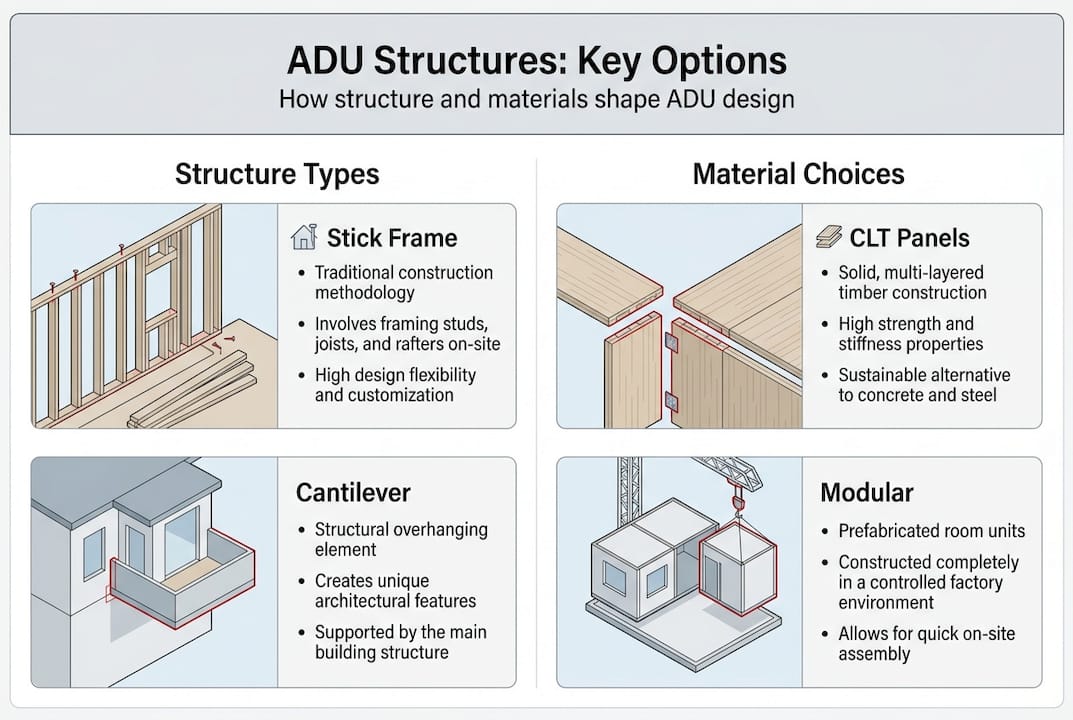
Cross-Laminated Timber (CLT) is one of the most promising materials in residential construction right now. CLT panels are made by layering lumber in alternating directions and bonding them under pressure, which creates a panel that is strong, dimensionally stable, and surprisingly fire-resistant. The Polyhaus Tetra-One uses CLT panels that offer 3 to 5 times the fire resistance of standard framing, assembles in just 3 days, covers 540 sq ft with a mezzanine, and costs $300k. The timber is sourced from forest restoration programs, which supports a lower carbon footprint.
Key advantages of CLT and fire-resistant panel systems:
- Fire resistance: 3 to 5 times greater than conventional wood framing
- Assembly speed: Structural panels arrive pre-cut and ready to install
- Carbon impact: Sustainably sourced CLT stores carbon rather than releasing it
- Dimensional accuracy: Factory precision reduces on-site waste and rework
Modular and prefabricated ADUs take the efficiency argument further. These units are built in a controlled factory environment, then transported and set on a prepared foundation. Learning more about modern architecture materials can help you evaluate which system fits your project goals.
| Build method | Assembly time | Customization level | Avg. cost range |
|---|---|---|---|
| Traditional stick frame | 6 to 12 months | High | $250k to $500k+ |
| Modular prefab | 1 to 3 months | Moderate | $150k to $350k |
| CLT panel system | 3 to 14 days (structure) | Moderate to high | $250k to $400k |
The trade-off with modular systems is customization. If your lot has an unusual shape, a steep grade, or specific zoning offsets, a fully prefabricated unit may not fit without modifications. Exploring prefabricated ADU builds alongside custom options helps you find the right balance for your specific parcel.
Statistic callout: CLT panels can reduce construction time by up to 25% compared to traditional framing, according to industry data on mass timber projects.
Structural engineering essentials: Foundations, resilience, and code compliance
No innovative design survives contact with a weak foundation or a failed permit review. Structural engineering is the backbone of every successful ADU project, and in Los Angeles, the requirements are more specific than in most cities.
Here is a step-by-step look at what structural engineering covers in a typical LA ADU:
- Geotechnical assessment: Evaluate soil conditions, especially on hillside lots or near fault zones. This report informs foundation type and depth.
- Foundation design: Slab-on-grade foundations require a minimum 3.5-inch reinforced concrete slab. Raised foundations need anchor bolts and hold-downs.
- Seismic shear walls: Engineers design shear walls to resist lateral forces during earthquakes. Placement affects window and door locations.
- Garage conversion upgrades: Existing garage slabs often need thickening or full replacement. Fire separation between the garage and living space is required by code.
- Permit documentation: Structural calculations, connection details, and foundation plans must be submitted with your ADU permit application.
Engineering costs for these elements range from $2,000 to $8,000 depending on complexity, lot conditions, and the scope of structural work required. Garage conversions and hillside projects tend to fall at the higher end.
For a deeper look at how prefab and custom approaches handle these engineering requirements differently, the comparison of prefab vs custom ADUs is a useful reference.
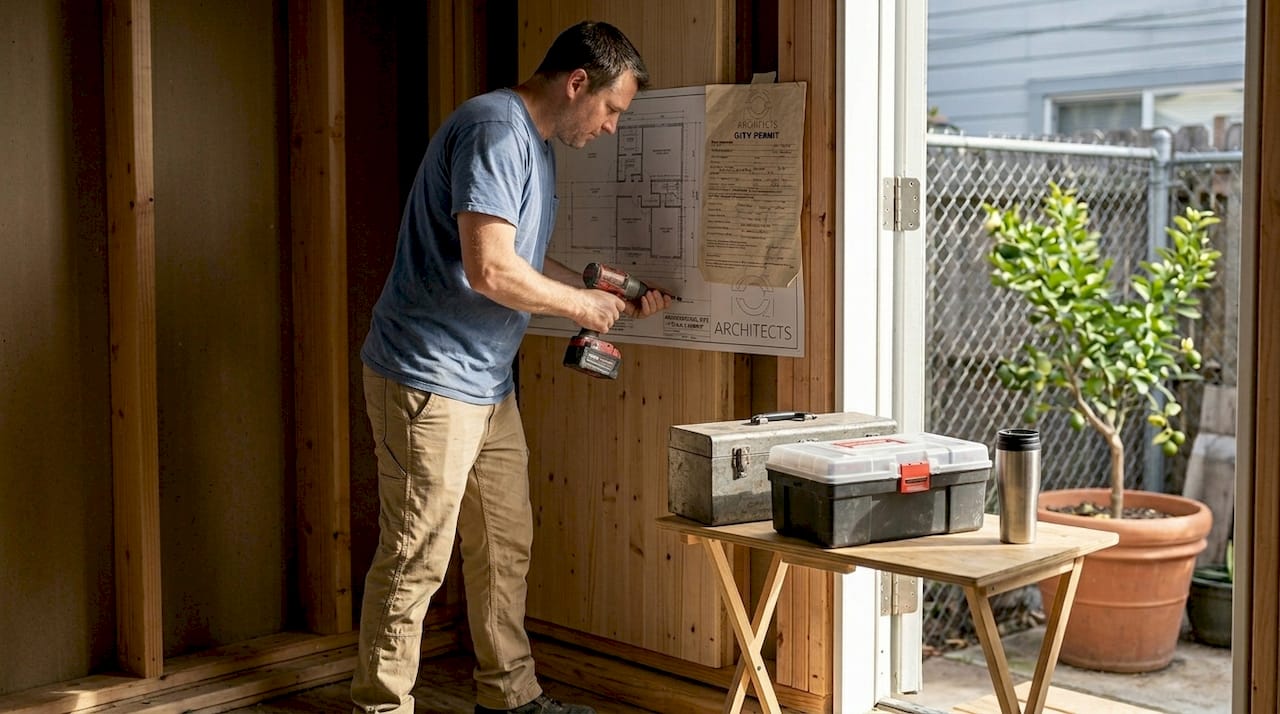
Pro Tip: Always commission a geotechnical and structural assessment before finalizing your ADU design. Discovering a problem after permit submission adds weeks to your timeline and significant cost to your budget.
Special engineering challenges in LA include older garage structures with inadequate footings, lots with expansive soils that shift seasonally, and properties in liquefaction zones near the coast. Each of these requires a tailored engineering response, not a template solution.
What actually sets successful LA ADUs apart
Based on our experience working across Los Angeles, the projects that deliver the most value are not the ones that went fully modular or fully custom. They are the ones that combined both approaches with clear intention.
Many clients come to us convinced that prefab is the answer because it is fast and cost-predictable. Others insist on fully custom design because their lot is unusual. In reality, the most successful ADUs we have seen blend a prefabricated structural system with site-specific architectural decisions: a custom facade, a repositioned entry, a deck orientation that captures the right view.
The edge-case projects teach you the most. A narrow lot with overhead power lines forces you to think vertically and laterally at the same time. A hillside parcel in a fire zone demands that you treat material selection as a life-safety decision, not just an aesthetic one. These constraints push design toward genuine innovation.
What most people miss is that design agility, the ability to adapt a system to a specific site, is the real competitive advantage. Clients who engage early, share their priorities clearly, and stay open to hybrid solutions consistently end up with better outcomes. Explore the latest thinking on these approaches through FO Studio insights to see how this plays out across real projects.
The lesson is straightforward: do not pick a camp. Pick the right tool for each decision.
Ready to unlock your next innovative ADU?
If this guide has shown you anything, it is that innovative ADU design in Los Angeles is not a luxury. It is a practical response to real constraints, and the right design team makes all the difference.
At FO+H Architects, we have developed ready-to-use and fully customizable plans that address LA's specific challenges, from fire-resistant structures to seismic-compliant foundations. Whether you are starting from scratch or refining an existing concept, you can explore ADU plans in our plan library to find a starting point that fits your lot and goals. For properties in high-fire-risk zones, our anti-fire duplex designs offer a proven, code-compliant foundation. Reach out to our team to schedule a feasibility consultation and take the next step with confidence.
Frequently asked questions
What makes an ADU design truly innovative in Los Angeles?
Innovation in LA means solving site-specific constraints like power line clearances, seismic loads, and fire risk, while maximizing multi-use space. The Offset ADU is a clear example, using a steel cantilever offset to clear power lines and gain usable deck space.
Are modular and prefab ADUs more cost-effective than custom designs?
Prefab ADUs are faster to build and easier to budget, but custom designs better address unusual lots and local zoning rules. The Polyhaus Tetra-One shows that prefab can deliver high performance at $300k, though blending both methods often yields the strongest results.
How does material choice impact ADU fire safety and sustainability?
Material selection directly affects how a structure performs in a fire and how much carbon it generates during construction. CLT panels offer 3 to 5 times the fire resistance of standard framing and support sustainable sourcing goals.
What is the typical cost of innovative ADU projects in Los Angeles?
Costs vary based on complexity, but advanced facade or structural solutions typically range from $300k to $400k for construction, with structural engineering fees adding $2,000 to $8,000 depending on site conditions. A garage conversion ADU with a custom facade and roof deck came in at $400k for 1,182 sq ft.
Recommended
- 🏘️ The ADU Revolution: How Accessory Dwelling Units are Transforming Los Angeles Neighborhoods — Fo+H Architects
- /adu-plan-check-los-angeles — Fo+H Architects
- Los Angeles: A Vertical Oasis – Reimagining the Urban Landscape — Fo+H Architects
- ADU Store | ADU Garage & Duplex Plans by FO Studio — Fo Studio