

TL;DR:
- Los Angeles now offers a streamlined 60-day permit process for standard ADUs, reducing delays.
- Building a permitted ADU can increase property value by up to 30% and provide rental income.
- Proper planning, qualified professionals, and understanding zoning are essential for successful ADU development.
Many Los Angeles homeowners assume that building an Accessory Dwelling Unit (ADU) means months of red tape, costly delays, and complex zoning battles. That assumption is now outdated. LA regulations now allow a streamlined 60-day permit process, remove many owner-occupancy requirements, and have eliminated parking mandates for most standard ADUs. The result is that regular homeowners, not just developers, are now in a strong position to add real value to their properties. This guide walks you through what changed, the top reasons to build, and the practical steps to get it right.
Table of Contents
- What is an ADU and why do LA regulations matter?
- The top benefits of building an ADU in Los Angeles
- Navigating the permitting process: What homeowners need to know
- Common challenges and expert solutions for LA homeowners
- The real secret to a successful ADU project in Los Angeles
- Explore inspired ADU designs and get started today
- Frequently asked questions
Key Takeaways
| Point | Details |
|---|---|
| LA simplifies ADUs | New LA policies offer streamlined permitting, clear rules, and increased homeowner flexibility. |
| Boost property value | A permitted ADU can significantly raise both property value and market appeal. |
| Multiple living options | ADUs offer space for family, rental income, work, or aging in place. |
| Watch out for edge cases | Historic, high fire zones and unpermitted builds require extra care and planning. |
What is an ADU and why do LA regulations matter?
An ADU, or Accessory Dwelling Unit, is a self-contained residential unit built on the same lot as a single-family home. It has its own kitchen, bathroom, and living space, functioning as a fully independent unit. Understanding the different types helps you figure out which option fits your property best.
Common ADU types include:
- Detached backyard cottage: A standalone structure built in the rear yard, completely separate from the main home.
- Garage conversion: An existing attached or detached garage transformed into a livable unit.
- Attached addition: A new unit added directly to the side or rear of the main house, sharing at least one wall.
- Interior conversion: Converting existing interior space, such as a basement or large room, into a separate unit.
Each type has different cost profiles and design considerations, but all four are now well-supported under current LA rules.
The regulatory shift is significant. Thanks to state laws including AB 976 and AB 1332, LA now guarantees 60-day permit approval for standard ADUs, no longer requires owner-occupancy on the primary lot, and has removed parking requirements for most projects. You can stay current with the latest LA ADU policy changes as rules continue to evolve.
Stat to know: Los Angeles has issued over 20,000 ADU permits since 2017, making it one of the most ADU-friendly cities in the United States.
This volume reflects genuine momentum. Homeowners across the city are responding to a policy environment that actively encourages adding housing. If you want to understand exactly what happens after you submit your plans, the ADU plan review process is a useful next read.
The top benefits of building an ADU in Los Angeles
Now that you know what an ADU is and why LA's rules matter, let's examine the real case for building one. The benefits go well beyond a simple rental income calculation.
Financial and property value gains:
- A properly permitted ADU can add up to 30% to your property's appraised value in many cases.
- Rental income from an ADU can offset your mortgage payment or generate consistent monthly cash flow.
- Unpermitted ADUs add no value and risk fines, while properly permitted units increase both marketability and appraised worth.
Lifestyle and family flexibility:
- An ADU can house aging parents or adult children, keeping family close while maintaining privacy for everyone.
- It can serve as a dedicated home office, a creative studio, or a guest suite depending on your needs.
- If your household situation changes, the unit can shift from personal use to rental use without major renovation.
Community and neighborhood impact:
- ADUs contribute to the city's affordable housing supply without large-scale development.
- Denser, well-designed neighborhoods tend to support better walkability and local services.
- Explore creative ADU design ideas to see how thoughtful architecture supports both individual homeowners and broader community goals.
Pro Tip: Before committing to a design, calculate your break-even point. Divide your total construction cost by the expected monthly rental income to estimate how many months it takes to recover your investment. Most well-designed LA ADUs reach break-even within five to eight years.
"The financial case for a permitted ADU is clear, but the lifestyle flexibility it creates is often what homeowners value most once the unit is built."
See how ADUs are transforming neighborhoods across Los Angeles for real examples of what this looks like in practice.

Navigating the permitting process: What homeowners need to know
Understanding the benefits, the next step is figuring out how to actually bring an ADU to life on your property. The good news is that the permitting process is now more predictable than it has ever been for standard projects.
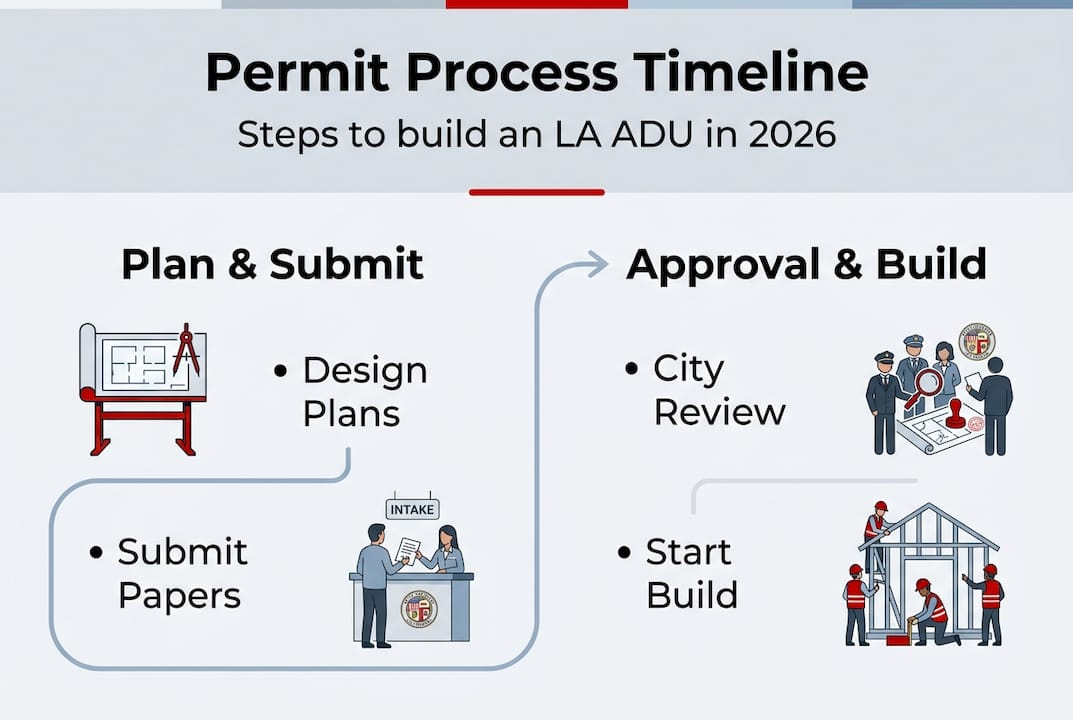
Step 1: Work with a licensed architect or designer to develop your plans, including floor plans, elevations, and Title 24 energy documentation.
Step 2: Submit your plans to the LA Department of Building and Safety (LADBS) for plan check review.
Step 3: The city conducts its ministerial review. For standard ADUs, this must be completed within 60 days under current state law.
Step 4: Once approved, pull your building permit and begin construction with a licensed contractor.
Step 5: Schedule inspections at key construction milestones, including framing, rough plumbing, electrical, and final inspection.
For most homeowners, this process is straightforward. However, edge cases do exist. Ministerial 60-day review applies to standard ADUs, but high fire hazard zones require special on-site parking, and historic properties must meet objective design standards that add review steps.
| Feature | Standard ADU | ADU in high fire or historic zone |
|---|---|---|
| Permit timeline | 60 days | Potentially longer |
| Parking required | Generally exempt | On-site parking may be required |
| Design standards | Standard zoning | Objective historic standards apply |
| Extra documentation | Minimal | Fire-resistant materials, historic review |
Understanding how ADU plan check works in detail can help you prepare the right documents upfront and avoid costly resubmittals.
Pro Tip: Keep a dedicated project folder, physical or digital, with every permit application, approval letter, inspection report, and contractor invoice. This documentation protects you during resale and makes future renovations far easier to manage.
Common challenges and expert solutions for LA homeowners
Even with smoother processes, some challenges do remain. Here's what to watch for and how experienced professionals handle them.
Pitfall 1: Unpermitted work. Some homeowners inherit unpermitted structures or attempt to build without permits to save money. This is a serious risk. Unpermitted construction carries specific requirements and penalties, and those units cannot be legally rented or counted toward property value.
Pitfall 2: Zoning mismatches. Not every lot configuration supports every ADU type. Setbacks, lot coverage limits, and height restrictions vary by zone. A feasibility review before design begins saves time and money.
Pitfall 3: Low-quality finishes. ADUs built with budget materials tend to underperform in the rental market and require more maintenance. Investing in durable, mid-range finishes pays off over time.
| Challenge | Risk | Expert solution |
|---|---|---|
| Unpermitted work | Fines, no added value | Retroactive permitting or demolition |
| Zoning mismatch | Rejected plans | Pre-design feasibility review |
| Low-quality finishes | Poor rental returns | Specify durable, cost-effective materials |
| Wrong contractor | Delays, cost overruns | Hire ADU-specialized firms |
Contractor selection matters more than most homeowners realize. General contractors without ADU experience often underestimate the complexity of utility connections, structural anchorage, and fire separation requirements. Consider ADU design for historic properties or engineering for multi-story ADUs if your project involves those conditions. When in doubt, choose specialized ADU professionals who understand LA-specific requirements.
Pro Tip: Schedule a pre-construction walkthrough with your architect and contractor together. Catching design-to-construction conflicts before breaking ground is far less expensive than discovering them mid-build.
The real secret to a successful ADU project in Los Angeles
With these realities in mind, here's the deeper takeaway most LA homeowners miss when considering an ADU.
Conventional wisdom focuses almost entirely on rental revenue or resale value. Those are real benefits, but they are not the full picture. In our experience working with homeowners across Los Angeles, the most satisfied clients are the ones who treated their ADU as a long-term planning tool, not just a short-term income source.
An ADU gives you options. It lets you house a parent today, rent it tomorrow, and convert it to a home office the year after. No other improvement to your property offers that kind of adaptability. As LA continues to evolve its zoning laws and housing policy, owning a permitted ADU positions you ahead of those changes rather than scrambling to respond to them.
Explore innovative ADU strategies that go beyond the basics to see how forward-thinking homeowners are using ADUs to future-proof their properties. The smartest investment is one that adapts to your life, not just your current financial goals.
Explore inspired ADU designs and get started today
Ready to move from ideas to reality? Whether you are just beginning to explore your options or you already have a site in mind, the right design makes all the difference.
Browse our curated ADU garage and duplex plans to find pre-designed options that are ready to permit and build in Los Angeles. If you want something tailored to your specific lot, our team at FO+H Architects offers personalized consultation and feasibility reviews. Check out Blue ADU ideas for design inspiration, or visit our main site to learn about our full range of residential and ADU services. We are here to help you build something that works for your home, your family, and your future.
Frequently asked questions
Does building an ADU really increase my property value in Los Angeles?
A properly permitted ADU can raise your property's appraised value by 20 to 30%, but unpermitted units add no value and may result in fines or legal complications.
How long does it take to get an ADU permit in LA?
Los Angeles typically approves standard ADU permits within 60 days under current rules, though projects in high fire or historic zones may take longer due to additional review requirements.
Are there special requirements for building an ADU in high fire hazard or historic zones?
Yes. High fire zones require on-site parking and fire-resistant materials, while historic properties must meet objective design standards that go beyond standard ADU rules.
What's the difference between a permitted and unpermitted ADU?
A permitted ADU meets all city codes, adds measurable property value, and can be legally rented, while an unpermitted unit risks fines, insurance complications, and contributes zero to your appraised value.