

TL;DR:
- California law streamlines ADU approvals, but Los Angeles adds specific local review requirements.
- Proper preparation involves feasibility checks, accurate documentation, and understanding local overlays.
- Special zones like hillsides or coastal areas require additional permits, studies, and costs.
Navigating the ADU permitting process in Los Angeles feels overwhelming for most homeowners and investors. Between zoning overlays, plan checks, agency clearances, and site-specific reviews, it's easy to lose track of where to start or what comes next. The good news: California's streamlined state laws have made ADU approvals more accessible than ever, and LA has followed suit with faster ministerial approvals. This guide walks you through every stage, from initial feasibility checks to permit issuance, so you know exactly what to prepare, what to expect, and how to avoid the most common delays that cost time and money.
Table of Contents
- Understanding ADU permitting in Los Angeles
- What you need before starting your ADU permit
- Step-by-step: The Los Angeles ADU permitting process
- Edge cases: Special reviews, fees, and LA-specific hurdles
- Our take: Why the LA ADU permit process is simpler—and trickier—than you think
- Ready to start your ADU project?
- Frequently asked questions
Key Takeaways
| Point | Details |
|---|---|
| Start with site readiness | Assess zoning, overlays, and utilities before drafting plans to avoid major delays later. |
| Follow each permitting step | Submitting a complete, accurate package reduces corrections and saves months. |
| Watch for local hurdles | Special site conditions like hillsides or historic zones can add costly reports and permits. |
| Know local vs. state law | State law streamlines approvals but LA-specific nuances require careful attention. |
| Consider expert support | Local ADU specialists can help navigate complex approvals, especially for unique properties. |
Understanding ADU permitting in Los Angeles
An ADU, or Accessory Dwelling Unit, is a secondary residential unit built on the same lot as a primary home. It can be detached, attached, or a garage conversion. In Los Angeles, ADUs have become one of the most practical tools for homeowners to generate rental income, house family members, or increase resale value. Many homeowners are surprised to learn that state law preempts local restrictions, meaning LA cannot require owner occupancy or impose discretionary review on most ADU applications. Approvals must be ministerial, which means the city reviews your plans against objective standards only.
That said, LA's local rules add a layer of detail that state law doesn't fully cover. The city's ZA Memo 143 standards provide specific guidance on setbacks, height limits, design requirements, and more. These local standards operate within state boundaries but carry real weight during plan check.
Why does permitting matter? Simply put, an unpermitted ADU creates serious liability. It can block refinancing, complicate a sale, and expose you to code enforcement penalties. A properly permitted ADU, on the other hand, can unlock property value and open financing options that an unpermitted unit never could.
Here are some LA-specific nuances you should know before starting:
- Zoning overlays: Some parcels fall under Specific Plans, Historic Preservation Overlay Zones (HPOZs), or Hillside Area designations that add review requirements.
- Coastal zone properties: These require a Coastal Development Permit in addition to the standard building permit.
- Hillside areas: Steeper slopes trigger grading reviews and sometimes geological reports.
- Multi-family lots: State law allows ADUs on multi-family properties, but the rules differ from single-family lots.
- Utility connections: LA requires separate utility connections for some ADU types, which affects cost and timeline.
LA issued thousands of ADU permits annually in recent years, reflecting a sharp increase in homeowner interest. Understanding the full regulatory picture is your first step toward a smooth project.
What you need before starting your ADU permit
With the basics clear, your next move is to get your ducks in a row before applying. Let's cover what you must have ready and what shortcuts can hurt you later.
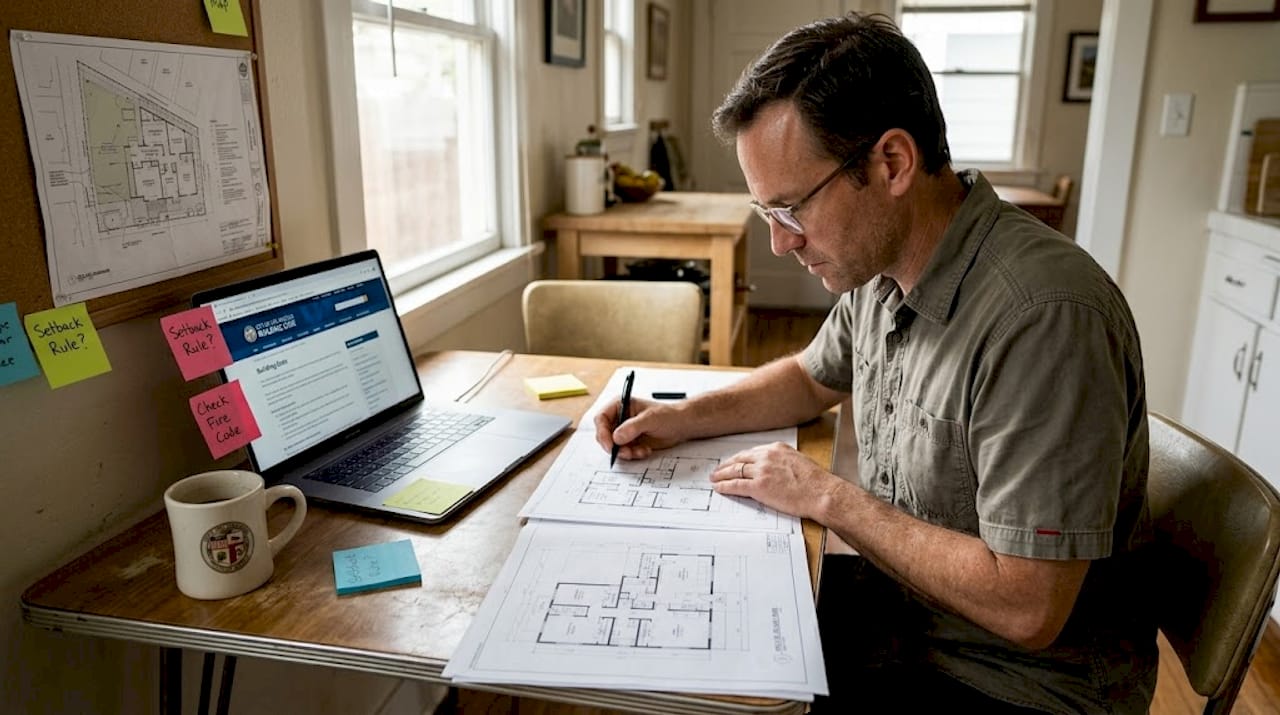
The first thing to do is run a feasibility check. Use the city's ZIMAS tool (Zoning Information and Map Access System) to look up your parcel's zoning, overlays, and any special designations. According to the ZA Memo 143, Step 1 in the process is a full feasibility and site check, including zoning verification, utility access, and setback confirmation. Skipping this step is the single most common reason projects stall after design work has already begun.
Pro Tip: Run ZIMAS on your parcel and call your utility providers before you hire a designer or draw a single line. Knowing your constraints upfront saves thousands in redesign costs.
Here's a summary of the key documents you'll need and why each one matters:
| Document | Purpose |
|---|---|
| Site plan | Shows property boundaries, existing structures, and ADU placement |
| Floor plans | Illustrates interior layout, room dimensions, and code compliance |
| Elevations | Depicts exterior heights, windows, and design features |
| Structural calculations | Confirms the structure meets safety and load requirements |
| Title 24 energy documentation | Demonstrates compliance with California's energy efficiency standards |
| Soils/geological report | Required for hillside or geo-hazard sites |
| Special studies | Needed for coastal, historic, or hazardous material zones |
Before you apply, review our ADU design checklist to make sure nothing slips through the cracks.
Top mistakes homeowners make before applying:
- Assuming their lot is ADU-eligible without checking overlays
- Starting design without confirming utility capacity
- Underestimating setback requirements, especially on corner lots
- Choosing a plan that doesn't match their specific zoning designation
- Ignoring fire access requirements for hillside or narrow-lot properties
Standard plans (pre-approved by the city) move faster and cost less upfront. Custom plans offer more flexibility but require a full plan check cycle. Knowing which route fits your property early saves significant time.
Step-by-step: The Los Angeles ADU permitting process
Once your documents are ready, you're set for the actual permit process. Let's walk through every stage so you avoid backtracking and delays.
The six-step process outlined by the city covers everything from initial feasibility to permit issuance:
- Feasibility and site check: Confirm zoning, setbacks, utility access, and any overlay requirements using ZIMAS and utility provider contacts.
- Design: Prepare all required drawings and documents. Decide between a standard pre-approved plan or a custom design based on your site and goals.
- Submit your application package: Upload or submit in person through the LA Department of Building and Safety (LADBS) portal. Ensure every required document is included.
- Plan check and corrections: A city plan checker reviews your submission. Expect one or more correction rounds. Respond promptly and accurately to each comment.
- Agency clearances: Depending on your site, you may need sign-off from Planning, Fire, Public Works, or other departments before the permit can issue.
- Pay fees and receive your permit: Once all clearances are obtained and fees are paid, the building permit is issued and construction can begin.
Pro Tip: Submit a complete, accurate package the first time. Every incomplete item triggers a correction cycle that adds weeks to your timeline. Have a licensed architect or experienced designer review the package before submission.
Here's how standard and custom plans compare:
| Factor | Standard plans | Custom plans |
|---|---|---|
| Cost | Lower upfront | Higher design cost |
| Speed | Faster approval | Full plan check required |
| Flexibility | Limited design options | Fully tailored to your site |
| Best for | Simple, flat lots | Complex sites or unique programs |
For a deeper look at what happens during review, read our guide on the ADU plan check process. If you're still exploring design directions, our post on innovative ADU design concepts covers practical ideas worth considering early.
Typical timelines range from 3 to 6 months for straightforward projects. Sites with corrections, special reviews, or incomplete submissions can stretch well beyond that.
Edge cases: Special reviews, fees, and LA-specific hurdles
Even when you follow all the standard steps, some properties face extra hurdles. Here's what to do if your ADU project triggers special reviews or requirements.
Certain site conditions automatically add complexity to your permit. The ZA Memo 143 identifies several edge cases that require additional permits, studies, or reviews beyond the standard process:
- Hillside areas: Soil reports are often required, with costs starting at $5,000 or more. Grading over 50 cubic yards triggers a separate grading permit.
- Coastal zones: A Coastal Development Permit (CDP) is required in addition to the building permit. CDP review adds time and may involve the California Coastal Commission.
- Historic districts (HPOZs): Design must meet preservation standards. Expect additional review by the Office of Historic Resources.
- Geo-hazard zones: Fault zones, liquefaction areas, and landslide zones each trigger specific studies and engineering requirements.
- Hazardous materials: Sites near oil wells or with prior industrial use may require environmental clearance.
Estimated added costs for common edge cases:
- Soil report: $5,000 to $10,000
- Coastal Development Permit: $2,000 to $8,000 in fees plus review time
- Historic review: $1,500 to $5,000 depending on scope
- Geotechnical engineering: $3,000 to $15,000 depending on site conditions
Important: Never begin grading, demolition, or construction before obtaining all required permits and clearances. Unpermitted work in special review zones can result in stop-work orders, fines, and mandatory removal of completed work. The cost of correcting unpermitted construction far exceeds the cost of doing it right the first time.
If you're unsure whether your property triggers any of these reviews, explore real project examples and discussions on our ADU project blog for practical context from LA homeowners who've navigated similar situations.
Our take: Why the LA ADU permit process is simpler—and trickier—than you think
After everything we've covered, here's what most guides don't tell you: the LA ADU process is genuinely more accessible than it was five years ago, but the local complexity means that even experienced property owners get tripped up.
Ministerial approval and the removal of owner-occupancy requirements are real advantages. We've seen clients move from concept to permit in under four months on clean, flat lots with complete submissions. That kind of speed is rare in most major cities.
But here's the honest truth: LA's web of overlays, HPOZs, hillside designations, and utility constraints catches people who assume their lot is straightforward. In our experience, roughly one in three projects we review has at least one site condition the homeowner didn't know about. That's not a small number.
The biggest time-saver we can recommend is working with a local ADU specialist who knows LA's specific requirements, not just state law. Generic knowledge doesn't help when your parcel sits in a Specific Plan area or near a fault zone.
We've watched projects sail through in 90 days and others drag past 18 months. The difference almost always comes down to preparation and knowing the local rules before design begins. Start with our ADU design checklist to build that foundation early.
Ready to start your ADU project?
If you've made it this far, you have a solid understanding of what the LA ADU permitting process involves. The next step is moving from knowledge to action.
At FO+H Architects, we've helped homeowners and investors across Los Angeles navigate every stage of the ADU process, from feasibility to final permit. You can browse ADU plans in our store, including ready-to-permit designs like our Spanish ADU example, which shows what a well-designed, permit-ready unit looks like in practice. If your site has special conditions or you want expert guidance tailored to your parcel, contact FO+H Studio directly. We're here to make the process clear and manageable.
Frequently asked questions
How long does it take to get an ADU permit in Los Angeles?
A straightforward ADU permit in LA typically takes 3 to 6 months; complex sites or incomplete paperwork can extend this timeline significantly based on process duration factors like correction rounds and agency clearances.
What documents do I need to submit with my ADU application?
You typically need a site plan, floor plans, elevations, structural calculations, and Title 24 energy documents, plus special studies if your site is in a hillside or coastal zone.
Are there extra fees for ADUs in hillside or historic zones?
Yes, hillside soil reports typically start at $5,000, and historic or coastal zones require additional permits and reviews that add both cost and time to your project.
Does state law override Los Angeles' ADU rules?
State law sets minimum ADU rights including streamlined ministerial approval, but Los Angeles applies its own local standards within those state boundaries, which is why site-specific knowledge matters.