

TL;DR:
- Successful LA ADUs treat site constraints as design features, not problems.
- Prefab and sustainable options offer faster, more predictable, and eco-friendly construction choices.
- Interior space-saving features like Murphy beds and lofts enhance functionality in small units.
Building a modern ADU in Los Angeles means navigating a layered set of decisions: city regulations, lot constraints, neighborhood character, and your own vision for how the space should function. Many homeowners assume that restrictions like small lots, power line easements, or tight setbacks will limit what they can build. In practice, the most inspiring ADU projects in Los Angeles treat those constraints as design opportunities. This article walks you through the key factors that drive great ADU design, four concrete inspirations drawn from real projects and industry leaders, and a practical framework for making decisions that serve your household and your community.
Table of Contents
- Key factors in inspiring modern ADU designs
- Inspiration 1: The Offset ADU – Site-driven creativity
- Inspiration 2: Prefab and sustainable innovations
- Inspiration 3: Multifunctional interiors and smart space use
- Inspiration 4: Designs that reflect and respect Los Angeles communities
- Our perspective: The constraint is the design
- Work with FO+H architects on your ADU project
- Frequently asked questions
Key Takeaways
| Point | Details |
|---|---|
| Leverage site constraints | Transform obstacles like power lines or small lots into unique features that add style and function. |
| Prioritize sustainability | Choose eco-friendly strategies such as reusing foundations, prefab construction, and solar energy for a greener ADU. |
| Maximize every inch | Flexible layouts and multifunctional furniture turn small footprints into spacious, livable homes. |
| Honor community context | Blend ADU design with the main house and neighborhood to respect privacy and street character. |
Key factors in inspiring modern ADU designs
Before you start sketching floor plans or browsing prefab catalogs, it helps to understand what separates a good ADU from a great one. In our experience working with LA homeowners, the projects that turn out best share a few consistent qualities.
The most important factors to evaluate early:
- Reuse of existing structures. Reusing a garage foundation or existing walls reduces construction costs significantly and lowers the environmental footprint of your project. As Byben's sculptural backyard ADU in Mar Vista demonstrates, prioritizing reuse of existing structures and turning constraints like power lines into assets like terraces is one of the smartest moves you can make from both a cost and sustainability standpoint.
- Site-specific thinking. Every lot in Los Angeles is different. Lot shape, sun orientation, neighboring structures, and utility easements all influence what you can build and where. The best designs respond directly to these conditions rather than ignoring them.
- Privacy and neighborhood fit. Your ADU will exist in a community. Window placement, roofline design, and material choices all affect how the unit relates to neighboring properties and the street.
- Sustainability from the start. Sustainable design is not just about adding solar panels at the end. It starts with orientation, insulation, material selection, and layout. Exploring prefab and sustainable options early in your process gives you more choices and often better outcomes.
- Regulatory awareness. Los Angeles has specific setback rules, height limits, and owner-occupancy requirements that vary by zone. Getting a feasibility review before you commit to a design saves time and money.
Pro Tip: Schedule a site consultation with your architect before finalizing any design direction. Bring your property survey, utility maps, and any HOA documents. The more information your architect has upfront, the more creative and code-compliant your design will be.
Thinking through these factors early also shapes which ADU design concepts make sense for your specific property. Not every inspiration will fit every lot, but understanding the criteria helps you evaluate options with clarity.
Inspiration 1: The Offset ADU – Site-driven creativity
One of the most talked-about ADU projects in Los Angeles right now is the Offset ADU by Byben, located in Mar Vista. It is a strong example of what happens when a design team treats site constraints not as problems to work around, but as features to build with.
What makes the Offset ADU stand out:
- Reused garage foundation. The 890 sq ft two-story unit was built on an existing garage foundation, which reduced excavation costs, minimized waste, and accelerated the permitting process.
- Ipe wood cladding. Ipe is a dense, durable hardwood commonly used in outdoor applications. On this ADU, it serves as a rainscreen cladding that reduces solar heat gain while giving the building a warm, natural aesthetic that softens the modern form.
- Curved edges. Rather than a boxy rectangular volume, the Offset ADU uses curved corners to reduce the visual mass of the structure. This is especially important in residential neighborhoods where a large new building can feel intrusive.
- Cantilevered upper level and terrace. Power lines running across the rear of the lot would have forced a setback that reduced usable square footage. Instead, the design cantilevered the upper level over the constraint zone and created a terrace directly beneath it, turning a limitation into an outdoor living feature.
- Indoor-outdoor connection. Large glazed openings on the ground floor blur the boundary between interior living space and the backyard, making the unit feel larger than its footprint suggests.
"Instead of fighting site constraints, this design turns them into defining features."
This approach is directly applicable to many LA properties. Power lines, mature trees, irregular lot shapes, and neighboring structures are common. The lesson from the Offset ADU is that your architect's job is not just to fit a unit onto your lot. It is to find the design logic that makes the site's unique conditions work in your favor.
Using an ADU design checklist before your first design meeting helps you document these site-specific conditions so your architect can begin thinking creatively from day one.
Inspiration 2: Prefab and sustainable innovations
Custom architecture like the Offset ADU delivers exceptional results, but it is not the only path. Prefabricated ADUs have matured significantly over the past several years, and the best prefab products now offer real design quality alongside meaningful sustainability advantages.
Key advantages of prefab and sustainable ADU construction:
- Reduced construction waste. Factory-built components are cut and assembled with precision, generating far less material waste than traditional site construction.
- Faster timelines. Prefab can cut typical site construction time by more than half, which means less disruption to your household and your neighbors.
- Integrated sustainability features. Many prefab ADU manufacturers now offer units with solar panels, passive solar orientation, green roofs, and materials like hempcrete built into their standard specifications.
- Cost predictability. Factory production reduces the variability of labor costs and material pricing that often drives budget overruns in custom builds.
- Design quality. Firms highlighted by AIA San Fernando Valley, including amorphous.Studio and Builtra, demonstrate that prefab does not mean generic. These firms offer sustainable contemporary and resilient design options that hold up architecturally alongside custom work.
Pro Tip: When evaluating prefab ADU companies, ask to see completed projects in your neighborhood or a similar context. Photos on a company website can look great in isolation, but seeing how a unit sits on a real LA lot tells you much more about how it will work for you.
Sustainability in prefab goes beyond the building itself. Faster installation means fewer truck trips, less concrete poured on-site, and a shorter period of noise and dust for your neighbors. For homeowners in denser parts of Los Angeles, that community consideration matters. Exploring energy-efficient designs alongside prefab options gives you a fuller picture of what modern sustainable ADU living can look like.
The way prefab is reshaping how we think about urban landscape reimagining in Los Angeles is genuinely exciting. More homeowners are realizing that adding a well-designed unit to their property is not just a financial decision. It is a contribution to the neighborhood's housing supply and long-term character.
Inspiration 3: Multifunctional interiors and smart space use
The exterior and structure of your ADU set the stage, but the interior is where daily life actually happens. In compact ADUs, interior design decisions have an outsized impact on how comfortable and functional the space feels.
Top multifunctional features for modern ADU interiors:
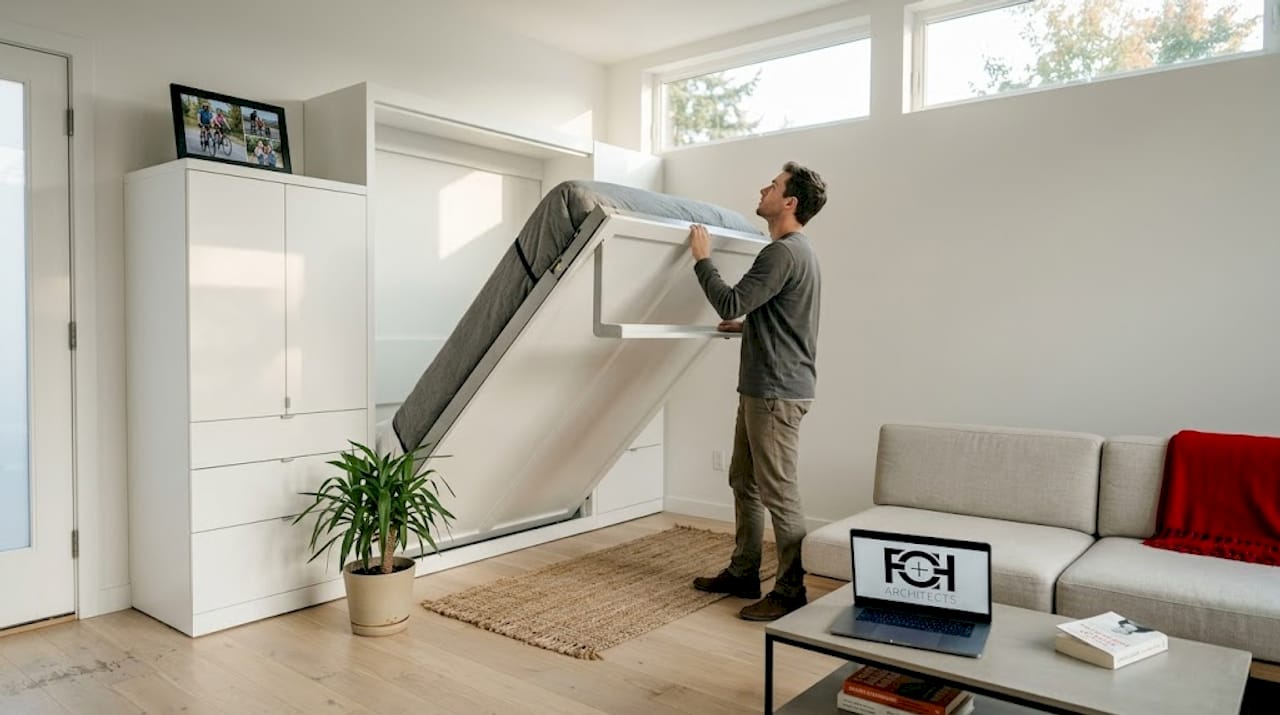
- Murphy beds. A wall-mounted Murphy bed folds away during the day, converting a bedroom into a home office, yoga space, or living area. This single feature can effectively give a studio ADU the flexibility of a one-bedroom unit.
- Fold-out desks. With remote work now a standard part of many households' routines, a dedicated workspace that folds away when not in use is a practical and space-efficient solution.
- Modular sofas. Sectional sofas with reconfigurable components adapt to different uses: seating for guests, a lounging surface, or an additional sleeping area.
- Vertical storage. Floor-to-ceiling shelving, built-in cabinetry above doorways, and loft storage areas make use of vertical space that would otherwise go unused.
- Loft sleeping areas. In ADUs with ceiling heights above 10 feet, a sleeping loft can free up the entire ground floor for living and working functions.
| Feature | Primary benefit | Secondary benefit |
|---|---|---|
| Murphy bed | Converts bedroom to living space | Reduces need for larger square footage |
| Fold-out desk | Creates dedicated workspace | Folds away to open up floor area |
| Modular sofa | Adapts to different uses | Can serve as guest sleeping surface |
| Vertical storage | Maximizes unused wall height | Reduces clutter in living areas |
| Sleeping loft | Frees ground floor entirely | Adds architectural interest |
As resource furniture research shows, multifunctional furniture including Murphy beds and modular sofas combined with vertical storage and lofts directly reduces a unit's energy needs by concentrating living functions efficiently. A well-organized compact unit uses less heating and cooling energy than a poorly laid out larger one.
The key is planning these features during the design phase, not after construction. Built-in cabinetry, structural support for sleeping lofts, and wall reinforcement for Murphy beds all need to be coordinated with your architect before walls go up. Understanding how to unlock ADU value through smart interior planning is one of the most practical steps you can take early in your project.
Inspiration 4: Designs that reflect and respect Los Angeles communities
A well-designed ADU does not just serve the people living in it. It also serves the neighborhood around it. This is a principle we return to consistently in our work, and it is one that distinguishes thoughtful architecture from simply building to code.
Design strategies for community-sensitive ADUs:
- Material and roofline continuity. Matching or complementing the primary house's roofline, siding material, and color palette creates visual cohesion between the two structures. This matters especially in neighborhoods with strong architectural character, like craftsman bungalow blocks or Spanish Colonial streetscapes.
- Privacy screening. Strategic placement of windows, fencing, and planted screens protects both the ADU occupants and the neighboring properties. Thoughtful window placement can maximize natural light while minimizing sightlines into adjacent yards.
- Activating the yard. A well-placed ADU can actually improve the outdoor space of a property by defining zones for the primary house and the ADU, creating private garden areas for each.
- Sensitivity to scale. An ADU that is too tall or too wide for its context can feel imposing. Setbacks, step-downs in height, and material choices all help a new structure settle into its surroundings.
| Factor | Prefab ADU | Custom ADU |
|---|---|---|
| Construction time | 3 to 6 months typical | 9 to 18 months typical |
| Community fit | Good with careful selection | Excellent with site-specific design |
| Cost range | Generally lower and more predictable | Higher and more variable |
| Design flexibility | Limited to manufacturer options | Fully customizable |
| Neighborhood character match | Moderate | High |
As craftsman home design principles illustrate, designs that blend with neighborhood character through matching main house style, thoughtful privacy screening, and activated yards create stronger community outcomes than units that prioritize only the occupant's needs.
For homeowners in neighborhoods with strong Spanish Colonial or craftsman character, exploring purpose-built options like Spanish-style ADUs or the Orange ADU example gives you a starting point that is already calibrated to LA's most common residential contexts.
Our perspective: The constraint is the design
After working on ADU projects across Los Angeles, we have come to believe that the most common mistake homeowners make is treating their site's limitations as problems to minimize rather than conditions to design with. We see this repeatedly: a homeowner wants to ignore the power line easement, push the unit as far back as possible, and maximize square footage at the expense of everything else.
The projects that actually perform well, that feel good to live in, that get approved faster, and that neighbors appreciate, are the ones where the architect spent real time understanding what the site was already telling them. The Offset ADU is a public example of this principle, but we see it play out on smaller, less publicized projects all the time.
Sustainability works the same way. Many homeowners think of green features as add-ons: solar panels bolted on after the fact, a low-flow fixture here and there. The most effective sustainable ADUs integrate those principles from the first sketch. Orientation, window placement, insulation strategy, and material selection all happen before a single permit is filed. Getting those decisions right early costs nothing extra. Getting them wrong and trying to fix them later costs significantly.
Our advice: bring your constraints to your first meeting with your architect. The power lines, the awkward lot shape, the neighbor's second-story window, the mature tree you want to keep. Those are not problems. They are the raw material of a design that is genuinely yours.
Work with FO+H architects on your ADU project
If you are ready to move from inspiration to action, FO+H architects brings deep experience in ADU design, permitting, and community-sensitive residential architecture across Los Angeles.
We work with homeowners at every stage, from early feasibility and site analysis through design development, permitting, and construction oversight. Whether you are drawn to a custom site-specific design like the Offset ADU, interested in sustainable prefab options, or looking for a unit that fits seamlessly into your neighborhood's architectural character, we can help you find the right path. Visit fostudiodesign.com to explore our project gallery, review our ADU services, and get in touch with our team. Your site has more potential than you might think, and we would like to help you find it.
Frequently asked questions
What is the most sustainable way to build an ADU in Los Angeles?
The most sustainable approach combines reuse of existing structures, prefab components where appropriate, and integrated green features like solar panels and passive strategies including green roofs, hempcrete, and ipe rainscreen cladding that reduces solar heat gain.
How do you maximize space in a small ADU?
Use multifunctional furniture including Murphy beds and modular sofas, combined with vertical storage systems and sleeping lofts, to create flexible living areas that adapt to different daily needs.
Do modern ADUs work in historic or older LA neighborhoods?
Yes. Modern ADUs can be designed to complement the primary house's style and blend with the neighborhood through sensitive material choices and roofline continuity, privacy screening, and careful siting.
Are prefab ADUs really faster to build than custom ones?
Prefab ADUs are typically installed in 3 to 6 months compared to 9 to 18 months for custom builds, and prefab efficiency from firms like amorphous.Studio and Builtra significantly reduces neighborhood construction disruption.