

TL;DR:
- Proper site feasibility assessment is crucial to avoid project delays and overspending.
- Permitted ADUs add full value and legality, while unpermitted units pose significant risks.
- Thoughtful, flexible design enhances long-term usability and maximizes property and rental value.
Designing an ADU in Los Angeles is one of the smartest moves a homeowner can make right now. A well-planned unit can generate rental income, house family members, and add meaningful equity to your property. But between zoning rules, setback requirements, and state versus local code differences, many homeowners feel stuck before they even start. This guide walks you through each stage of the ADU design process, from site feasibility to budget planning, so you can move forward with confidence and avoid the most common and costly mistakes.
Table of Contents
- Assess site feasibility and choose your ADU type
- Understand approval standards and legal requirements
- Plan the design: space, functionality, and style
- Budget, timelines, and maximizing long-term value
- What most homeowners miss (and why it matters)
- Explore ready-to-go ADU solutions for your LA home
- Frequently asked questions
Key Takeaways
| Point | Details |
|---|---|
| Start with feasibility | Check your site’s zoning, setbacks, and utilities before designing an ADU. |
| Follow objective standards | Sticking to LA’s ministerial ADU rules makes approval much faster and less risky. |
| Permitted units add value | A properly permitted ADU is valued much higher than an unpermitted one when you refinance or sell. |
| Design for livability | Maximize space, light, and flexibility to create an ADU that’s useful long-term. |
Assess site feasibility and choose your ADU type
Before you sketch a single floor plan, you need to understand what your property can actually support. Based on our experience working with LA homeowners, skipping this step is the single biggest reason projects stall or go over budget.
A proper feasibility review covers these key areas:
- Zoning: Confirm your lot is in a residential zone that permits ADUs. Most single-family and multi-family zones in LA qualify.
- Setbacks: Setbacks are typically 4 ft on the side and rear for detached ADUs.
- Lot coverage: Your combined structures cannot exceed the maximum percentage of your lot area allowed by code.
- Utilities: Sewer capacity, water meter size, and electrical panel capacity all affect what you can build and how much it costs.
- Soil conditions: Slope, soil type, and drainage affect foundation design and construction cost significantly.
Once you confirm feasibility, you can choose your ADU type. Here is a quick overview:
| ADU type | Max size | Key feature |
|---|---|---|
| Detached ADU | Up to 1,200 sq ft | Standalone structure, most flexible |
| Attached ADU | Up to 1,200 sq ft | Shares a wall with the main home |
| Garage conversion | Varies by structure | Reuses existing footprint |
| JADU (Junior ADU) | 500 sq ft max | Inside the primary residence |
Each type has different cost implications and design possibilities. A garage conversion is often the most affordable path. A detached unit offers the most privacy and rental appeal. Review our LA ADU design checklist to make sure you are covering all the right bases from the start.
Pro Tip: Check for utility easements and existing underground infrastructure on your property before committing to a location. Moving a unit even 5 feet can sometimes save you thousands in utility connection costs.
If you want inspiration before you finalize your type, browsing ADU design concepts can help you visualize what is possible within your constraints.
Understand approval standards and legal requirements
Once you determine which ADU type fits your property, the next step is ensuring you meet all necessary codes and standards in Los Angeles.
One of the most important shifts in recent years is the move to ministerial approval for most ADUs. This means the city reviews your project against objective, measurable standards only. There is no subjective design review board, no neighborhood discretion, and no public hearings. If your plans meet the standards, they get approved. State ADUs under GC 66323 are exempt from local design standards except objective ones, which streamlines the entire process considerably.
Here is the general ADU approval process in Los Angeles:
- Pre-application research: Confirm zoning, overlay districts, and any deed restrictions.
- Design and plan preparation: Prepare architectural drawings, site plans, and Title 24 energy documentation.
- Plan check submission: Submit to the LA Department of Building and Safety (LADBS).
- Corrections and resubmittal: Address any plan check comments from the city.
- Permit issuance: Once approved, permits are issued and construction can begin.
- Inspections: Schedule required inspections at each construction phase.
- Certificate of occupancy: Final inspection confirms the unit is legal and habitable.
Understanding the LA ADU plan check process in detail will help you avoid delays at each stage.
A critical point many homeowners overlook: the difference between a permitted and unpermitted ADU is enormous.
| Factor | Permitted ADU | Unpermitted ADU |
|---|---|---|
| Appraised value contribution | 100% | 40–60% only |
| Rental legality | Fully legal | Illegal, subject to fines |
| Financing eligibility | Qualifies for loans | Typically excluded |
| Risk | Low | High (fines, demolition orders) |
"Permitted ADUs contribute 100% of their value to your property appraisal. Unpermitted units contribute only 40–60%, and they expose you to serious legal and financial risk."
The numbers are clear. Going through the proper approval process is not just about following rules. It is about protecting your investment.
Plan the design: space, functionality, and style
With your legal strategy ready, now you can focus on making your ADU functional and beautiful.
Good ADU design is about doing more with less. Most units range from 400 to 1,200 square feet, so every decision matters. Here are the design principles we prioritize with every project:
- Natural light: Position windows to maximize daylight. Skylights are a strong option for smaller footprints.
- Ventilation: Cross-ventilation reduces cooling costs and improves comfort, especially important in LA's warmer months.
- Privacy: Orient the entry and main windows away from the primary residence and neighboring properties.
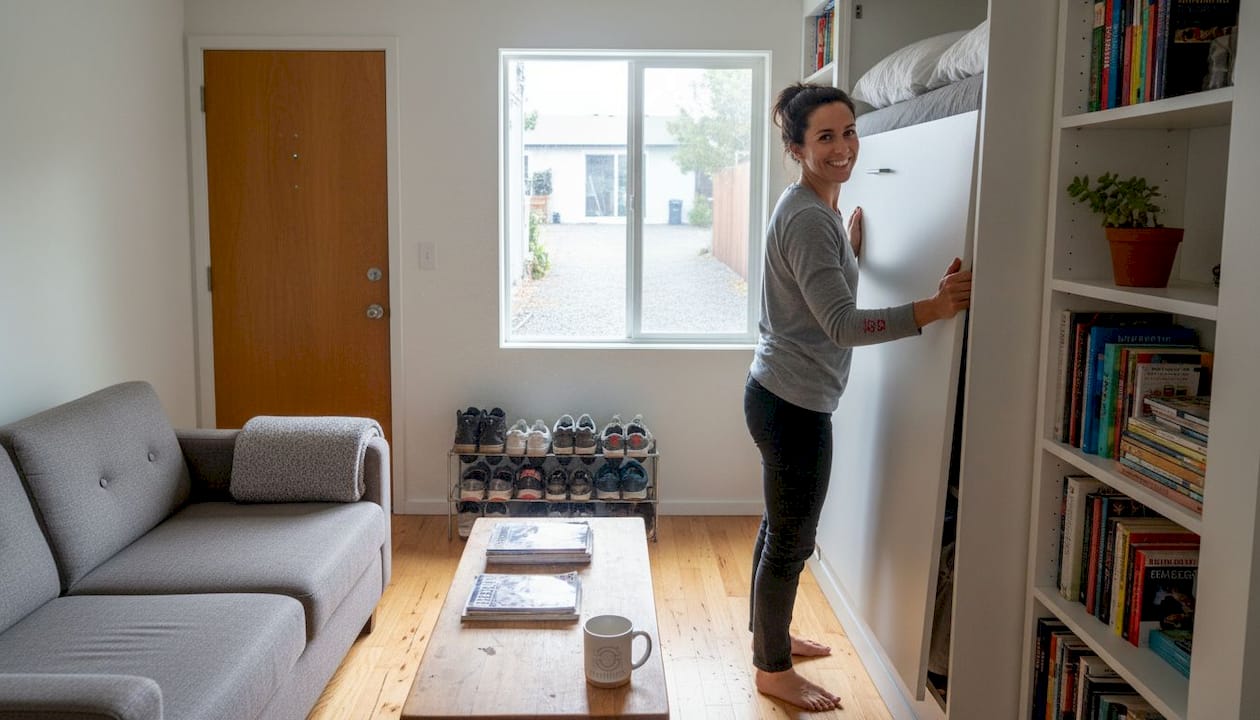
- Storage: Built-in cabinetry, under-stair storage, and lofted areas make small spaces feel organized and livable.
- Multi-purpose areas: Open floor plans with flexible furniture arrangements allow the space to serve different uses over time.
It is worth noting that state-mandated ADUs bypass local subjective design review for speed, but city ordinance allows larger units with objective standards. Choosing the city ordinance path can give you more square footage and design flexibility if your timeline allows.
Top features that increase ADU value and livability:
- Full kitchen with standard appliances
- Private entrance separate from the main home
- In-unit laundry hookups
- Accessible bathroom layout
- Covered outdoor area or small patio
- Energy-efficient windows and insulation
For style, many LA homeowners choose to match the ADU's exterior to the main home for visual cohesion. Others use the ADU as an opportunity to introduce a modern or updated aesthetic. Both approaches work well. Browse modern LA ADU designs to see how different styles translate in real projects.
Pro Tip: Design for flexibility from day one. A layout that works for a young renter today should also work for an aging parent or a home office in ten years. Wider doorways, a step-free entry, and a ground-floor bedroom are small decisions that pay off long-term.
Exploring ADU space-saving ideas early in the design phase can also help you identify smart solutions before construction begins.
Budget, timelines, and maximizing long-term value
Finally, understanding the numbers helps you stay realistic and unlock the true return on your ADU investment.
Here is a general breakdown of typical ADU costs in Los Angeles:
| Cost category | Typical range |
|---|---|
| Architecture and design fees | $15,000–$40,000 |
| Permitting and plan check fees | $5,000–$15,000 |
| Construction (detached, new) | $200,000–$400,000+ |
| Garage conversion | $80,000–$150,000 |
| Utility connections | $10,000–$30,000 |
| Contingency (10–15%) | Varies |
These ranges vary based on size, finishes, site conditions, and contractor rates. Always build in a contingency of at least 10% to cover surprises.
Here is a realistic timeline from design to move-in:
- Feasibility and design: 2–4 months
- Plan check and permitting: 3–6 months (varies by project type)
- Construction: 4–8 months for new detached; 2–4 months for conversions
- Final inspections and certificate of occupancy: 2–4 weeks
Total: expect 9–18 months from start to finish for most projects.
The financial upside is significant. Permitted ADUs are valued at 100% of their contribution to your property, while unpermitted units only reach 40–60%. That gap can represent hundreds of thousands of dollars in appraised value in the Los Angeles market.
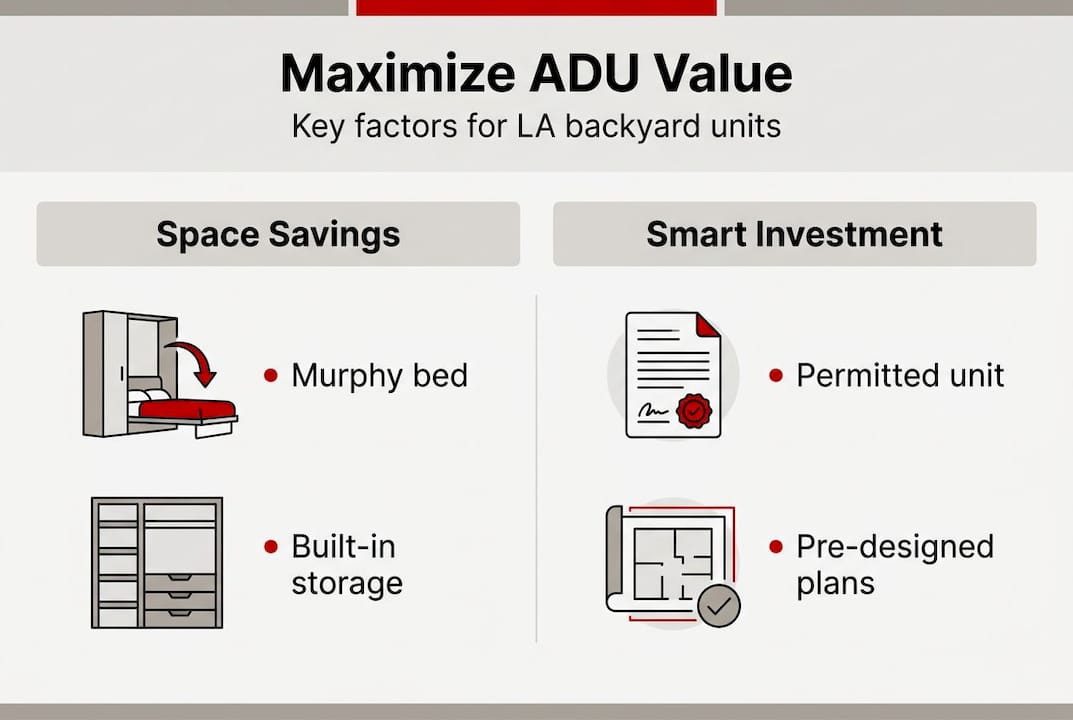
Learn more about ADU value in LA and how to maximize LA ADU income through smart design and rental strategy.
Using pre-approved or pre-designed plans can also shorten your permitting timeline and reduce design costs, which is worth exploring early in the process.
What most homeowners miss (and why it matters)
Here is something we see consistently in our work: homeowners focus almost entirely on getting approved and getting built. They treat design as an afterthought once the permits are in hand. That approach leaves real value on the table.
The homeowners who see the best outcomes treat legal compliance and thoughtful design as one unified strategy, not two separate phases. They ask: how will this unit function in five years? Will it appeal to a range of renters? Can it adapt if my family's needs change?
Rushing through design to hit an approval deadline often results in a unit that is technically legal but practically limited. Narrow hallways, poor natural light, and awkward layouts reduce both rental appeal and long-term value.
Our recommendation is to use the detailed ADU checklist not just as a compliance tool, but as a design quality benchmark. Every item on that list represents a decision that affects how well the space will serve you and future occupants for decades.
Explore ready-to-go ADU solutions for your LA home
If you are ready to take the next step in your ADU journey, we have resources to help you move forward with clarity and confidence.
At FO+H Architects, we offer a range of pre-designed ADU plans built specifically for Los Angeles properties, covering different lot sizes, styles, and budgets. Whether you are drawn to the clean lines of our Blue ADU ideas or the warmer tones of our Gold ADU designs, there is a starting point that fits your vision. Every plan is designed to meet current LA standards and can be customized to your specific site. Reach out to our team for a personalized consultation and let us help you turn your property's potential into a real, livable, high-value space.
Frequently asked questions
What is the minimum lot size for an ADU in Los Angeles?
Los Angeles does not impose a minimum lot size for ADUs, but you must still meet all standard setback requirements, lot coverage limits, and objective development standards for your zone.
Can I build both an ADU and a JADU on the same lot?
Yes, 1 ADU plus 1 JADU is a standard combination permitted in most single-family zones in Los Angeles, subject to specific size and approval requirements.
What is the height limit for detached ADUs in Los Angeles?
Detached ADUs in Los Angeles can reach 25 to 30 feet in height depending on your lot type and zoning designation under the 2025 ministerial approval standards.
What happens if I build an unpermitted ADU?
Unpermitted ADUs are valued at only 40–60% of a legally permitted unit and can result in fines, mandatory demolition orders, and denied utility connections from the city.