

TL;DR:
- Recent policy changes in Los Angeles have made ADUs easier and faster to build.
- Properly permitted ADUs can increase property value and rental income significantly.
- Using pre-approved plans and professional guidance ensures a smooth, cost-effective ADU project.
Many Los Angeles homeowners assume building an accessory dwelling unit (ADU) means months of red tape, impossible costs, and uncertain approval. That assumption is outdated. Recent policy shifts have made LA one of the most ADU-friendly cities in the country, with streamlined approvals, relaxed setback rules, and no parking requirements for many projects. Whether you want rental income, space for aging parents, or a home office that pays for itself, an ADU is one of the most practical investments you can make on your existing property right now.
Table of Contents
- What is an ADU and why do they matter in Los Angeles?
- Key regulations making Los Angeles ADUs easier than ever
- The biggest benefits: Income, family utility, and boosting property value
- Barriers and misconceptions: Costs, approval worries, and unpermitted ADUs
- Design and approval strategies for a successful LA ADU project
- Our perspective: The ADU surge is just beginning, but buyer beware
- Ready to launch your LA ADU project? Explore tailored plans
- Frequently asked questions
Key Takeaways
| Point | Details |
|---|---|
| Regulation changes | Recent LA laws make ADU approvals faster and easier for most homeowners. |
| Major homeowner benefits | ADUs can create new income streams, support family needs, and significantly increase property value. |
| Know the risks | Unpermitted or poorly executed ADUs can actually reduce resale value and cause major headaches. |
| Smart strategies | Leverage pre-approved plans and expert resources to fast-track success and avoid costly mistakes. |
What is an ADU and why do they matter in Los Angeles?
An ADU is a secondary residential unit built on the same lot as a primary home. It can take many forms: a converted garage, a detached backyard unit, a basement apartment, or even an attached addition to your existing home. Each type serves a different purpose and fits a different property layout, which is part of what makes ADUs so appealing across LA's diverse neighborhoods.
Los Angeles has a well-documented housing shortage. The city needs more units, but large-scale development is slow and expensive. ADUs fill that gap by adding housing on already-developed lots without requiring new infrastructure. For homeowners, that translates into real opportunity. The ADU revolution in LA has been accelerating steadily, driven by both policy reform and genuine demand from families and renters alike.
Here are the main advantages LA homeowners are seeing from ADU projects:
- Monthly rental income from long-term or short-term tenants
- Multi-generational living that keeps family close while maintaining privacy
- Dedicated workspace or studio without leaving the property
- Increased resale value when the unit is properly permitted
- Future flexibility to adapt the space as your needs change
One of the most important regulatory updates to understand: LA now allows up to 1,200 sq ft, 4-foot setbacks, and no parking for many ADUs. That is a significant shift from earlier restrictions that made many projects infeasible. Homeowners who dismissed ADUs five years ago because of size limits or parking requirements should take another look.
The demand side is equally strong. Renters in LA are actively seeking smaller, more affordable units. A well-designed backyard ADU or garage conversion can command competitive rents in almost every LA neighborhood, making the investment case straightforward for most properties.
Key regulations making Los Angeles ADUs easier than ever
Understanding the regulatory environment is the first step toward a successful project. The good news is that recent state and local legislation has removed many of the traditional barriers.
Ministerial approval is the key concept here. Unlike discretionary approval, which requires public hearings and subjective review, ministerial approval means the city must approve your ADU if it meets the objective code requirements. There is no neighborhood opposition process. No design review board. If your plans check the boxes, you get your permit.
State bills AB 1332 and AB 976 pushed this further by requiring cities to pre-approve ADU plans and eliminating owner-occupancy requirements for standard ADUs. The ADU plan check process in LA has been restructured around these mandates, making it faster and more predictable than most homeowners expect.
Here is how the timelines compare:
| Approval type | Estimated timeline |
|---|---|
| Standard ministerial approval | 45 to 60 days |
| Pre-approved ADU plan | 21 to 30 days |
| Discretionary (older process) | 6 to 18 months |
The difference is significant. Using a pre-approved plan can cut your approval window from months to weeks.
"Ministerial approval within 60 days; pre-approved ADU plans can be approved in as little as 21 days." — LA City Planning, ZA Memo 143 Revision 1
Other key rule changes worth knowing:
- No parking required for ADUs within half a mile of public transit or in historic districts
- 4-foot side and rear setbacks apply to most new detached ADUs
- Owner-occupancy no longer required for standard ADUs under AB 976
- Impact fees waived for ADUs under 750 sq ft
Pro Tip: If you want the fastest possible approval, ask your architect about using one of LA's pre-approved standard plans. These designs have already cleared city review, so your plan check focuses only on site-specific details. This alone can shave months off your project schedule, and it reflects how urban development trends in LA are moving toward faster, more accessible housing solutions.
The biggest benefits: Income, family utility, and boosting property value
Once you understand the regulatory landscape, the reasons to build become even more compelling. Let us look at what LA homeowners are actually gaining from their ADU projects.
Key benefits at a glance:
- Rental income ranging from $1,500 to $3,500 per month depending on size, location, and finishes
- Housing for adult children, aging parents, or in-laws without sacrificing privacy
- A dedicated home office, art studio, or workspace that generates tax benefits
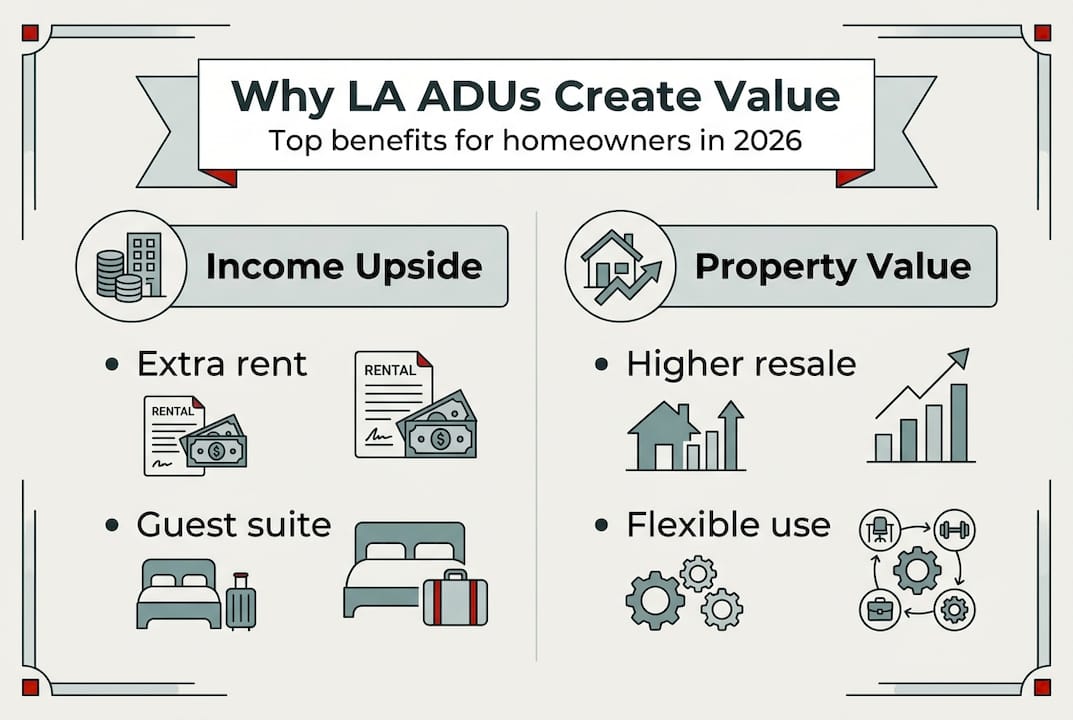
- Significant boost to resale value when the unit is properly permitted and built
- Long-term flexibility as your household's needs evolve
Here is a comparison of how ADU properties perform against non-ADU properties:
| Factor | Property with ADU | Property without ADU |
|---|---|---|
| Monthly income potential | $1,500 to $3,500 | $0 |
| Resale value increase | 20% to 35% typical | Baseline |
| Cost recoup timeline | 7 to 12 years average | N/A |
| Buyer appeal | Significantly higher | Standard |
Research from UCLA's Lewis Center confirms high income and value upsides for ADU properties, while also noting that cost barriers and tenant hesitancy remain real considerations for some homeowners. The data supports moving forward, but with clear-eyed planning.

Flexibility is one of the most underrated benefits. A unit built for a college student today can house an aging parent in ten years and serve as a rental after that. This adaptability is exactly why many families view ADUs as multi-family housing options that serve changing needs without requiring a move.
Pro Tip: If you plan to rent your ADU, screen tenants carefully and set lease terms that align with your long-term goals. A well-managed rental unit protects your investment and maintains the property condition that supports future resale value.
The impact of ADUs on neighborhoods is also positive when projects are done right. Thoughtfully designed units add housing supply without disrupting neighborhood character, which matters both to communities and to future buyers.
Barriers and misconceptions: Costs, approval worries, and unpermitted ADUs
Not every ADU story ends well. Many guides focus only on the upside, but based on our experience, the homeowners who struggle are usually the ones who skipped a critical step or underestimated a real challenge.
Here are the top four hurdles we see most often:
- Construction costs: A new detached ADU in LA typically runs $200,000 to $400,000 depending on size and finishes. Garage conversions are cheaper, but still require significant investment. Underestimating this number is the most common mistake.
- Process misconceptions: Many homeowners still believe approval takes a year or more. As we covered above, that is no longer true for most projects. But the process does require accurate, complete documentation from the start.
- Tenant hesitation: Some homeowners worry about renting to non-family members. This is a legitimate concern, but it is manageable with proper lease agreements, tenant screening, and clear property rules.
- Regulatory confusion: Zoning overlays, historic districts, and Coastal Zone rules can add complexity. What applies to your neighbor may not apply to your lot.
The most serious risk is building without permits. Unpermitted ADUs can hurt resale and expose owners to fines, forced removal, and liability. Buyers and their lenders flag unpermitted structures immediately, and resolving the issue after the fact is often more expensive than permitting correctly from the start.
"Unpermitted ADUs can decrease resale value and expose homeowners to significant legal and financial risk." — UCLA Lewis Center, ADUs in CD3
The solution is straightforward: work with qualified professionals, permit everything, and set realistic timelines. For practical guidance on navigating these challenges, the FO+H blog covers common pitfalls in detail. And if you want to see what innovative ADU designs look like when done right, the contrast with poorly executed projects is striking.
Design and approval strategies for a successful LA ADU project
Knowing the regulations and risks is important. Knowing how to act on that knowledge is what actually gets your project built.
LA's pre-approved ADU plan program is one of the most practical tools available. These are architect-designed plans that have already passed city review. When you submit one for your property, plan check times drop to 21 to 30 days, because reviewers only need to verify site-specific conditions rather than reviewing the full design from scratch.
Current design trends in LA ADUs prioritize:
- Natural light: Clerestory windows, skylights, and glass doors make small spaces feel larger
- Privacy: Thoughtful orientation and landscaping separate the ADU from the main house
- Multipurpose layouts: Convertible furniture, built-in storage, and open floor plans maximize usability
- Sustainability: Solar-ready roofs and energy-efficient systems reduce operating costs
For a step-by-step approach, here is how we recommend getting started:
- Step 1: Research your zoning, lot size, and any applicable overlays with your city planning department
- Step 2: Consult with a licensed architect who specializes in LA ADU projects
- Step 3: Select a pre-approved plan or develop a custom design that fits your site
- Step 4: Submit for permits and manage the plan check process with professional support
- Step 5: Build with a licensed contractor and schedule required inspections
- Step 6: Lease or occupy the finished unit, ensuring all certificates of occupancy are in place
One recent example: a homeowner in the San Fernando Valley used a city pre-approved plan for a 600 sq ft detached ADU. From first consultation to permit issuance, the process took 28 days. Construction wrapped in four months. The unit now rents for $2,200 per month. That outcome is increasingly common when homeowners follow the right process. Working with architects who understand the LA ADU design trends and the LA plan check steps makes a measurable difference in both speed and quality.
Our perspective: The ADU surge is just beginning, but buyer beware
Based on our experience working with LA homeowners, the policy environment right now is genuinely the best it has ever been for ADU development. The regulatory barriers that stopped projects five years ago are largely gone. But we want to be honest about something most articles skip: opportunity does not guarantee success.
The homeowners who struggle are not the ones who face bad regulations. They are the ones who treat ADUs as automatic cash machines, skip the permitting process to save money upfront, or hire unqualified contractors to cut costs. Those decisions create problems that outlast the project itself.
Our take is this: rethink your ADU as a long-term flexibility tool, not just a short-term income source. The families who get the most value are the ones who design for adaptability, permit everything correctly, and choose professionals who understand both the design and the process. The next few years will bring even more innovative home design ideas to the ADU space, but the fundamentals will not change. Informed execution is what separates a great investment from a costly mistake.
Ready to launch your LA ADU project? Explore tailored plans
If you are serious about adding an ADU to your LA property, the next step is finding a design that fits your site, your goals, and your budget. At FO+H Architects, we have developed a range of pre-approved, thoughtfully designed ADU plans built specifically for Los Angeles properties and regulations.
Whether you want to browse options independently or sit down with our team for a personalized consultation, we make it easy to move from idea to approved plans. Our ADU store features a full range of designs, including our popular Gold ADU plan, which balances livability, efficiency, and fast-track approval potential. Start with a design you love and we will help you get it built.
Frequently asked questions
How long does ADU approval take in Los Angeles?
With pre-approved plans, approval takes 21 to 30 days; standard ministerial approval for custom designs typically completes within 60 days.
Can I rent my LA ADU to anyone or do I need to live on site?
Owner-occupancy is no longer required for standard ADUs under AB 976, so you can rent to non-family tenants without living on the property.
Will building an ADU always increase my property value?
Properly permitted ADUs typically boost resale value by 20 to 35 percent, but unpermitted units can reduce value and expose owners to fines and legal risk.
What size and features are allowed for an LA ADU?
LA allows up to 1,200 sq ft, 4-foot side and rear setbacks, and no additional parking for many ADU types, particularly those near transit.