

TL;DR:
- Unexpected costs during site work and soft costs often cause ADU budgets to overrun.
- Early, detailed cost estimation and secure financing are essential for managing expenses and maintaining project control.
Building an Accessory Dwelling Unit is one of the most financially significant projects a homeowner can undertake, yet unexpected costs derail more ADU budgets than any other single factor. This guide to ADU cost management walks you through the full financial picture: from understanding cost categories and pre-construction estimation to controlling design expenses, managing site work, and securing the right financing. Whether you are adding a detached unit to a Los Angeles property or converting an existing garage, the strategies here will help you stay in control without sacrificing the quality your project deserves.
Table of Contents
- Key takeaways
- Understanding ADU costs: hard costs, soft costs, and contingencies
- Pre-construction cost estimation strategies
- Managing costs during design and permitting
- Controlling construction and site work costs
- Financing your ADU project and managing cash flow
- My take on early-stage cost management
- How Fostudiodesign simplifies ADU cost management
- FAQ
Key takeaways
| Point | Details |
|---|---|
| Hard costs dominate the budget | Construction, labor, and site work account for roughly 85% of total ADU project costs. |
| Contingency reserves prevent surprises | Set aside 10 to 20% of your budget as a contingency buffer before breaking ground. |
| Estimate costs before hiring anyone | Early cost estimation guides design decisions and prevents expensive late-stage redesigns. |
| Phase-based cash flow planning matters | Tracking spending across planning, design, permitting, and construction phases prevents funding gaps. |
| Financing should be secured early | Arranging a HELOC or construction loan before work begins protects your cash flow throughout the project. |
Understanding ADU costs: hard costs, soft costs, and contingencies
Before you can manage ADU expenses effectively, you need to understand what you are actually paying for. The industry uses two primary categories: hard costs and soft costs. Together, they form the complete cost breakdown for ADUs, and misunderstanding either one is how budgets collapse.
Hard costs are the physical, tangible expenses of building. They include construction labor, materials, utility connections, and site work such as grading, trenching, and excavation. Hard costs typically represent about 85% of a total ADU project budget, ranging from $30,000 for a simple interior conversion up to over $400,000 for a large detached unit with high-end finishes. That is a wide range, which is exactly why understanding what drives those numbers matters so much.
Soft costs cover the professional services and administrative requirements that surround construction. These include:
- Architect and engineering fees
- Permit application and plan check fees
- Feasibility and soils reports
- Title and escrow costs (if financing)
- Project management fees
Design fees alone typically run around 10% of the total project budget. When you add permits and plan checks, you are typically looking at an additional 3 to 8% of total costs, according to ADU cost data for 2026.
Then there are contingencies. This is not a line item many homeowners budget for willingly, but it is non-negotiable. Contingency buffers of 10 to 20% are standard practice in ADU construction to absorb unforeseen costs. Hitting an underground obstruction during site work, discovering outdated plumbing that must be replaced, or facing a plan check correction can each add thousands to your bill without warning.
Pro Tip: When building your budget spreadsheet, treat contingency as a locked line item rather than a leftover. Allocate it at the start and do not count it as available spending money.
Pre-construction cost estimation strategies
The single most effective thing you can do before hiring anyone is build a realistic cost estimate. Estimating costs early guides your decisions about design, size, and features before money is on the table, saving you from expensive late-stage redesigns that ripple across the entire project.
A practical starting formula for ADU cost estimation looks like this:
Total ADU Cost = (Base cost per sq ft) × (Location factor) × (Total square footage)
The base cost per square foot varies by ADU type: a detached new construction unit in Los Angeles runs higher than a garage conversion or attached addition. Multiply that by a location factor that accounts for local labor rates, permit costs, and site accessibility. This formula-based estimation approach becomes far more accurate when you factor in hidden costs like sewer lateral upgrades and electrical panel expansion from the start.
Follow this process to build your pre-construction budget:
- Identify your ADU type. Detached, attached, garage conversion, and junior ADUs each carry different cost profiles. A detached unit costs more but typically delivers the highest rental income.
- Assess your site conditions early. Walk the property with a contractor or civil engineer and identify grading requirements, utility connection distances, and vehicle access constraints before committing to a design.
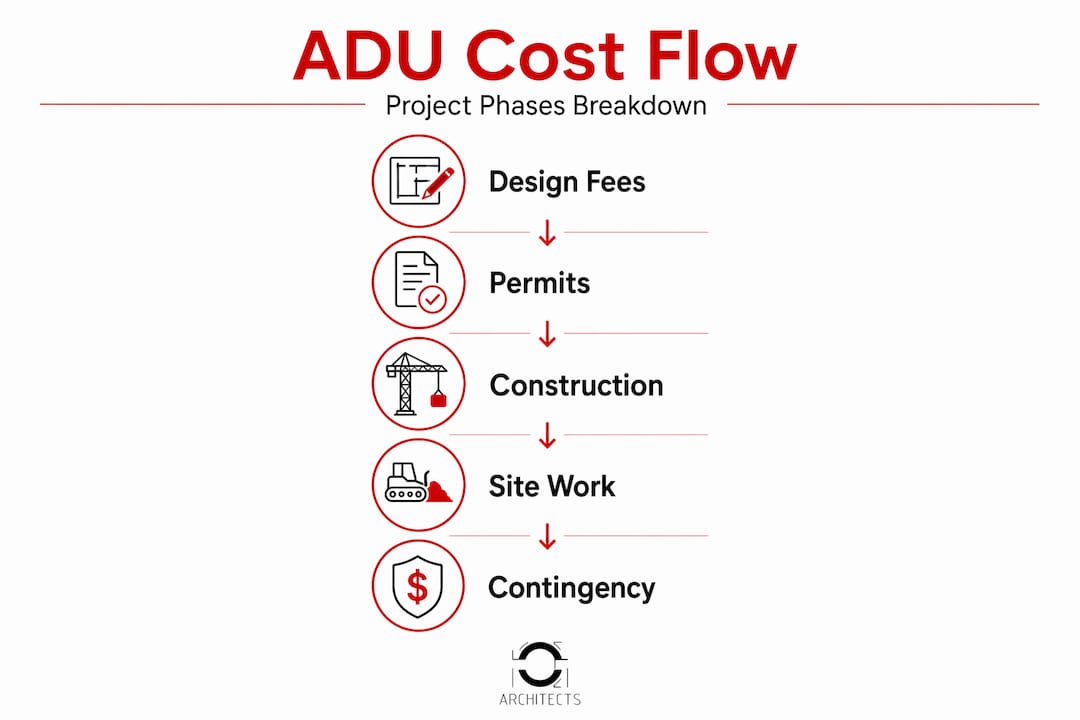
- Build a phase-by-phase budget. ADU projects typically span 9 to 27 months, covering 1 to 3 months of planning, 1 to 6 months of design, 1 to 6 months of permitting, and 6 to 12 months of construction. Assign a cash outflow estimate to each phase so you are never caught short.
- Stress-test your budget. Run a scenario where everything costs 15% more than estimated. If that number would break the project, you need to either reduce scope or arrange additional financing before you start.
- Separate your contingency. As noted above, 10 to 20% of your budget should sit in a reserve category. A well-structured budget spreadsheet includes cash flow projections by phase alongside this contingency line to avoid mid-project funding gaps.
One of the most common mistakes is ignoring soft costs until construction begins, then scrambling to cover permit fees or design revisions. Underestimating site work complexity and omitting soft costs from early planning are the two leading causes of ADU budget overruns.
Pro Tip: Do not estimate your ADU cost based on a neighbor's project. Costs vary significantly by site conditions, ADU type, and finish level. Get at least two itemized contractor bids and cross-check them against your phase-based budget.
Managing costs during design and permitting
Design and permitting are where experienced homeowners spend wisely and inexperienced ones spend carelessly. Understanding how to work within this phase protects both your budget and your timeline.
The design choices you make early directly set the cost ceiling for construction. Selecting a simple rectangular footprint instead of an L-shape or multi-level design reduces structural complexity, lowers framing costs, and shortens plan check review times. Learning how to design an ADU around efficient shapes and standard dimensions is one of the most practical affordable ADU solutions available. Pre-approved plan programs, which some California jurisdictions now offer, can reduce design fees and cut months off permitting timelines.
Key strategies for controlling design and permit expenses include:
- Scope your design contract precisely. A clear scope of work prevents scope creep, which is one of the most overlooked budget risks in the design phase.
- Use the LA ADU permitting process to your advantage. Understanding what reviewers look for allows your architect to submit cleaner drawings, reducing costly correction cycles.
- Avoid mid-design changes. Every change after design development begins costs time and money in revised drawings, re-submittals, and sometimes additional plan check fees.
- Negotiate your architect's contract upfront. Clarify whether fees are hourly or fixed, what happens if corrections are required, and who is responsible for re-submission costs.
Staying organized and communicating clearly with your design team is not just good practice. It is a direct cost control strategy.
Controlling construction and site work costs
Construction is where the largest share of your budget moves, and where surprises are most expensive. Understanding the major cost drivers before ground breaks is the foundation of good construction cost management.
The table below shows a typical cost breakdown by component:
| Cost component | Typical share of total budget |
|---|---|
| Structure and building envelope | 25 to 35% |
| Site work and utility connections | 10 to 20% |
| Interior finishes and fixtures | 15 to 25% |
| Design and engineering fees | 6 to 10% |
| Permits and plan checks | 3 to 8% |
| Contingency reserve | 10 to 20% |
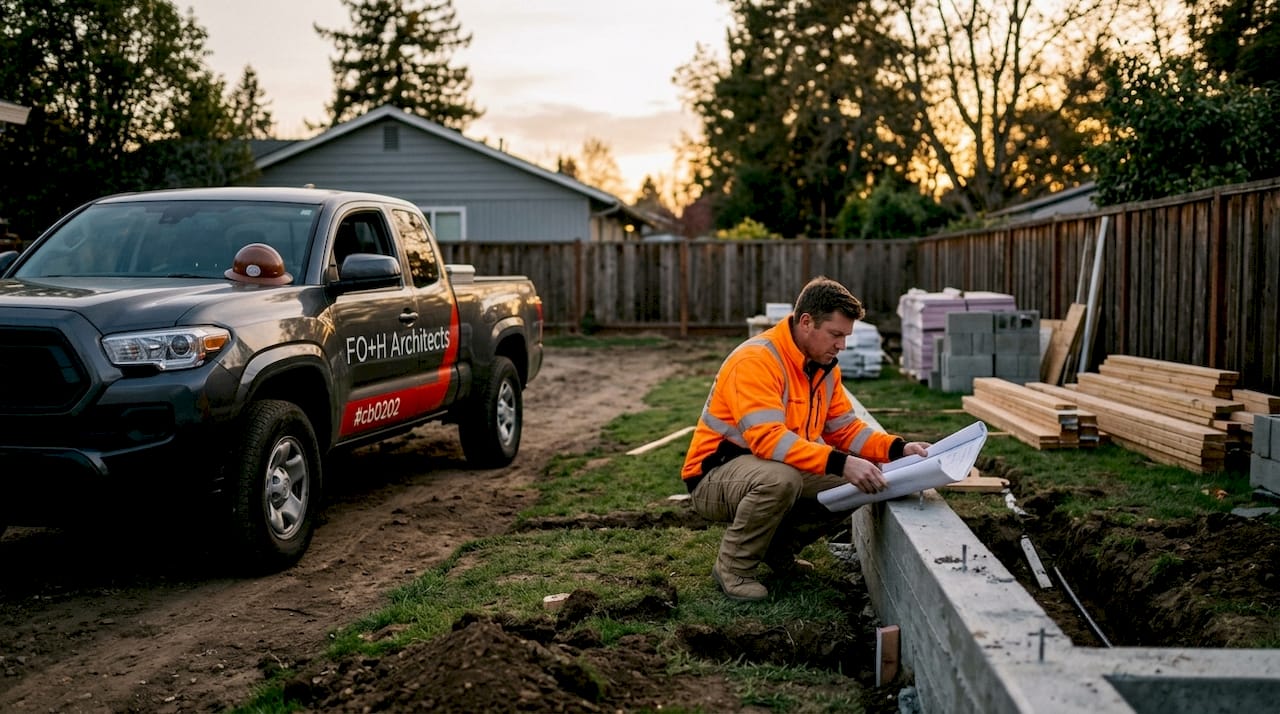
Site-specific factors such as trenching distance, grading requirements, and vehicle access are consistently among the most underestimated cost variables on ADU projects. A utility connection that requires 80 feet of trenching across a slope costs dramatically more than a 20-foot connection across flat ground. This is not something you discover on the fly. You identify it in pre-construction.
Once construction begins, your primary cost control tools are clear contracts, regular site visits, and fast decision-making. Change orders are expensive not just because of the added scope but because of the schedule disruption they cause. If your contractor requests a decision and you delay two weeks, you may pay for crew downtime.
Working with professional design/build firms can increase upfront costs but frequently saves money overall through fewer change orders and faster project completion. Before hiring, review any firm's track record carefully. Learning to spot contractor red flags before signing a contract protects your budget far more than negotiating a lower bid from someone unqualified.
Pro Tip: Lock down your site scope completely before finalizing your construction contract. Undefined site work is the number one source of cost surprises in ADU projects.
Financing your ADU project and managing cash flow
Securing financing before construction starts is not just convenient. It determines whether your project stays on schedule when unexpected expenses arrive. Many homeowners begin construction relying on savings alone and then hit a funding gap mid-project, which is both costly and stressful.
Common financing methods include:
- Home equity line of credit (HELOC). Flexible draw schedule makes it well-suited to phased ADU construction expenses.
- Second mortgage or home equity loan. These loans often carry repayment terms up to 30 years and may allow interest-only payments during the construction period, which helps cash flow significantly.
- Cash-out refinance. Converts existing equity into a lump sum at a new mortgage rate.
- Personal construction loans. Shorter terms and higher rates, but accessible when equity is limited.
- Cash savings with phased draws. Works if reserves are sufficient to cover the full project including contingency, without leaving you exposed.
The strongest financing strategy for an ADU investment ties your loan amount to projected rental income and the resulting property value increase. Lenders familiar with ADU projects understand this math and structure products accordingly. Working with a lender who does not understand ADU valuation can result in underfinancing based on current property value alone, leaving you short at the worst possible moment.
Plan your cash flow by project phase. Soft costs (design, permits, reports) arrive first and must be covered before construction draws begin. Your construction contract will specify a payment schedule tied to milestones, so map those against your loan draw schedule before signing anything. A useful resource for understanding how ADU investment returns affect financing decisions is the Los Angeles ADU investment strategy guide, which covers how rental income projections can strengthen your financing case.
My take on early-stage cost management
In my experience, the homeowners who manage ADU budgets successfully share one habit: they do the hard planning work before any money moves. I have seen projects where the owner had a clear phase-by-phase budget, a locked site scope, and a funded contingency reserve. Those projects ran close to budget. I have also seen projects where someone got a contractor bid, felt confident, and started construction without resolving key site unknowns. The overruns were painful and, in every case, avoidable.
What most people overlook is that the design and pre-construction phases are where your budget is actually set. By the time the framing crew shows up, your financial outcome is largely determined. Investing time and modest fees in thorough pre-construction planning, good drawings, and a realistic contingency is the most cost-effective decision you will make on the entire project. The numbers simply work out better when you plan early, communicate clearly, and resist the temptation to cut corners on professional services.
— Henry
How Fostudiodesign simplifies ADU cost management
Planning an ADU in Los Angeles does not have to start from scratch. Fostudiodesign offers a curated collection of pre-designed ADU plans through its ADU Store, giving homeowners and investors a faster, more affordable path to a fully developed design package. Pre-designed plans reduce architect fees and speed up permitting because the design work is already refined.
Whether you are drawn to a compact, efficient layout like the Blue ADU or prefer the bolder proportions of the Orange ADU, each plan comes backed by the firm's expertise in Los Angeles permitting requirements and site-specific design. The team at Fostudiodesign also provides permitting and feasibility consulting, so you go into construction with accurate cost projections, not estimates built on assumptions.
FAQ
What percentage of an ADU budget should go to hard costs?
Hard costs typically represent about 85% of a total ADU budget, covering construction labor, materials, utility connections, and site work. The remaining 15% covers soft costs such as design fees, permits, and professional services.
How much contingency should I budget for an ADU project?
A contingency reserve of 10 to 20% of your total project budget is standard practice. This buffer covers unforeseen site conditions, plan check corrections, and material cost changes during construction.
What financing options work best for ADU construction?
HELOCs and home equity loans are the most commonly used financing tools for ADUs, offering flexible draw schedules and repayment terms up to 30 years. Working with a lender experienced in ADU projects improves your chances of getting financing that reflects the unit's income potential.
What causes most ADU budget overruns?
The two most common causes are underestimating site work complexity and failing to account for soft costs until construction is already underway. Addressing both through early, detailed budgeting prevents the majority of cost surprises.
How long does an ADU project typically take?
Most ADU projects run between 9 and 27 months from initial planning through construction completion. Longer pre-construction phases increase carrying costs, which is why moving efficiently through design and permitting saves both time and money.