

TL;DR:
- Building an ADU in Los Angeles offers high financial returns due to rising property values and strong rental demand facilitated by streamlined permitting. Success depends on careful property assessment, accurate budgeting, understanding local regulations, and strategic design to maximize rental income; prudent investors separate rental income modeling from appreciation projections. Connecting with experienced local architects and planners ensures a predictable, profitable ADU project aligned with specific site conditions and market data.
Building an ADU in Los Angeles is one of the most financially compelling moves a homeowner can make right now. Property values across the region continue to climb, rental demand stays strong, and recent state legislation has made the permitting process faster than ever before. But many owners still leave money on the table, not because they chose the wrong contractor, but because they skipped the strategic groundwork. This guide walks you through the real numbers, the permitting realities, and the rental optimization tactics that separate high-performing ADU projects from those that barely break even.
Table of Contents
- Understand ADU investment fundamentals in Los Angeles
- Step 1: Assess your property and set clear investment goals
- Step 2: Budget, finance, and underwrite your ADU project
- Step 3: Navigate LA's ADU permitting and approval processes
- Step 4: Maximize rental income and ongoing returns
- What most ADU guides miss about LA investment strategy
- Ready to unlock your property's potential with a Los Angeles ADU?
- Frequently asked questions
Key Takeaways
| Point | Details |
|---|---|
| Know your numbers | ADU build costs, rents, and ROI vary widely by location and project type—run local comps before committing. |
| Permitting strategy matters | Leveraging LA’s 60-day approval rule and pre-approved plans can save months and cash-flow headaches. |
| Focus on sustainable ROI | Separate rental cash flow from appreciation, and budget for real-world operating costs to safeguard returns. |
| Long-term rentals are safest | In most LA neighborhoods, long-term leases offer steadier income and fewer regulatory complications. |
| Expert guidance pays off | ADU investments succeed when guided by local data, proven processes, and specialist expertise. |
Understand ADU investment fundamentals in Los Angeles
An ADU, or Accessory Dwelling Unit, is a secondary residential unit on the same lot as a primary home. It can be a detached backyard structure, a garage conversion, an attached addition, or an interior unit carved from existing square footage. What makes ADU investment distinct in Los Angeles is the combination of high land values, strong rental demand, and a regulatory environment that now actively encourages construction.
Understanding the financial benchmarks before you break ground is critical. Based on current market data, build costs typically range from roughly $150 to over $400 per square foot, with total project costs landing between $90,000 and $400,000 or more depending on unit type and finishes. That is a wide range, and where your project lands within it depends heavily on site conditions, ADU type, and design complexity.
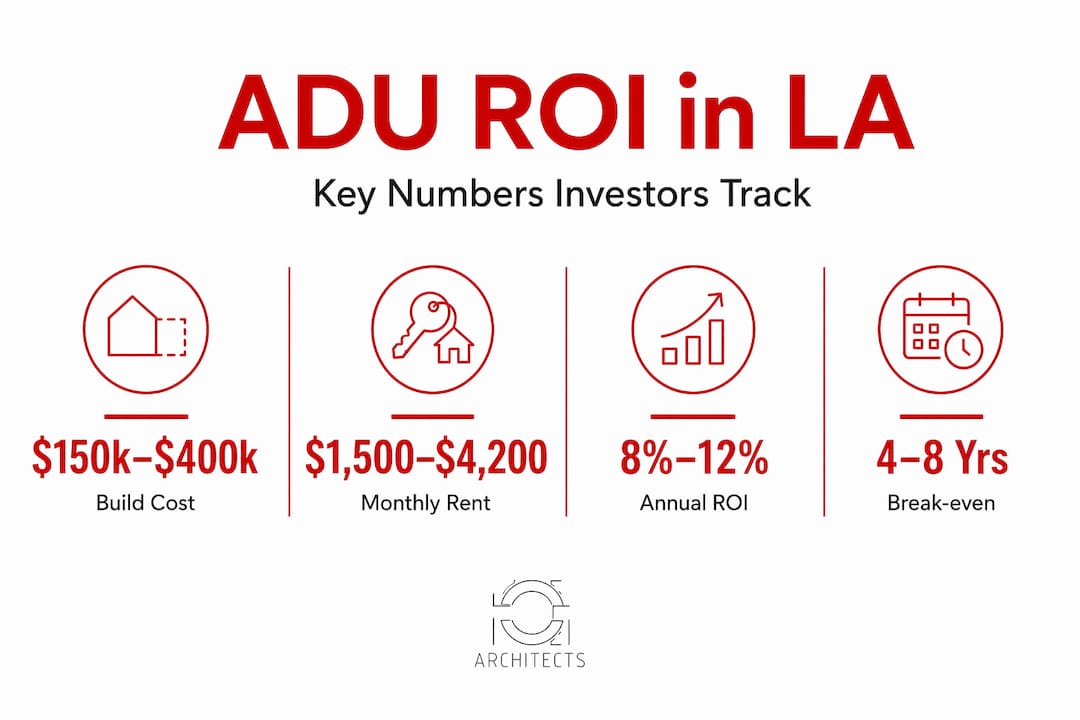
On the income side, LA rent benchmarks for permitted long-term ADU rentals typically fall between $1,500 and $4,200 per month, varying by neighborhood, unit size, and finish level. A well-designed unit in Silver Lake, Culver City, or Eagle Rock will command rents closer to the top of that range. A modest conversion in a less central neighborhood may sit closer to the floor.
| ADU type | Typical cost range | Expected monthly rent | Approx. break-even |
|---|---|---|---|
| Garage conversion | $90,000 to $160,000 | $1,500 to $2,400 | 4.5 to 6 years |
| Attached addition | $150,000 to $250,000 | $2,000 to $3,200 | 5 to 7 years |
| Detached new build | $200,000 to $400,000+ | $2,500 to $4,200 | 5.5 to 8 years |
| Junior ADU (JADU) | $50,000 to $120,000 | $1,200 to $2,200 | 3.5 to 5.5 years |
A practical LA cash-flow benchmark for ADU projects is roughly 8 to 12 percent annual ROI, with break-even commonly cited around 4.5 to 6.5 years depending on your build method and financing. These numbers are achievable, but they require disciplined planning. Understanding why build an ADU makes sense for your specific situation is the right starting point before committing to any project path.
Step 1: Assess your property and set clear investment goals
With LA benchmarks in mind, the next step is evaluating whether your property is a strong candidate and aligning your financial goals with realistic outcomes.
Start with a property feasibility checklist. Not every lot is equally suited for an ADU, and site constraints can meaningfully affect both cost and timeline. Here are the key items to verify early:
- Lot size and setbacks: Most LA parcels allow ADUs up to 1,200 square feet, but setback requirements (typically four feet from rear and side property lines for detached units) can limit buildable area.
- Utility connections: Water, sewer, and electrical tie-ins are major cost variables. A lot with aging infrastructure or a shared sewer lateral can add $15,000 to $40,000 to your project budget.
- Parking requirements: State law has reduced parking requirements for ADUs near transit, but verifying your specific parcel's requirements with LADBS before designing saves time and redesign fees.
- Existing structures: Garage conversions and JADU projects often carry lower construction costs but may involve structural upgrades, insulation, and Title 24 energy compliance work.
Location-specific rental demand is just as important as physical site conditions. A unit designed for the right micro-market, with the right features, can rent for 20 to 30 percent more than a comparable unit a few miles away. Expert underwriting guidance consistently recommends validating permitting timeline assumptions, confirming rent comps for your exact micro-market, and stress-testing build costs against site conditions and finish levels, because even small overruns in schedule or cost can materially impact your early cash flow.
Clarify your primary investment goal before finalizing your design direction. Are you targeting maximum monthly cash flow? Long-term property appreciation? Multi-generational housing flexibility? Or a combination? Your answer shapes unit size, finish level, and leasing strategy. Refer to an ADU design checklist specific to Los Angeles properties to make sure nothing falls through the cracks early in the process.
Pro Tip: Pull rental comps for your block, not just your zip code. Rents can vary by $400 to $600 per month within a single neighborhood based on walkability, parking availability, and proximity to transit stops.
Step 2: Budget, finance, and underwrite your ADU project
Once you know your property's strengths and your financial goals, smart budgeting and financing set the foundation for a high-performing investment.

Many homeowners underestimate total project costs because they focus only on construction. A realistic all-in budget includes design and architectural fees (typically 8 to 15 percent of construction cost), permit fees, utility connection fees, soils or structural reports if required, landscaping, and furniture if renting furnished. For a $200,000 construction budget, expect total project costs of $230,000 to $260,000 when all soft costs are included.
Financing options compared:
| Financing method | Typical rate (2026) | Uses ADU income for qualification | Best for |
|---|---|---|---|
| Cash out of pocket | None | Not applicable | Owners with equity |
| Cash-out refinance | 6.5% to 7.5% | Sometimes | Significant equity available |
| Home equity line of credit | 7% to 8.5% | Rarely | Phased draws preferred |
| ADU-specific construction loan | 7% to 9% | Sometimes, varies by lender | Tight cash position |
| Renovation loan (FHA 203k, HomeStyle) | 6.75% to 8% | Occasionally | Lower down payment owners |
It is worth noting that for borrowers who are income-constrained, some financing approaches may incorporate projected ADU rental income into loan qualification, but terms vary significantly between lenders. Always request lender-specific underwriting guidance rather than assuming every ADU loan product treats projected rental income the same way.
Here is how to model your net operating income and ROI step by step:
- Calculate gross annual rent: Multiply your expected monthly rent by 12 (for example, $2,800/month x 12 = $33,600/year).
- Subtract vacancy reserve: Apply a 5 to 8 percent vacancy allowance, which reflects typical turnover between tenants ($33,600 x 0.93 = $31,248 effective gross income).
- Subtract operating expenses: Include property insurance allocation, maintenance reserve (typically 1 to 2 percent of project cost annually), and any property management fees. A realistic expense load is often 25 to 35 percent of effective gross income.
- Calculate net operating income: Effective gross income minus total operating expenses equals your NOI.
- Divide NOI by total project cost: This gives you your cash-on-cash return. For a $220,000 project generating $21,000 NOI, that is roughly 9.5 percent annual cash-on-cash.
A critical underwriting rule we apply on every project: model ADU income separately from property appreciation. Some ROI figures you see online blend rental cash flow with projected appreciation, which inflates the numbers and leads to poor decisions. Even if gross rent looks attractive, net returns require budgeting for maintenance, vacancy reserves, and property tax and insurance effects. Watch for ADU contractor red flags that could put your budget at risk before construction even begins.
Pro Tip: Never blend appreciation assumptions into your rental ROI calculation. Model rental income return and appreciation upside separately so you know exactly what your cash flow looks like before any assumed equity gain.
Step 3: Navigate LA's ADU permitting and approval processes
With a sound financial plan in place, your next challenge is successfully navigating Los Angeles's evolving permitting requirements.
Under California's ministerial ADU framework, local agencies must approve or deny a complete ADU application within 60 days. This is a major advantage for investors, because a faster approval means earlier rental income. The key steps in the LA ADU permitting process are:
- Confirm zoning and feasibility: Verify your parcel's zoning designation, ADU eligibility, and any overlay restrictions through the LADBS or a qualified architect before committing to design.
- Complete architectural drawings: Prepare a full permit set including site plan, floor plans, elevations, structural plans, and Title 24 energy documentation.
- Submit a complete application: An incomplete application does not trigger the 60-day clock, so review checklists carefully before submitting. Missing documents are the single most common cause of delays.
- Respond to corrections promptly: If LADBS issues a correction notice, respond quickly. Each round of corrections can add two to four weeks to the timeline.
- Secure permits and begin construction: Once issued, permits are typically valid for one year with extensions available.
Important: Only a complete application triggers the 60-day statutory review window. Applications with missing documents, incorrect forms, or incomplete drawings will be deemed incomplete and returned, resetting your timeline.
A commonly recommended approach for maximizing early cash flow is using LADBS pre-approved standard plans to reduce corrections and shorten your total approval timeline compared to fully custom designs. This works especially well for straightforward detached units on standard lots. For detailed guidance on submitting a complete package, our LA ADU permitting guide covers every required document, and our ADU plan check process guide explains exactly what happens once your application is in review.
Pro Tip: Using LADBS pre-approved plan sets can cut several weeks off your approval timeline and reduce the chance of costly plan check corrections, which translates directly to earlier rental income.
Step 4: Maximize rental income and ongoing returns
After approvals, the ADU's ongoing performance depends on smart management choices, particularly around rental strategy and feature selection.
The features that consistently push rents to the top of the market range are well documented. Based on our experience designing and permitting ADUs across LA, the upgrades with the strongest return on investment include:
- Private entrance: Tenants pay a significant premium for a unit that feels fully independent from the primary home.
- In-unit laundry: A washer and dryer hookup (or better, included units) commands $150 to $300 more per month in most LA neighborhoods.
- Private outdoor space: Even a small patio or deck adds meaningful rental appeal and often justifies higher asking rents.
- Dedicated parking: In neighborhoods with limited street parking, off-street parking can add $100 to $200 per month to rent.
- Natural light and ceiling height: These factors affect tenant perception of quality and can distinguish your unit in a competitive rental listing.
The LA rent range for ADUs is typically $1,500 to $4,200 per month, and these features are what move a unit from the bottom to the top of that range.
On leasing strategy, Southern California operators generally recommend long-term leasing for steadier and more predictable income. Short-term rentals may require separate permits and are subject to restrictions in many LA zones that can complicate compliance. Rental product positioning should be tied to neighborhood rent data and confirmed comps, not to optimistic projections or what a similar unit charged two years ago.
Review our detailed guidance on ADU design for value when finalizing your unit's layout and feature set.
Pro Tip: Tie every upgrade decision to verified rent comps from active listings in your specific neighborhood. An in-unit washer/dryer may add $200/month in Los Feliz but only $75/month in a neighborhood with ample laundromat access nearby.
What most ADU guides miss about LA investment strategy
Here is an honest perspective that most ADU guides overlook, and what we believe truly separates consistently successful LA investors from those who get burned.
Most ADU content online is optimistic by design. The 8 to 12 percent ROI benchmarks frequently cited are real, but they are achievable only under favorable conditions, and many guides inflate figures further by blending rental cash flow with projected appreciation. We model these as separate scenarios for every project we touch, and the discipline of keeping them separate changes decisions significantly.
The investors who perform most consistently in this market are the ones who demand proof for every assumption. They do not use zip-code-level rent comps; they pull street-level data. They do not assume the cheapest contractor is the right one; they verify licensing, insurance, and a track record with permitted ADU projects in Los Angeles specifically. They plan for a 10 to 15 percent construction contingency, not because they expect problems, but because Los Angeles sites frequently surface hidden utility conflicts, foundation conditions, or structural requirements that were not visible during initial scoping.
LA ADU ROI is not one-size-fits-all. Your results hinge on site constraints, the speed of your permitting process, your financing cost, and the accuracy of your micro-market rent data. The safest investors separate rental income modeling from appreciation, include ample maintenance and vacancy reserves, and evaluate real ADU project results rather than relying on best-case projections from sources with a stake in making projects look attractive.
The most valuable return you can build toward is a predictable one, grounded in detailed local data and conservative underwriting. Hype is easy to find. Reliable cash flow takes deliberate work.
Ready to unlock your property's potential with a Los Angeles ADU?
If the steps in this guide have clarified your path forward, the next move is connecting with a team that understands LA's permitting landscape, rental market, and design requirements at a granular level.
At FO+H Architects, we bring together architectural expertise, local permitting knowledge, and investment-minded design to help you build an ADU that performs. Whether you want to start with a proven plan set or work with us on a fully custom design, our ADU plans in LA are developed specifically for Los Angeles lots and permitting requirements. Explore our Blue ADU concepts for a streamlined, value-focused approach, or browse our Gold ADU designs for elevated finishes and premium rental positioning. Reach out to schedule a consultation and get site-specific guidance tailored to your property and investment goals.
Frequently asked questions
What is the typical cost to build an ADU in Los Angeles in 2026?
ADU build costs in Los Angeles usually range from $150 to over $400 per square foot, with total project costs commonly landing between $90,000 and $400,000 or more depending on unit size and finishes.
How long does it take to get an ADU permit approved in Los Angeles?
Los Angeles is required by California law to approve or deny a complete ADU application within 60 days, though only a fully complete application triggers that statutory window.
What kind of rental income can I expect from an LA ADU?
Permitted long-term ADU rentals in Los Angeles can generate between about $1,500 and $4,200 per month, varying significantly by neighborhood and the ADU's size and finish level.
Are short-term ADU rentals allowed in Los Angeles?
Short-term ADU rentals often require additional permits or may be restricted depending on your specific zone, so long-term leasing is recommended for steadier income and fewer compliance risks.
How should I calculate true ROI on an ADU investment?
Separate your rental cash flow from future property appreciation projections, and always factor in operating costs, vacancy reserves, and maintenance expenses to avoid overstating returns.