

TL;DR:
- Modern urban housing in Los Angeles emphasizes high-density, mixed-use, and sustainable community designs.
- Projects like Habitat Culver City demonstrate that affordability and sustainability can coexist successfully.
- Human-centered design, community involvement, and quality planning are key to long-term success.
Modern urban housing in Los Angeles is not what most people picture. Many homeowners and investors still assume it means towering glass high-rises packed with identical units and zero community feel. The reality is quite different. Contemporary urban living is now defined by high-density, mixed-use developments that prioritize walkability, sustainability, shared amenities, and genuine community spaces. From Culver City to the San Fernando Valley, LA is quietly leading a shift toward housing that is both environmentally responsible and deeply human. This guide breaks down what modern urban housing actually looks like, which LA projects are setting the standard, and how you can apply these lessons to your own property or investment.
Table of Contents
- Defining modern urban housing
- Sustainable innovations in Los Angeles projects
- Balancing affordability, quality, and policy
- Community engagement and design for well-being
- Risks and challenges: What the data reveals
- A fresh approach: Human-scale, co-created modern urban living
- Connect with modern urban housing solutions
- Frequently asked questions
Key Takeaways
| Point | Details |
|---|---|
| Mixed-use and sustainable by design | Modern urban housing blends multiple functions and eco-friendly features to enhance community living. |
| Real projects lead the way | LA’s developments show sustainable design with net-zero, solar, and community-focused amenities. |
| Balancing cost and quality | Policy, smart construction, and human-scale design are all key to livability and affordability. |
| Community matters most | Resident input and co-design help create lasting, valued urban neighborhoods. |
Defining modern urban housing
Now that you've seen how urban housing is being reframed, let's define exactly what makes it modern and relevant in Los Angeles.
At its core, modern urban housing blends residential, retail, and office uses within a single development or neighborhood. The goal is walkability: residents should be able to meet most daily needs without a car. Mixed-use designs integrate residential floors above ground-level retail, shared office space, and flexible layouts that allow dual-aspect lighting and long-term adaptability. These are not just aesthetic choices. They reduce commute times, lower household transportation costs, and create more vibrant street life.
Sustainability is equally central. Energy-efficient construction methods, green roofs, and rooftop solar arrays are now standard features in well-designed urban projects. These elements reduce operating costs for residents and lower the building's overall carbon footprint. The impact of sustainability in real estate is measurable: green-certified buildings consistently command higher rents and resale values while attracting tenants who prioritize long-term value.
"Shared amenities and sustainability are no longer optional upgrades in modern urban housing. They are the primary drivers of resident satisfaction and long-term project viability."
Compared to traditional suburban models, modern urban housing uses land far more efficiently. A single mid-rise building can house hundreds of families on a fraction of the land a sprawling subdivision would require. Energy footprints per household are smaller, and connectivity to transit, services, and employment is dramatically better. You can explore how these principles apply to sustainable community homes in the LA context for a deeper look at what this means for your neighborhood.
| Feature | Modern urban housing | Traditional suburban housing |
|---|---|---|
| Land use | High-density, compact | Low-density, sprawling |
| Energy footprint | Lower per household | Higher per household |
| Transit access | Strong, walkable | Car-dependent |
| Community amenities | Shared, integrated | Private, dispersed |
| Mixed-use integration | Yes | Rarely |
Key features that distinguish modern urban housing include:
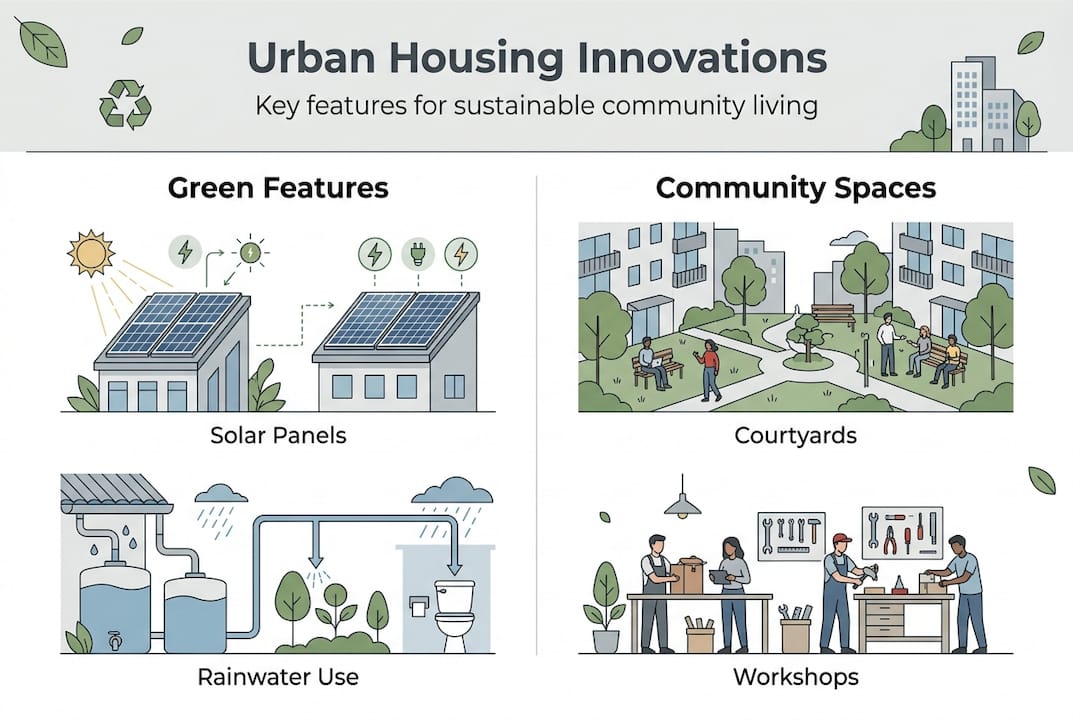
- Green roofs and solar arrays that reduce energy costs and manage stormwater
- Flexible floor plans that adapt to changing household needs over time
- Shared courtyards and social spaces that encourage neighbor interaction
- Ground-floor retail and services that activate street life and reduce car trips
- High-performance building envelopes that meet or exceed Title 24 energy standards
Sustainable innovations in Los Angeles projects
With the foundation set, let's explore how these principles come to life through actual Los Angeles developments.
LA is home to some of the most ambitious sustainable housing projects in the country. Three standout examples show what is genuinely achievable when design, policy, and investment align.
| Project | Units | Certification | Key sustainability feature | Affordable units |
|---|---|---|---|---|
| Habitat Culver City | 260 | LEED Platinum (target) | Solar array, net-zero emissions | Mixed income |
| Corazón Del Valle | 180 | Green certified | Solar producing 203 kWh/year, greywater recycling | 100% affordable |
| Brunson Terrace | Affordable | LEED Platinum | Stormwater retention over 100%, all-electric | 100% affordable |
LA sustainable housing projects like Habitat Culver City and Corazón Del Valle demonstrate that luxury and affordability can both benefit from the same green strategies. Corazón Del Valle's solar system produces 203 kWh per year while its greywater recycling system reduces municipal water demand significantly.
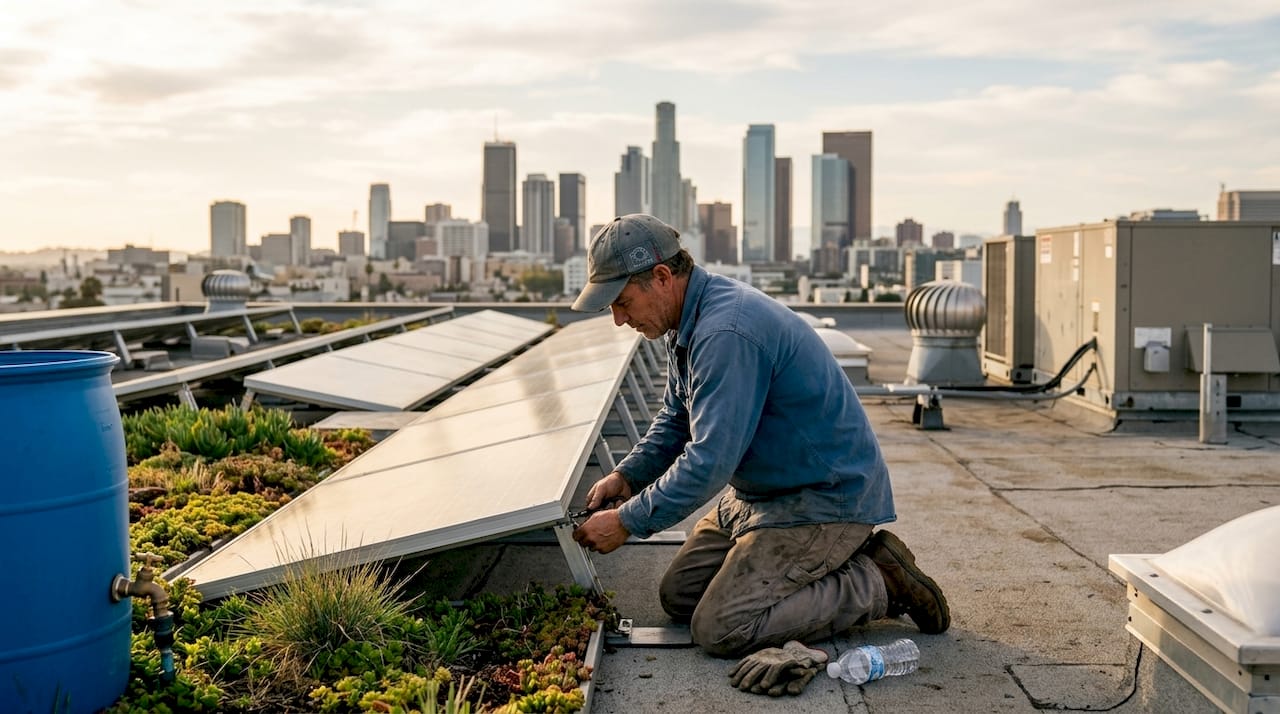
Brunson Terrace is particularly striking. This net-zero, LEED Platinum affordable housing project achieved stormwater retention exceeding 100% of site demand, diverted 99% of construction waste from landfills, and designed an all-electric system that exceeds California's Title 24 energy code by 50%. These are not small achievements. They represent a new benchmark for what affordable housing can look like in LA.
Here are the steps these projects took to reach their sustainability benchmarks:
- Early energy modeling to identify the most cost-effective efficiency measures before construction began
- All-electric design to eliminate natural gas dependency and align with LA's long-term decarbonization goals
- On-site solar and storage to reduce grid reliance and lower resident utility bills
- Greywater and stormwater systems to address LA's chronic water scarcity
- Waste diversion protocols during construction to minimize landfill impact
For homeowners and investors reviewing LA architecture tips, these projects offer a practical roadmap. If you're exploring multi-family housing in LA, understanding these benchmarks helps you evaluate which developers are truly committed to long-term performance.
Balancing affordability, quality, and policy
These innovations set the stage, but policy and costs shape what's really possible. So how does LA balance these factors?
LA's housing policy landscape is complex. Measure JJJ requires developers using density bonuses to include 5 to 11% affordable units in new projects. That sounds meaningful, but the affordability gaps study reveals that high land and construction costs often make those requirements difficult to meet without significant subsidies. Policy creates the framework, but it does not automatically solve the underlying economics.
"Policy doesn't always equal affordability. Without addressing the cost of land, materials, and financing, mandating affordable units can simply shift the burden rather than solve it."
Factors that affect affordability and quality in LA urban housing include:
- Land costs, which remain among the highest in the nation and consume a large share of project budgets
- Construction material prices, which have risen sharply since 2020 and show no sign of reversing
- Design standards, which vary widely and directly affect long-term livability and maintenance costs
- Permitting timelines, which add months or years to project schedules and increase financing costs
- Community opposition, which can delay or kill projects that would otherwise deliver needed housing
Research on quality design approaches points to an instructive contrast. Vienna's social housing model shows that investing in quality design, durable materials, and resident-centered planning actually reduces long-term costs and generates community support. Low-quality high-rises, by contrast, often accelerate displacement by degrading neighborhood character without delivering lasting affordability.
Pro Tip: Prioritizing thoughtful design early in a project, even on a tight budget, reduces change orders, speeds permitting, and builds the community goodwill that keeps projects moving. Review sustainable building guidelines to see which design choices deliver the best return.
For investors reviewing modern LA architecture tips or evaluating LA multifamily housing opportunities, understanding this balance is essential before committing to a site or a development strategy.
Community engagement and design for well-being
It's clear that balancing cost and policy is complex, but what about the impact on day-to-day life and well-being?
Expert research is increasingly clear: the physical design of housing directly shapes residents' mental and physical health. Human-scale buildings of 3 to 5 stories consistently outperform podium towers on resident satisfaction, natural light access, and community cohesion. Fewer units per stairwell, moderate building depths, and dual-aspect layouts that allow cross-ventilation and daylight from two sides are not luxury features. They are quality standards that every project should aim for.
Design strategies that support well-being include:
- Dual-aspect units that provide natural light and ventilation from two sides of the building
- Shared courtyards that create semi-private outdoor spaces for neighbors to interact
- Flexible unit layouts that accommodate different household sizes and life stages
- Ground-level social spaces like community rooms, gardens, or maker spaces
- Accessible design that supports aging in place and mobility for all residents
Co-design workshops that bring future residents into the planning process produce measurably better outcomes. When people help shape their own housing, they feel a stronger sense of ownership, take better care of shared spaces, and are less likely to be displaced by changes they didn't understand or support. Retrofitting existing buildings with green upgrades through this kind of participatory process also avoids the social disruption that demolition creates.
Pro Tip: If you're planning a new development or renovation, hold at least one community workshop before finalizing the design. The insights you gain will improve the project and reduce friction during permitting.
For a practical look at optimizing home layouts for community, we've documented specific layout decisions that consistently improve resident experience in LA's climate and urban context.
Risks and challenges: What the data reveals
While best practices show what's possible, navigating these pitfalls is key to successful outcomes.
Not every densification project delivers on its promise. Some of the most common failures are predictable and avoidable with the right design decisions upfront.
Common pitfalls in modern urban housing projects include:
- Single-aspect apartments that face only one direction, limiting natural light and creating dark, poorly ventilated units
- Rising energy costs from low-efficiency electrification that disproportionately affect low-income residents
- Displacement through demolition of existing affordable housing stock to build new market-rate units
- Oversized podium towers that overwhelm neighborhood scale and reduce street-level activity
- Inadequate green space that leaves residents without access to outdoor areas for rest and recreation
"Low-efficiency electrification can increase energy burden for low-income households by 2 to 3 times in Los Angeles, turning a sustainability initiative into a financial hardship for the residents it was meant to help."
The demolition versus retrofit debate is particularly important for investors. Contrasting perspectives on demolition highlight both the environmental cost of tearing down existing buildings and the social cost of displacing established communities. Embodied carbon in existing structures is a real asset. Demolishing a functional building to replace it with a new one often produces more emissions than a deep retrofit would.
For long-term investors, the risk calculus is clear. Projects that prioritize modern community architecture principles, including quality unit design, energy efficiency, and community integration, outperform those that chase density alone. Residents stay longer, maintenance costs are lower, and community opposition is reduced.
A fresh approach: Human-scale, co-created modern urban living
With both innovations and risks considered, here is our perspective on what truly matters for LA's next generation of urban housing.
Most conversations about modern urban housing focus on scale: how many units, how tall, how fast. Based on our experience working with homeowners and investors across Los Angeles, we believe that framing misses the point. The projects that genuinely succeed are not the tallest or the densest. They are the ones built around human experience, adaptability, and shared ownership of the outcome.
Vienna's model and LA's own Brunson Terrace both demonstrate that quality, modesty of scale, and community input are not obstacles to affordability. They are the path to it. When residents help shape their environment, they protect it. When buildings are designed for daylight, ventilation, and flexibility, they last longer and cost less to maintain.
The future of LA housing is not a 40-story tower with a rooftop amenity deck. It is a well-designed, modestly scaled building where residents know their neighbors, where energy bills are low, and where the design reflects the community's actual needs. Explore design for well-being to see how these principles translate into specific design decisions you can apply today.
Connect with modern urban housing solutions
Ready to be part of modern LA living? Here are resources to help you move forward.
At FO+H Architects, we design ADU and urban residential projects that reflect exactly the principles covered in this guide: sustainability, community integration, and quality at every scale. Whether you're a homeowner adding an ADU or an investor planning a multi-family project, we have tailored solutions ready for you.
Browse the ADU Store for pre-designed plans that meet LA's permitting requirements and sustainability standards. The Gold ADU plan is a strong starting point for scalable, community-oriented housing on your existing lot. For fully custom ADU house plans tailored to your site and lifestyle, our team is ready to guide you through every step from feasibility to final permit approval.
Frequently asked questions
What makes modern urban housing different from traditional housing?
Modern urban housing integrates mixed-use spaces, sustainable features, and shared community amenities, while traditional housing typically separates uses and has larger energy footprints. The key difference is intentional design for community connection and long-term resource efficiency.
How do modern LA housing projects address sustainability?
Projects like Habitat Culver City and Corazón Del Valle use solar panels, green roofs, LEED certification standards, and greywater recycling to reduce both energy use and environmental impact. These features also lower long-term operating costs for residents.
What are the key risks of densification in modern urban housing?
Densification risks include single-aspect units with poor natural light and electrification upgrades that can increase utility costs for low-income households by 2 to 3 times. Thoughtful design and energy efficiency investments can prevent both outcomes.
How can community engagement improve urban housing projects?
Co-design workshops and resident involvement create better unit layouts, reduce displacement risk, and build a stronger sense of ownership among residents. Projects with early community input also tend to move through permitting more smoothly.
What policies support affordability in LA's modern urban housing?
Measure JJJ requires 5 to 11% affordable units in density bonus projects, but high land and construction costs mean affordability gaps remain a significant challenge. Combining policy requirements with quality design and community input produces the best long-term outcomes.
Recommended
- Modern living architecture: Sustainable, community homes
- Modern residential architecture tips for LA homes 2026
- Optimize LA home layouts for lifestyle and community
- Multi-family housing in LA: options, benefits & design
- Luxury In A Small Footprint
- Environmental Sustainability in Real Estate: Impact on Multifamily Pro