

TL;DR:
- Developers in LA benefit from involving architects early in design to maximize efficiency, compliance, and community impact. Well-designed layouts and sustainability features directly boost financial performance, resident satisfaction, and approval speed. Prioritizing social and resilience strategies enhances project value, reduces costs, and fosters long-term success in LA’s complex environment.
Most developers in Los Angeles think of architects as the people who produce drawings and get stamps of approval. That view is not just incomplete, it leaves significant returns on the table. In LA's complex regulatory and social landscape, architects are strategic partners who determine how much rentable square footage you get, whether your project sails through design review or stalls for months, and whether your residents stay long-term or churn. This guide lays out exactly how skilled, equity-focused architects deliver measurable value across every phase of a multi-family project.
Table of Contents
- The architect's impact: Efficiency, value, and compliance
- Navigating approvals: Design review and sustainability in Los Angeles
- Designing for community: Social equity and interaction strategies
- Innovating for resilience: LA's unique challenges and edge cases
- Perspective: Why the best returns in LA multifamily projects come from bold, equity-driven design
- Partner with architectural experts to elevate your next LA project
- Frequently asked questions
Key Takeaways
| Point | Details |
|---|---|
| Architects maximize efficiency | Strategic space planning and regulatory compliance drive higher returns in multi-family developments. |
| Navigating LA approvals | Experienced architects streamline design review and integrate sustainability early to secure funding. |
| Design boosts social equity | Features like courtyards and shared amenities foster community and long-term project value. |
| Resilience is essential | Addressing LA's fire and regulatory challenges early unlocks approval and market advantage. |
| Bold design pays off | Innovative, equity-focused projects in LA deliver superior long-term returns for developers and investors. |
The architect's impact: Efficiency, value, and compliance
The decisions an architect makes in the first few weeks of a project have a disproportionate effect on everything that follows. Floor plate configuration, corridor placement, unit mix, and structural system selection are not aesthetic choices. They are financial ones.
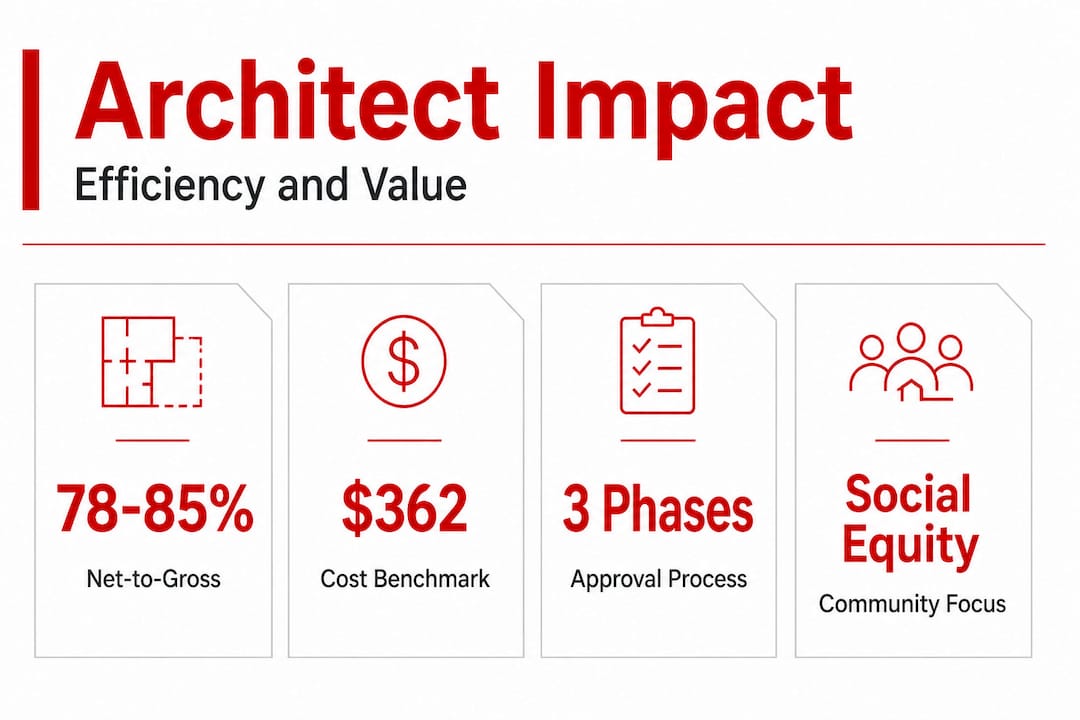
One of the clearest metrics developers should track is the net-to-gross ratio, which measures how much of a building's total floor area is actually leasable. A well-designed floor plate achieves net-to-gross ratios of 75 to 85%, with the central core (elevators, stairs, mechanical shafts) occupying just 20 to 25% of the floor plate. That ratio directly determines your revenue ceiling. Pair this with full compliance under IBC R-2 occupancy standards, FHA accessibility requirements, and ASHRAE energy baselines, and you have a project that is both profitable and defensible during permit review.
Cost benchmarks matter just as much. California's total development costs average $362 per net rentable square foot for market-rate projects, compared to $157 in Texas. That gap makes material selection and structural efficiency critical in a way that simply does not apply in other states. Architects who understand LA's cost environment will specify materials like mass timber, which reduces embodied carbon and can lower long-term operating expenses, rather than defaulting to conventional concrete and steel. Projects like Coliseum Place in Los Angeles have achieved an Energy Use Intensity (EUI) of 23, representing a 51% reduction compared to code-minimum baselines, by combining careful envelope design with passive ventilation strategies. That kind of outcome requires an architect who treats energy performance as a core design variable from day one, not an afterthought addressed by consultants at the end.
Studying residential best practices for LA homes shows that developers who engage architects early, before site acquisition in some cases, consistently outperform those who bring them in after deals are already structured.
Key efficiency benchmarks for LA multi-family projects:
- Net-to-gross ratio target: 75 to 85%
- Core zone allocation: 20 to 25% of floor plate
- California average total development cost: $362 per NRSF (market rate)
- Target EUI for sustainability-focused projects: below 30
- Typical ROI improvement from early schematic planning: 5 to 10%
| Metric | Baseline performance | Optimized performance |
|---|---|---|
| Net-to-gross ratio | 68 to 72% | 78 to 85% |
| Core zone share | 28 to 32% | 20 to 24% |
| Energy Use Intensity (EUI) | 47 to 55 | 22 to 30 |
| Total dev cost per NRSF (CA) | $390+ | $340 to $362 |
Pro Tip: Bringing your architect into schematic design before finalizing your financing structure lets them optimize the floor plate for your specific unit mix and funding source requirements. This single step can improve ROI by 5 to 10% by reducing wasted circulation area and aligning the unit count with LAHD affordability thresholds.
Navigating approvals: Design review and sustainability in Los Angeles
LA's approval process is not a formality. It is a structured, multi-phase evaluation where design quality is directly assessed. Many developers underestimate how much the design review process can either accelerate or delay a project, and that has real carrying cost implications.
Under LAHD's design review framework, projects go through three distinct phases of review: concept, schematic, and construction documents. Each phase has specific deliverable requirements, and sustainability scoring is mandatory across all of them. Failing to accumulate enough sustainability points at the concept stage does not just create a comment letter. It can require a full redesign at schematic, costing you weeks and tens of thousands of dollars.
Understanding what sustainability points are calculated on is essential. Points are awarded for features like solar-ready roof configurations, high-efficiency HVAC systems, bicycle storage, EV charging infrastructure, and materials with low embodied carbon. The system is additive, meaning you need a cumulative score that reflects genuine environmental commitment, not just minimum-code performance. The design review insights available from experienced LA architects show that projects with well-prepared concept packages consistently receive fewer revision cycles.
Common design review pitfalls to avoid:
- Submitting a concept package without a completed sustainability scoring worksheet
- Specifying exterior materials that conflict with neighborhood design guidelines
- Underestimating the number of required accessible units for your building type
- Ignoring setback and massing compatibility with adjacent historic structures
- Failing to address open space and pedestrian connectivity in the site plan
"Neighborhood compatibility is not just a box to check. In our experience, projects that genuinely respond to the scale, materials, and rhythm of their surrounding context move through design review significantly faster and encounter less community opposition during public hearings."
Looking at multi-family design options in Los Angeles reveals that developers who treat neighborhood compatibility as a competitive tool, rather than a bureaucratic hurdle, often secure approvals two to four months ahead of comparable projects that take a generic approach to site design.
Pro Tip: Review neighborhood design guidelines and any existing specific plans for your project area before your architect begins concept drawings. Resolving compatibility questions at the concept stage costs almost nothing. Resolving them after schematic submittal can cost a full redesign cycle.
Comparison: Traditional vs. sustainability-focused design review outcomes
| Factor | Traditional approach | Sustainability-focused approach |
|---|---|---|
| Average review cycles | 3 to 4 | 1 to 2 |
| Time to permit approval | 18 to 24 months | 12 to 16 months |
| Funding eligibility | Standard financing only | Access to LACDA and HCD incentive programs |
| Community opposition rate | Moderate to high | Low to moderate |
Designing for community: Social equity and interaction strategies
Efficiency and code compliance get you a buildable, fundable project. What they do not do is create a place where people choose to stay, build relationships, and take care of their environment. That outcome requires deliberate social design.
Architects working on LA's best affordable and mixed-income projects use shared spaces as what the field sometimes calls social condensers, meaning physical elements that draw residents together and generate informal interaction. Shared courtyards, exterior corridors, and rooftop decks, along with recreation rooms and green passages, have been shown to directly enhance resident well-being and social connection. These are not luxury amenities. They are retention tools that reduce vacancy and turnover.
Real LA projects back this up with concrete data. Mariposa at Avalon, Evermont, and Coliseum Place are frequently cited as examples where careful amenity placement and landscape design produced measurable improvements in resident satisfaction and neighborhood stability. In each case, the project team prioritized design benefits in LA that went beyond unit count and square footage to consider how residents would experience the full building.
Social design features and their measurable impact:
| Feature | Primary benefit | Secondary benefit |
|---|---|---|
| Central courtyard | Informal social interaction | Passive cooling and air quality |
| Rooftop deck | Recreation and gathering | Mental health and stress reduction |
| Green passages | Pedestrian connectivity | Biophilic well-being effects |
| Exterior corridors | Neighbor interaction | Natural ventilation |
| Shared recreation rooms | Programming and events | Youth development opportunities |
What separates high-performing projects from average ones is the integration of social and environmental goals into a single design move. A green passage that connects the courtyard to the street does triple duty: it provides open space credit under LA's zoning code, creates a pleasant pedestrian experience that raises the project's perceived value, and gives residents a reason to be outdoors and interact with neighbors. Smart architects design these layers of benefit into every major feature.
Key social equity strategies in LA multi-family projects:
- Locate amenity spaces at grade level for maximum accessibility
- Design for visual connectivity between common areas and unit entries
- Incorporate community garden plots in projects with family-oriented unit mixes
- Prioritize shade and seating in outdoor spaces to serve diverse age groups
- Use ground-floor retail or nonprofit tenants to activate the street edge
Innovating for resilience: LA's unique challenges and edge cases
LA presents conditions that you simply do not face in most other major markets. Wildfire risk, seismic exposure, historic district adjacency, and extreme cost pressure all converge on multi-family sites in ways that require architectural expertise, not just standard solutions applied from other regions.
Defensible space requirements, non-combustible landscaping, and perimeter fire systems are mandatory in fire-prone zones, and early review by the local fire authority is not optional if you want to avoid costly redesigns. After the 2025 LA wildfires, many developers discovered mid-construction that their landscaping specifications and building envelope details did not comply with updated fire authority guidance. Those corrections were expensive and time-consuming. The lesson is simple: fire authority pre-consultation needs to happen before schematic design is finalized, not after.
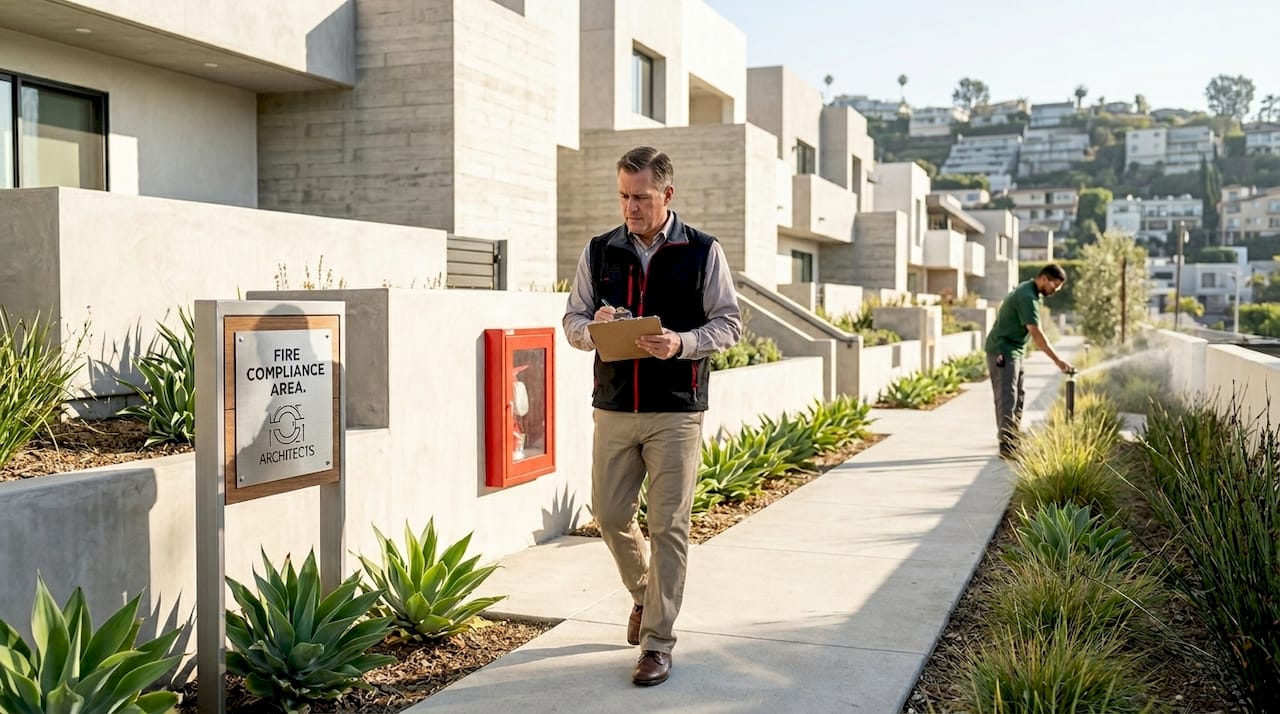
Seismic design adds another layer of complexity. Buildings in LA must meet stringent requirements under the California Building Code, and certain soil conditions, especially in hillside or near-fault locations, require site-specific geotechnical reports that influence foundation design. An architect who understands LA fire-safe design and seismic requirements simultaneously can structure a single design response that satisfies both, rather than handling them as separate, competing constraints.
Resilience design checklist for LA multi-family projects:
- Confirm fire hazard severity zone designation before site acquisition
- Specify non-combustible cladding materials for buildings in Very High Fire Hazard Severity Zones
- Design 100-foot defensible space with non-combustible planting within 30 feet of the structure
- Integrate perimeter fire suppression systems into the base building design
- Assess historic district adjacency for any site within a half-mile of a designated historic resource
- Plan value engineering reviews at 50% and 90% construction document stages
"Based on our experience in LA, the projects that handle fire risk, seismic requirements, and historic adjacency most successfully are the ones where the architect was empowered to raise these issues at the earliest possible stage, before the pro forma was locked and before schematic design created expensive path dependencies."
For detailed guidance on fire protection strategies in new construction, reviewing current compliance standards before design kick-off is time well spent.
Pro Tip: Request a pre-application meeting with the LA Fire Department before your architect completes schematic design. Fire departments in LA will often provide informal guidance on defensible space and suppression system requirements that can prevent costly revisions at the plan check stage.
Perspective: Why the best returns in LA multifamily projects come from bold, equity-driven design
Here is a perspective we hold firmly at FO+H, and it runs counter to what a lot of developers hear from financial advisors focused purely on cost containment: the projects that deliver the best long-term returns are not the ones that minimized design investment. They are the ones that treated architecture as a value-creation tool from the start.
We have watched developers cut design budgets to save $150,000 on a $25 million project, then spend twice that amount on change orders, redesign cycles, and delayed approvals. The math does not work in favor of under-investing in design. Equity-focused designs deliver better long-term outcomes, even when budgets are tight, by solving multiple problems simultaneously: energy performance, social resilience, and long-term maintainability addressed through a single coordinated design strategy.
Passive design strategies and biophilic elements are a good example of this principle in practice. Building in natural cross-ventilation, using thermally massive materials that reduce mechanical load, and adding plants and daylight to common areas do not just improve resident well-being. They reduce operating costs in ways that show up every month on your income statement for decades.
The uncomfortable truth is that some developers still see social equity goals as constraints on profitability rather than drivers of it. In LA's market, that perspective is becoming outdated. Residents in thoughtfully designed affordable and mixed-income projects stay longer, report higher satisfaction, and are more likely to recommend the building to others. That translates into lower vacancy, lower turnover costs, and stronger long-term asset performance.
At FO+H, we push developers to expand the brief: not just "how do we hit minimum sustainability points?" but "how do we create a building that multi-solves for energy, social connection, fire resilience, and community identity?" That broader question consistently leads to better projects. Explore LA multifamily perspectives that reflect this approach.
Partner with architectural experts to elevate your next LA project
If the frameworks in this article resonate with how you want to approach your next development, the next step is connecting with an architectural team that specializes in exactly this work. FO+H Architects brings deep experience in LA's regulatory environment, social equity-focused design, and multi-family project delivery.
Whether you are exploring ADU and duplex plans for a smaller infill site or developing a larger affordable or market-rate multi-family project, we have resources and expertise tailored to LA's specific conditions. Our team works with developers from feasibility through construction documents, with a focus on efficiency, compliance, and community value. Visit fostudiodesign.com to browse our project gallery, review our services, and get in touch with our team about your next project.
Frequently asked questions
How do architects increase ROI in LA multi-family projects?
They optimize floor plate efficiency by targeting net-to-gross ratios of 75 to 85% and choose materials that reduce long-term operating costs while integrating social amenities that raise desirability and support higher rents.
What is required for sustainable design approval in Los Angeles?
Projects must accumulate a minimum sustainability score and demonstrate neighborhood compatibility across all three LAHD design review phases: concept, schematic, and construction documents.
How do architects foster social equity in affordable housing?
They incorporate features like courtyards, recreation rooms, and green spaces that encourage resident interaction, reduce isolation, and support well-being across diverse household types.
What special considerations apply for multi-family developments in fire-prone LA zones?
Projects require defensible space, fire-resistant landscaping, and perimeter suppression systems, with early fire authority review needed before schematic design is finalized to avoid costly late-stage corrections.
Are passive design strategies cost-effective for LA multi-family projects?
Yes, passive and biophilic design approaches reduce mechanical system loads, lower operating costs, and improve resident well-being, delivering measurable life-cycle savings even in budget-constrained affordable housing projects.