

TL;DR:
- Building resilience in LA requires fire-resistant materials, seismic upgrades, and adaptable roadmaps.
- Policy volatility demands flexible designs that anticipate future code changes and environmental threats.
- Incorporating passive house principles and electrification ensures long-term safety and compliance.
Los Angeles is one of the most geologically active, fire-prone, and climate-exposed metro areas in the United States. The January 2025 wildfires alone destroyed more than 12,000 structures across the region, and seismic events remain a constant risk with the city sitting on multiple active fault systems. If you are planning a new build, a rebuild, or a major renovation, waiting until threats materialize is not a strategy. The decisions made at the design stage either protect your investment for decades or leave it vulnerable to the next disaster.
Table of Contents
- Assessing LA's main risks and requirements
- Essential features and materials for resilience
- Designing adaptable and defensible buildings
- Building electrification and code compliance
- Navigating LA's rebuild policies and incentives
- A smarter take: What most plans miss about true resilience
- Next steps: Build smart with expert plans
- Frequently asked questions
Key Takeaways
| Point | Details |
|---|---|
| Target LA’s main risks | Focus on wildfires, earthquakes, and climate volatility to ensure your building plan’s resilience. |
| Use proven resilient materials | Choose fire-resistant and energy efficient components to save on repairs and energy bills. |
| Design for adaptability | Flexible layouts and defensible spaces prepare your building for future threats and changing needs. |
| Comply with evolving codes | Stay informed on LA and California code updates, especially for electrification and rebuild policies. |
| Leverage city incentives | Utilize LA’s rebuild programs for faster, more cost-effective upgrades and expansions. |
Assessing LA's main risks and requirements
After understanding the stakes, let's map out the specific risks and rules you must address before starting your plans.
Los Angeles presents a unique combination of threats that no single code cycle fully captures. Fire, seismic activity, flooding, and rapid policy shifts all demand attention at the drawing board stage. Approaching resilient architecture in LA without a clear threat inventory often leads to costly redesigns mid-project or serious gaps in protection.
| Hazard type | Mitigation requirement | Code/policy notes |
|---|---|---|
| Wildfire | Fire-resistant materials, defensible space | LA Fire Hazard Severity Zone maps updated 2023 |
| Seismic activity | Enhanced foundations, energy-absorbing structural systems | CBC Chapter 16, LA Soft-Story Ordinance |
| Flooding/sea level rise | Elevated structures, permeable landscaping | FEMA flood map zone compliance |
| Policy shifts | Flexible systems, electrification readiness | Title 24, LA Green New Deal |
Common developer mistakes we see include ignoring newly updated fire hazard maps, relying on older soils reports that do not reflect current seismic data, and designing all-electric systems just before policy reversals create compliance uncertainty.
Common planning mistakes to avoid:
- Assuming last year's fire map still applies to your parcel
- Failing to commission a site-specific geotechnical report before foundation design
- Selecting mechanical systems that do not anticipate all-electric mandates
- Overlooking how dense lot coverage limits setback and defensible space options
Non-combustible materials like fire-resistant roofing, stucco, Type X gypsum, concrete, and metal studs are now baseline requirements in LA's high-risk zones, not upgrades. Meanwhile, seismic reinforcements including enhanced foundations and energy-absorbing structural elements, along with elevated structures for flood protection, must be integrated from day one. Policy volatility adds another layer. When LA's all-electric mandate faced partial reversal, projects that had locked in rigid system designs paid significant costs to course-correct.
Essential features and materials for resilience
Now that you know what you're protecting against, let's detail the features and materials that actually future-proof your building.
Material selection is where plans translate into performance. Choosing modern resilient materials correctly can mean the difference between a structure that survives a 100-foot flame front and one that ignites from ember cast alone.
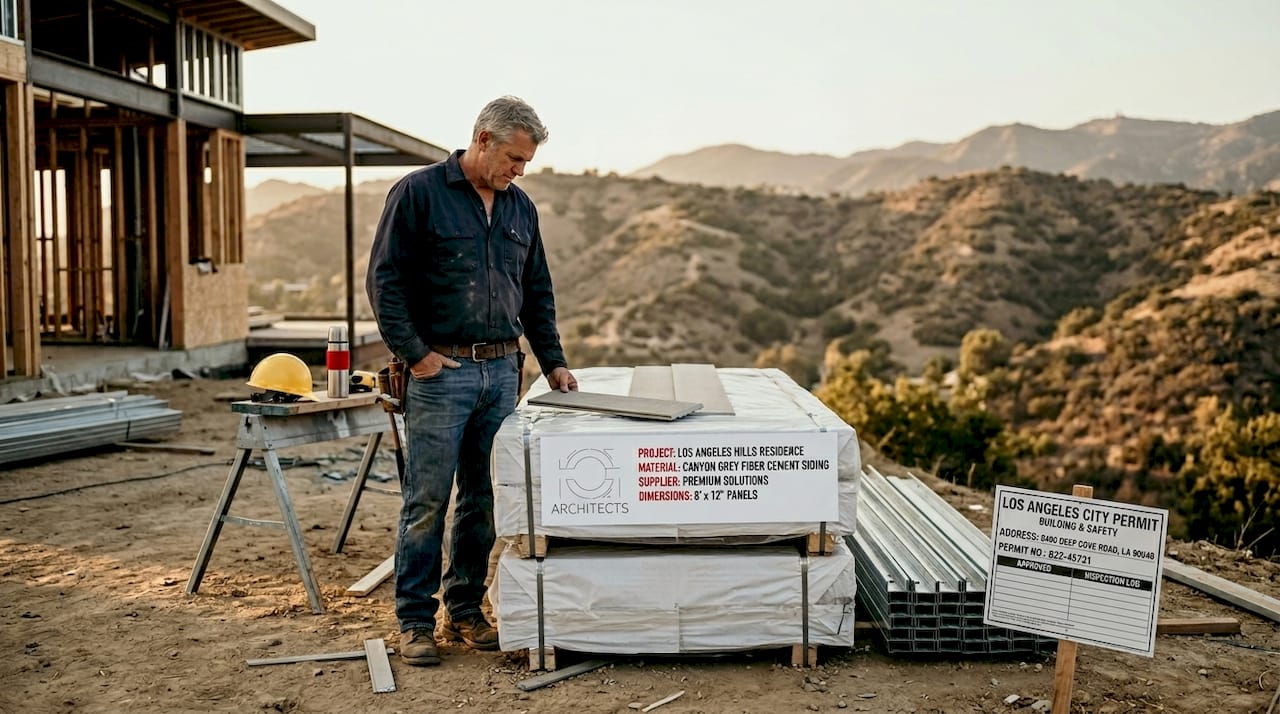
Fire-resistant exterior material comparison:
| Material option | Fire rating | Key benefit | Cost level |
|---|---|---|---|
| Fiber cement siding | Class A | Non-combustible, low maintenance | Moderate |
| Stucco over metal studs | 1-hour rating | Seamless ember resistance | Low to moderate |
| Concrete block/CMU | 2-hour or higher | Superior fire and seismic mass | Higher |
For roofing, Class A asphalt shingles or concrete tile are the minimum in fire zones. Any roof with exposed rafter tails, open eaves, or wood soffits creates points where embers can ignite. Sealing all these penetrations with non-combustible materials at the design stage is far cheaper than correcting them during construction.
Seismic upgrades that matter most:
- Foundation anchor bolts and hold-downs at shear walls
- Cripple wall bracing for raised foundations
- Moment frames or shear panels for soft-story conditions
- Base isolation for high-value or critical structures
Passive House principles offer a powerful secondary layer of resilience alongside fire and seismic protection. Passive House standards call for airtight envelopes, triple glazing with U-values between 0.8 and 1.0 W/m²K, wall insulation at U=0.15, ground floor insulation at U=0.11, heat pumps, and energy recovery ventilators (ERVs). These features do more than cut utility bills. An airtight envelope keeps wildfire smoke out during events. High-insulation walls and windows reduce HVAC load during heat emergencies when grid power may be compromised. ERVs maintain indoor air quality without opening windows into smoky conditions.
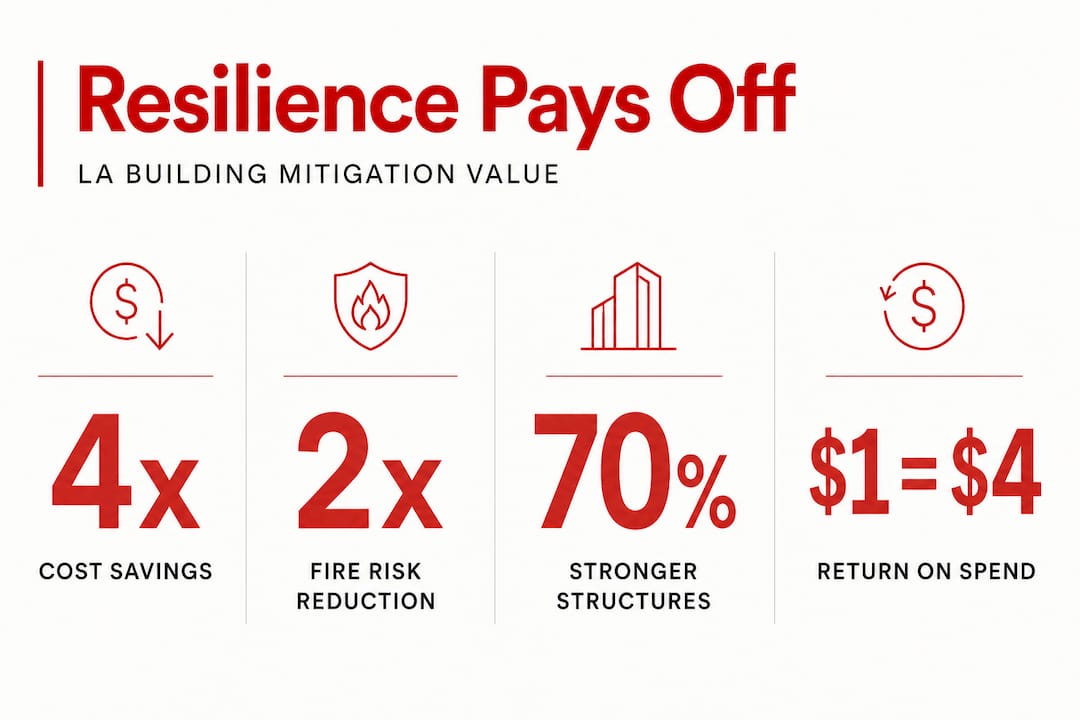
Research consistently shows that every $1 spent on hazard mitigation saves approximately $4 in future repair and recovery costs. That is not a rounding error. For a $1.5 million residential project, allocating $75,000 to resilience features could prevent $300,000 in future losses.
Pro Tip: In fire zones, prioritize simple rooflines with no overhanging eaves and specify 1-hour rated exterior walls throughout. Complex rooflines and decorative eaves create ember traps that standard fire ratings do not fully address.
You can also explore purpose-built anti-fire building plans designed specifically for LA's fire-prone conditions, which already incorporate the material specifications and rated assemblies described above.
Designing adaptable and defensible buildings
With your material choices dialed in, it's time to plan layouts that defend and adapt to future threats and needs.
Defensible space is a code requirement in LA fire hazard zones, but too many plans treat it as an afterthought. The layout of your site, structure, and landscaping directly determines whether fire or emergency vehicles can access and defend your property.
Zone 0 (the 5-foot perimeter immediately around the structure) must be completely free of combustible materials, including mulch, wood furniture, and gas meters in unprotected locations. Structure-to-structure separation matters too. Defensible space design principles recommend keeping ADUs and accessory structures far enough apart to prevent fire transfer, using native low-fuel landscaping throughout zones 1 and 2.
Steps to achieve flexibility and fire/earthquake safety together:
- Start with the site plan. Map out the 5-foot Zone 0 clearance, set structure separation distances, and orient the main entry away from prevailing fire-weather wind directions.
- Design the structural grid for openness. Use a column or shear wall grid that allows interior partitions to be reconfigured without touching the lateral system.
- Pre-plan utility corridors. Locate electrical, plumbing, and data conduit in wall and floor chases that allow expansion or system upgrades without opening finished surfaces.
- Incorporate secondary egress. Every bedroom and multi-use zone should have a secondary path out, both for fire evacuation and for seismic events that may block primary entries.
- Specify movable partition systems in live/work or mixed-use areas to allow the space to adapt to future use types without a permit-triggering renovation.
- Design for future ADU conversion. Pre-plumb and pre-wire garage or studio spaces so a future ADU can be added without a full gut renovation.
Exploring flexible interior design trends and ADU flexibility concepts gives you a stronger picture of how adaptable layouts are currently being executed across LA projects.
Important: Tight lots in LA often cannot achieve the full recommended setback distances through landscaping alone. In these cases, 1-hour fire-rated exterior wall assemblies and non-combustible cladding become your primary line of defense. Design for this from the start, not as a late-stage workaround.
Pro Tip: Pre-plan utility corridors in your floor plan. Reserving space for future mechanical, electrical, and data runs in accessible chases costs very little at the design stage but allows major upgrades, including battery storage or EV charging, without tearing open finished walls.
Building electrification and code compliance
Modern resilient buildings also need to meet California's and LA's ambitious energy and electrification goals.
California has set some of the most aggressive building electrification targets in the country. Title 24, the state's energy code, already requires solar photovoltaic systems on all new low-rise residential construction. As of 2023, California mandates solar and battery storage for new commercial buildings. LA's own decarbonization plan sets targets for converting existing buildings to all-electric systems at scale, with an 80-buildings-per-year conversion target among the near-term goals.
What your building plans should include for electrification compliance:
- Heat pump water heaters to replace gas-fired systems
- Air-source or ground-source heat pumps for space conditioning
- Solar PV system sized to cover baseline loads, with dedicated conduit for future array expansion
- Battery storage capable of operating critical loads (refrigeration, lighting, medical equipment) for a minimum of 4 hours during an outage
- High-efficiency electric HVAC with variable-speed compressors to reduce peak demand
- EV charging rough-in at parking spaces, even if chargers are not installed initially
- Sub-metering for separate dwelling units or tenant spaces to track consumption accurately
Title 24 compliance documentation must be submitted with permit applications, and inspectors are increasingly rigorous about performance verification at final inspection. Getting this right at the design stage prevents costly change orders during construction.
Pro Tip: All-electric systems are not just about emissions compliance. They also protect you from gas price volatility and position the building well if LA strengthens its decarbonization ordinances further. A well-designed electrification package adds measurable resale value and significantly reduces long-term operating costs.
Navigating LA's rebuild policies and incentives
Finally, here's how LA policy can work for you, unlocking rebuild and upgrade incentives while ensuring compliance.
If your property was affected by the 2025 wildfires, or if you are planning a rebuild on a previously improved lot, LA has created a series of streamlined pathways and financial incentives designed to accelerate reconstruction while maintaining safety standards.
Steps to access LA's rebuild incentives:
- Confirm your parcel's eligibility. Properties within declared fire disaster zones qualify for expedited review. Check your parcel against the city's published hazard area list.
- Engage a licensed architect for self-certification. LA's wildfire rebuild program allows architects to self-certify compliance with prior code provisions, which significantly shortens the plan check timeline.
- Apply for fee waivers early. Plan check, permit, and inspection fees may be waived or reduced for fire rebuild projects. Submit the fee waiver request with your initial application, not as an afterthought.
- Maximize footprint expansion. Under current LA policy, rebuilds can expand up to 110% of the original structure's footprint using the pre-fire building code as the baseline. This is a significant opportunity to add usable square footage.
- Submit before deadline. Fee waivers and expedited review apply to permits submitted within specific time windows. The current target for initial permit issuance is a 30-day review cycle for qualifying submittals, with a program deadline of 2032 for final completion.
| Incentive type | Eligibility criteria | Key deadline/target |
|---|---|---|
| Self-certification by architect | Fire-affected parcel, licensed architect of record | Per project application |
| 110% footprint expansion | Prior code compliance, same parcel | Permit by 2032 |
| Fee waiver | Declared disaster zone parcel | Submit at permit application |
| Expedited permit review | Qualifying wildfire rebuild submittal | 30-day review target |
Pro Tip: The 110% footprint allowance under pre-fire codes is one of the most underutilized opportunities in LA's rebuild program. Working with your architect to maximize this expansion from day one adds real estate value that far exceeds the incremental design and construction cost.
A smarter take: What most plans miss about true resilience
In our experience working on residential and ADU projects across LA, the most common gap is not a failure to comply with current code. It's a failure to anticipate what comes next. Plans that pass today's plan check can still be fundamentally fragile if they were designed around last year's fire map, last cycle's seismic data, or a policy environment that has already shifted.
Many resilient-labeled building plans do nothing more than check the current code minimums. But code minimums are, by definition, reactive. They reflect past events, not the ones coming. The edge cases that actually determine survival are often ignored: complex rooflines that trap embers, tight lots that cannot meet setback standards without fire-rated wall substitutions, and all-electric provisions that were specified just before a policy reversal created compliance ambiguity.
Policy volatility is the new normal in LA. Any design that is deeply dependent on a single policy framework, whether that is a specific electrification rule or a particular zoning allowance, is a fragile design. True future-proofing means building in flexibility so that the structure can adapt as rules change without requiring a wholesale redesign.
The architects and developers who navigate this best are the ones who treat custom residential solutions as a starting point for adaptability, not just aesthetic preference. They design with the next code cycle in mind. They specify systems that exceed current minimums so that when minimums rise, no remediation is needed. They think about what the building will need to be in 2040, not just 2026.
Bottom line: true future-proofing is adaptability, not just compliance. A building that meets today's code but cannot flex to meet tomorrow's rules or survive tomorrow's threats is not resilient. It is just temporarily compliant.
Next steps: Build smart with expert plans
Now that you know what makes building plans last, here's how you can put these strategies into action with expert help.
At FO+H Architects, we design every residential, ADU, and multi-family project with LA's specific threat landscape and policy environment in mind. Our plans already incorporate fire-resistant assemblies, flexible structural grids, and electrification readiness so that you are not retrofitting compliance after the fact.

Browse our ready-to-adapt ADU and duplex plans to see how pre-vetted designs can accelerate your permit timeline while meeting current fire, seismic, and energy requirements. For properties in high-risk fire zones, our purpose-built anti-fire ADU plans deliver compliant, tested assemblies that are ready for LA's toughest conditions. Reach out for a consultation to discuss code navigation, incentive maximization, and custom design strategies tailored to your parcel and goals.
Frequently asked questions
How do I make my building plan wildfire-resistant in LA?
Specify non-combustible materials including fire-resistant roofing, stucco, Type X gypsum, and metal studs, and establish a clean 5-foot Zone 0 perimeter around all structures per current city requirements. Sealing all roof and wall penetrations with rated assemblies is equally important.
What is the minimum seismic standard for new buildings in Los Angeles?
New plans must follow the California Building Code Chapter 16 and LA-specific amendments, which require energy-absorbing foundations and structural systems such as shear walls, hold-downs, and in some cases moment frames designed for the site's specific seismic hazard classification.
Are there incentives for rebuilding after fire in LA?
Yes. LA's wildfire rebuild program allows self-certification, footprint expansion up to 110% of the original structure, waived permit fees, and a 30-day expedited review target for qualifying submittals within declared disaster zones.
What is a Passive House, and should I consider it?
A Passive House uses an airtight envelope, triple glazing and high insulation, heat pumps, and energy recovery ventilators to drastically cut energy use while also keeping wildfire smoke out and maintaining indoor comfort during grid outages. For LA future-proofing, it is one of the strongest available frameworks.
How do LA energy and electrification codes affect building plans?
Title 24 and LA's decarbonization plan require solar, battery storage, and efficient electric HVAC systems in all new construction, with documentation submitted at permit and verified at final inspection. Designing for these requirements from the start avoids costly mid-construction changes.