

TL;DR:
- Residential architecture in LA emphasizes personalization, comfort, and community integration beyond basic construction.
- Key principles include adaptability, indoor-outdoor flow, sustainability, and addressing unique local zoning challenges.
- The process involves early site analysis, zoning review, design development, permitting, and active construction oversight.
Many homeowners assume residential architecture is simply about picking a floor plan and choosing finishes. That assumption misses the bigger picture entirely. Residential architecture is a design discipline that shapes how you live, how you connect with neighbors, and how your home fits into the broader fabric of Los Angeles. Residential architecture prioritizes personalization, comfort, and lifestyle in ways that commercial design never needs to consider. In this guide, we'll clarify what residential architecture actually means, walk through the principles that matter most in LA, and give you practical strategies to move forward with confidence.
Table of Contents
- Defining residential architecture: More than building homes
- Core principles in residential architecture for Los Angeles
- Design strategies: Enhancing lifestyle and community
- Applying residential architecture: Process and practical considerations
- How Los Angeles rewrites the rules of residential architecture
- Explore custom residential architecture solutions with FO Studio
- Frequently asked questions
Key Takeaways
| Point | Details |
|---|---|
| Residential vs. commercial | Residential architecture focuses on personal comfort, lifestyle, and community values, not just structures. |
| LA zoning opportunities | Los Angeles zoning setbacks offer design chances for outdoor spaces and creative layouts. |
| Sustainable requirements | Title 24 in LA drives innovative energy-efficient home solutions for homeowners. |
| Architect-led approach | Working with an architect streamlines the residential design-build process and reduces costly errors. |
| Lifestyle-driven design | Modern residential architecture in LA enhances lifestyle by creating flexible, inclusive, community-focused spaces. |
Defining residential architecture: More than building homes
Now that we've debunked myths about residential architecture, let's define exactly what it is and how it relates to your environment.
Residential architecture is the design discipline focused on creating homes and living spaces that serve personal comfort, reflect lifestyle values, and strengthen community bonds. It goes well beyond drawing walls on a page. It considers how natural light moves through a room, how a family gathers in a kitchen, and how a front porch signals welcome to a neighborhood. Personalization is the core of residential work, which is what separates it fundamentally from commercial architecture.
Commercial architecture prioritizes efficiency, code compliance for large occupancies, and operational flow. Residential architecture, by contrast, asks a different set of questions: How does this family live? What does comfort mean to them? How do spaces support daily routines and long-term wellbeing?
Here's a quick comparison to clarify the distinction:
| Feature | Residential architecture | Commercial architecture |
|---|---|---|
| Primary focus | Lifestyle and comfort | Efficiency and throughput |
| Scale | Individual or small group | Large occupancy |
| Personalization | High | Low to moderate |
| Community impact | Neighborhood character | Business district function |
| Key regulations | Zoning, setbacks, Title 24 | ADA, occupancy, fire codes |
In Los Angeles, residential architectural choices carry outsized weight. Roughly 78% of LA's zoned land is designated for single-family use, meaning the homes built here define the character of entire communities. The way a home sits on a lot, orients toward the street, or integrates outdoor space shapes the neighborhood experience for everyone.
Key ways residential architecture shapes LA neighborhoods:
- Street presence: Setbacks and facade design influence how walkable and welcoming a block feels.
- Density: Thoughtful ADU integration adds housing without disrupting neighborhood scale.
- Sustainability: Energy-efficient homes reduce neighborhood-wide utility strain.
- Cultural expression: Design details reflect the diverse communities that make LA distinctive.
Understanding why design matters in residential architecture helps you see your home not as an isolated project but as a contribution to the larger urban fabric. For practical guidance specific to the LA context, reviewing residential architecture tips for local homes is a strong starting point.
Core principles in residential architecture for Los Angeles
Having defined residential architecture, let's explore its key principles and how these uniquely apply in Los Angeles.
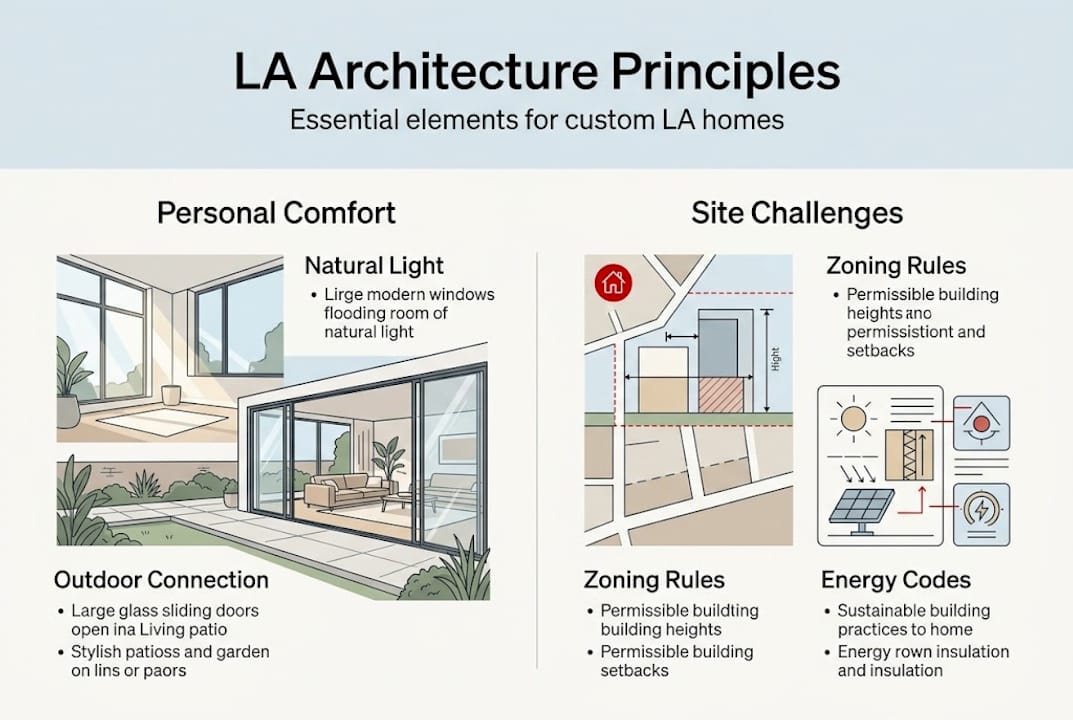
Every strong residential project is built on a set of guiding principles. In LA, those principles are shaped by climate, regulation, and the city's extraordinary diversity of lifestyles.
The five core principles we apply:
- Personalization: Every design decision should reflect the specific way a client lives, not a generic template.
- Comfort: Thermal comfort, acoustic quality, and spatial proportion all contribute to how a home feels day to day.
- Social spaces: Homes need to support gathering, whether that's a large family dinner or a quiet conversation between two people.
- Sustainability: LA's Title 24 energy standards require architects to use energy modeling and simulation tools that older methods simply can't match.
- Continuity: From concept through construction, consistent design leadership prevents costly miscommunication.
Title 24 is California's building energy efficiency standard, and it's one of the most demanding in the country. It covers insulation, glazing performance, mechanical systems, and lighting. Meeting it well requires early integration of energy modeling into the design process, not a last-minute compliance check.
Zoning setbacks, the required distances between a structure and property lines, are often seen as restrictions. In LA, setbacks become outdoor rooms when approached creatively. A required front setback becomes a planted entry garden. A side setback becomes a shaded breezeway. This reframing is central to how we approach LA residential work.
On the question of team structure, architect-led design-build consistently outperforms fragmented project teams. When the designer and builder are aligned from day one, decisions are faster, errors are fewer, and the final result more closely matches the original vision.
Pro Tip: Review current architecture trends in LA before your first consultation. Knowing what's possible in your neighborhood helps you ask better questions and set realistic expectations. You can also explore a typical design workflow for LA homes to understand how the process unfolds from start to finish.
Design strategies: Enhancing lifestyle and community
Once you understand the principles, it's essential to see how residential architecture translates into real strategies for living well and connecting in Los Angeles.
Good residential design doesn't just solve problems. It creates conditions for a better life. The strategies below reflect what we've seen work consistently in LA projects.
Lifestyle-driven design strategies:
- Flexible spaces: Rooms that adapt to changing needs, a home office that converts to a guest room, serve families better over time.
- Indoor-outdoor transitions: LA's climate makes this a high-value investment. Sliding glass walls, covered patios, and connected garden spaces extend usable square footage without adding built area.
- Multi-generational planning: Designing for grandparents, adult children, or caregivers within the same property is increasingly common and requires intentional spatial separation alongside connectivity.
- Communal areas: Shared courtyards or common outdoor spaces in multi-family settings build neighbor relationships organically.
For hillside properties, which are common across LA's canyons and foothills, early site assessment is not optional. Hillside builds require geotechnical analysis early in the process to avoid costly structural overruns later. Soil stability, drainage, and access all affect design feasibility before a single line is drawn.
"The best residential architecture doesn't announce itself. It simply makes daily life feel easier, more connected, and more meaningful."
Courtyard planning is another LA-specific strategy worth highlighting. A well-placed courtyard creates a private outdoor room that serves as the heart of a home, shielding it from street noise while encouraging family gathering. It also satisfies setback requirements creatively, turning regulatory constraints into design assets.
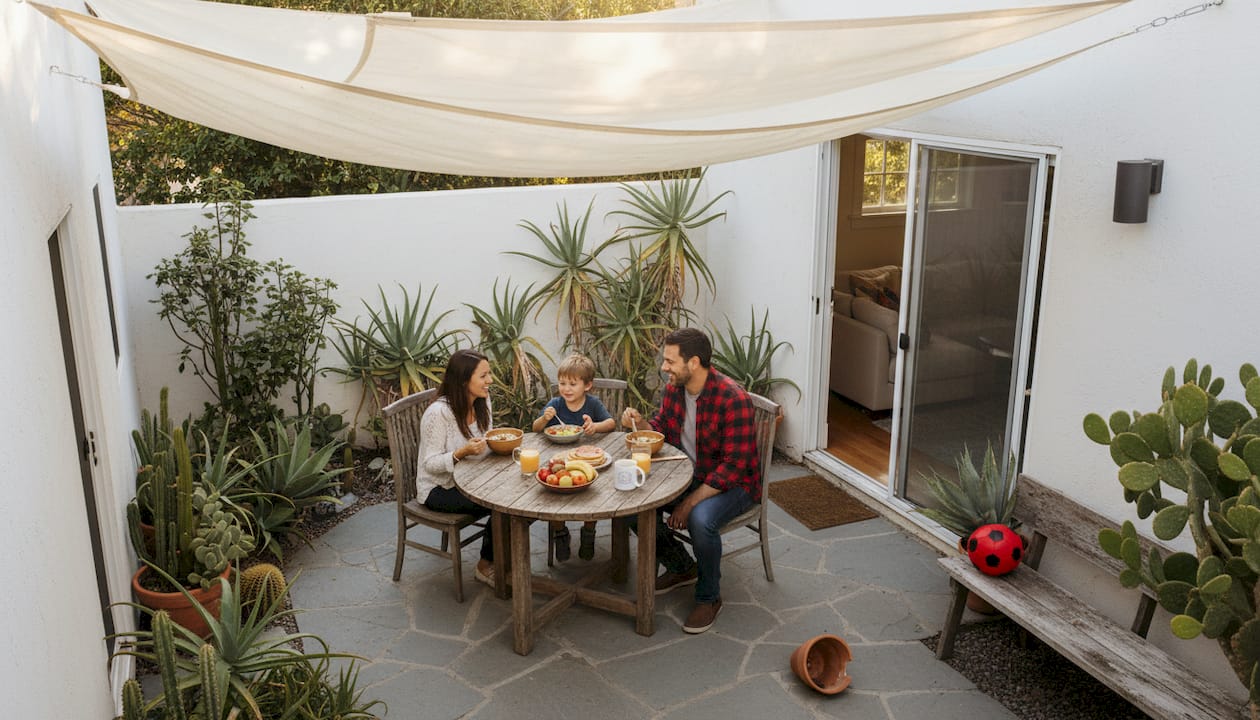
Pro Tip: When optimizing LA home layouts, prioritize the relationship between indoor and outdoor spaces first. That decision shapes every other layout choice downstream.
For those interested in how architecture supports broader community goals, exploring sustainable community homes offers useful context. You'll also find inspiration in innovative LA home design ideas that reflect 2026's most forward-thinking approaches.
Applying residential architecture: Process and practical considerations
With design strategies in mind, let's break down the practical process of bringing residential architecture to life in Los Angeles.
Knowing what good design looks like is one thing. Knowing how to get there is another. Here's the step-by-step process we follow with clients:
- Step 1: Initial consultation. We discuss your goals, lifestyle, budget, and timeline. This sets the foundation for every decision that follows.
- Step 2: Site analysis. We assess the property's orientation, topography, existing structures, and access. For hillside sites, this includes geotechnical review.
- Step 3: Zoning and feasibility review. We confirm what's permitted on your lot, including setbacks, height limits, allowable square footage, and ADU potential.
- Step 4: Schematic design. We develop initial concepts that respond to your goals and site conditions, presenting options for your feedback.
- Step 5: Design development and documentation. We refine the chosen direction and produce construction documents, including Title 24 energy compliance documentation required for LA permitting.
- Step 6: Permitting. We submit to the relevant LA agencies and manage the review process, responding to any correction requests.
- Step 7: Construction administration. We stay involved during construction to ensure the built result matches the design intent.
LA-specific challenges you should anticipate include hillside grading requirements, fire hardening standards in high-risk zones, and the time investment of Title 24 compliance. None of these are obstacles when you plan for them. They become obstacles only when they're discovered late.
Pro Tip: Engage your architect before you finalize a property purchase. Understanding the role of architects in early feasibility review can save you from buying a lot that doesn't support your vision.
For further reading on modern design for LA homes and how inclusive residential design can transform both homes and communities, we've covered both topics in depth.
How Los Angeles rewrites the rules of residential architecture
Having seen the process and strategies, let's examine how Los Angeles is changing what residential architecture means for the rest of the country.
Most cities treat zoning setbacks as hard limits. In LA, we've learned to treat them as invitations. The 78% single-family zoning that covers most of the city isn't a restriction on creativity. It's a canvas for it. When nearly every lot follows the same rules, the architects who find opportunity within those rules define what the city looks like.
LA is also a live testing ground for sustainability in residential design. Title 24 pushes every project to integrate energy performance from the first sketch, not as an afterthought. That discipline produces better buildings and forces architects to develop skills that are increasingly relevant everywhere.
What I find most compelling about working in LA is that the city's lifestyle diversity demands genuine personalization. A hillside home in Silver Lake, a courtyard compound in Boyle Heights, and a multi-generational residence in the San Fernando Valley each require a fundamentally different design response. Generic solutions don't survive here. That pressure makes LA architects better at their craft.
Exploring LA architecture trends reveals just how quickly the city's residential design vocabulary is evolving in response to these pressures.
Explore custom residential architecture solutions with FO Studio
If you're inspired by LA's unique approaches to residential architecture, see how FO Studio's solutions can help you realize your vision.
At FO+H Architects, we work with homeowners and developers across Los Angeles to create residential spaces that reflect real lives and real communities. Whether you're exploring an ADU addition or planning a full custom home, we have solutions scaled to your goals. Browse our Blue ADU ideas for compact, efficient designs or review Gold ADU plans for expanded options with greater flexibility. For full custom residential projects, visit our custom LA house plans page to connect with our team and explore what's possible on your property.
Frequently asked questions
What is the difference between residential and commercial architecture?
Residential architecture prioritizes personalization, comfort, and lifestyle, while commercial architecture focuses on operational efficiency and accommodating large numbers of users within regulated occupancy frameworks.
What are LA-specific challenges in residential architecture?
Los Angeles requires careful attention to zoning setbacks, hillside soil conditions, and Title 24 energy compliance, all of which directly affect project feasibility, timeline, and design decisions.
How does residential architecture enhance community values?
Thoughtful design creates shared spaces, supports multi-generational living, and builds inclusivity into the structure of a home, offering both private comfort and natural opportunities for neighbor connection.
What steps are involved in starting a residential architecture project in LA?
The process moves through consultation, site analysis, zoning review, schematic design, permitting, and construction administration, with architect-led continuity at each stage reducing errors and keeping the project aligned with your original goals.