

TL;DR:
- A structured five-phase workflow guides LA home design, ensuring control, cost savings, and permit readiness.
- Early architect hiring and clear decisions on style, sustainability, and budget set project success.
- Prioritizing personalized, community-responsive design over maximum square footage enhances long-term satisfaction.
Designing a custom home in Los Angeles carries a unique set of pressures. Local zoning codes, neighborhood character requirements, and high construction costs all add layers of complexity before a single wall goes up. Many homeowners feel overwhelmed before the process even begins, unsure of who to hire first or what decisions to make when. The good news is that a clear, structured residential design workflow removes the guesswork. When you understand each phase and your role in it, the project becomes manageable and genuinely rewarding. This guide walks you through every step, from early goal-setting to construction oversight, so you can steer your project toward a result that truly fits your life.
Table of Contents
- Understanding the residential design workflow
- Preparation: Key decisions and assembling your team
- Step-by-step through the five design workflow phases
- Integrating sustainability and community values into your project
- Troubleshooting, verification, and ensuring design success
- Why personalization and community matter more than square footage
- Ready to begin your LA home design journey?
- Frequently asked questions
Key Takeaways
| Point | Details |
|---|---|
| Five-phase workflow | Following a structured design workflow helps deliver projects on time and on budget. |
| Early team assembly | Hiring your architect first sets a strong foundation for project vision and coordination. |
| Personalized, sustainable design | Prioritizing sustainability and community values creates homes that truly fit LA lifestyles. |
| Step-by-step verification | Carefully reviewing every design phase can prevent costly mistakes and ensure satisfaction. |
Understanding the residential design workflow
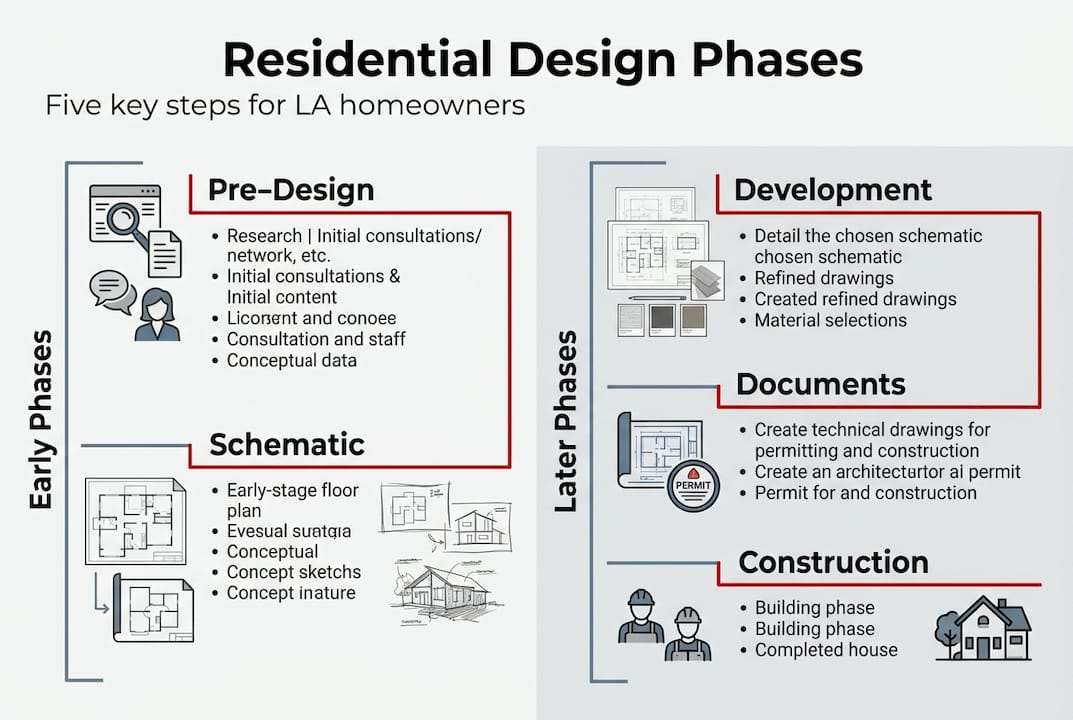
Before you review a single floor plan, it helps to know the full road ahead. The standard architectural design phases follow the American Institute of Architects (AIA) model, which organizes residential projects into five sequential phases. Each phase has a specific purpose, a defined set of deliverables, and a point where you, the homeowner, review and approve progress before the team moves forward.
Here is a quick overview of all five phases:
| Phase | Purpose | Key deliverable |
|---|---|---|
| Pre-Design | Define goals, analyze site and regulations | Program document, site analysis |
| Schematic Design | Develop preliminary concepts and layouts | Concept drawings, massing studies |
| Design Development | Refine systems, materials, and details | Coordinated drawings, specifications |
| Construction Documents | Produce detailed plans for permits and bidding | Full permit-ready drawing set |
| Construction Administration | Oversee build for design intent | Site visits, responses to RFIs |
Understanding this structure helps you stay actively engaged rather than passively waiting for updates. You will know when to ask questions, when to push for more design iterations, and when a decision is truly final.
The architect's role in residential projects goes well beyond drawing pretty pictures. Architects coordinate structural engineers, Title 24 energy consultants, and mechanical systems designers. They also navigate the Los Angeles Department of Building and Safety (LADBS) plan check process, which can add weeks or months if documents are incomplete.
Key benefits of following the phased workflow include:
- Controlled decision-making: You address major choices at the right time, not all at once.
- Fewer costly changes: Revisions made during Schematic Design cost a fraction of changes made during Construction Documents.
- Permit readiness: Each phase builds toward a complete, code-compliant drawing set.
- Better contractor bids: Detailed Construction Documents attract more accurate and competitive bids.
For LA homeowners interested in high-performance home design, the phased workflow also creates natural checkpoints to integrate energy modeling, passive cooling strategies, and resilient materials before the design is locked in.
Preparation: Key decisions and assembling your team
Understanding the big picture is helpful, but success starts with getting your own team and vision ready. This preparation phase happens before or alongside Pre-Design, and the choices you make here set the tone for everything that follows.
The single most important early decision is hiring your architect first. Many homeowners make the mistake of hiring a contractor first, then bringing in design help later. This limits your options and often results in a generic outcome. LA home architects can help you evaluate your site, clarify your budget range, and identify zoning constraints before you commit to any design direction.
You will also want to decide early whether you prefer a traditional phased approach or an integrated design-build model. Here is how they compare:
| Factor | Traditional phased | Design-build |
|---|---|---|
| Flexibility | High, more homeowner control | Lower, decisions made faster |
| Speed | Slower, sequential phases | Faster, overlapping phases |
| Cost transparency | Bids after documents complete | Early cost input from builder |
| Customization | Maximum | Moderate |
For most LA homeowners seeking a truly personalized result, the traditional phased approach gives you more control over design quality and community fit.
Before your first architect meeting, work through these key decisions:
- Style and character: What architectural language fits your neighborhood and your personal taste?
- Sustainability goals: Are you targeting net-zero energy, solar readiness, or specific green certifications?
- Resilience priorities: In Los Angeles, fire resistance and flood readiness are increasingly critical design factors.
- Community context: How does your home relate to adjacent properties, street presence, and shared open space?
- Budget and timeline: Establish a realistic range early so your architect can right-size the design scope.
Pro Tip: Use the AIA Find an Architect directory to identify licensed professionals with verified residential experience in Los Angeles. Look for portfolios that show projects in your neighborhood type, not just impressive one-offs.
Step-by-step through the five design workflow phases
Once your team and vision align, the real step-by-step work begins. Here is what to expect and do at each phase.
-
Pre-Design: Your architect conducts a site analysis, reviews zoning regulations, and documents your goals in a written program. Your job is to be thorough and honest about how you live. Do not hold back details about daily routines, storage needs, or future family changes.
-
Schematic Design: The team produces preliminary floor plans, elevations (exterior drawings showing building faces), and massing studies. Review these carefully. This is your best opportunity to redirect the design without significant cost. Request at least two or three concept variations before settling.
-
Design Development: Systems are coordinated here, including structural, mechanical, electrical, and plumbing. Materials and finishes are selected. Do not skip your review meetings during this phase. Decisions made here directly affect your Construction Documents.
-
Construction Documents: Your architect produces the full permit-ready drawing set. This includes detailed plans for bidding and LADBS plan check submission. Avoid requesting major design changes at this stage. They are expensive and delay permitting.
-
Construction Administration: Your architect visits the site regularly, reviews contractor submittals, and responds to Requests for Information (RFIs). Stay engaged. Attend key site visits and flag concerns early.
For more context on how each phase connects to your daily life, our posts on modern LA architecture tips and why design matters offer practical perspective.
Budget warning: In Los Angeles, permit plan check timelines at LADBS can run 3 to 6 months for over-the-counter projects and longer for complex cases. Factor this into your overall schedule from day one. Surprises here are the most common cause of project delays and budget overruns.
Pro Tip: Before each architect meeting, write down your top three questions or concerns. This keeps meetings focused and ensures you leave with clear answers rather than vague reassurances.
Integrating sustainability and community values into your project
Beyond the logistics, the greatest LA projects weave sustainability and personal values into every choice. This is not just about adding solar panels. It is about designing a home that fits its place, performs well over decades, and reflects who you are as a member of your community.
High-performance homes in LA increasingly prioritize restraint and right-sizing over maximum square footage. A well-designed 1,800-square-foot home that is properly oriented, insulated, and ventilated will outperform a poorly designed 3,000-square-foot home in comfort, energy costs, and long-term resilience.
Sustainable design priorities to discuss with your architect include:
- Right-sizing: Build what you actually need, not the maximum the zoning allows.
- Energy efficiency: Passive solar orientation, high-performance windows, and proper insulation reduce utility costs significantly.
- Resilient materials: Fire-resistant cladding, non-combustible roofing, and ember-resistant vents are increasingly essential in LA's wildland-urban interface zones.
- Water management: Permeable paving, greywater systems, and drought-tolerant landscaping address LA's ongoing water challenges.
- Material sourcing: Locally sourced or recycled materials reduce embodied carbon and support regional industries.
Personalization and community fit are equally important. The AIA guidance on assembling your team early emphasizes that homes reflecting individual lifestyles and community context produce higher homeowner satisfaction over time. That means your design should respond to your specific microclimate, your street's character, and your household's rhythms.
Our work on sustainable community homes, optimizing layouts for lifestyle, and inclusive architecture shows how these values translate into real design decisions at every scale.
Troubleshooting, verification, and ensuring design success
Even the best workflows can veer off-course. Here is how to course-correct before small issues become expensive problems.
At each phase, verify the following:
- Pre-Design: Does the program document accurately capture your goals, lifestyle, and budget? Are zoning constraints clearly identified?
- Schematic Design: Do the floor plans reflect how you actually live? Does the exterior character fit your neighborhood?
- Design Development: Are all systems coordinated? Have you reviewed material samples and confirmed costs with your contractor?
- Construction Documents: Are the drawings complete enough for LADBS plan check? Has your contractor reviewed them for constructability?
- Construction Administration: Is your architect visiting the site at critical milestones? Are RFIs being answered promptly?
Common red flags to watch for include: your architect missing scheduled reviews, contractors requesting frequent design clarifications, or permit submissions being returned with extensive corrections. These are signs of coordination gaps that need immediate attention.
The five AIA phases are designed to catch errors early, but only if you stay actively involved. Do not assume everything is on track. Ask for written phase summaries and milestone sign-offs.
Here is a quick reference for best practices in design verification:
| Phase | Best practice | Warning sign |
|---|---|---|
| Pre-Design | Written program approved by you | Vague goals, no site analysis |
| Schematic Design | Multiple concepts reviewed | Only one option presented |
| Design Development | Cost estimate updated | No contractor input on costs |
| Construction Documents | Permit submitted on schedule | Repeated plan check rejections |
| Construction Admin | Regular site visits documented | Architect absent from site |
For additional context on how urban sustainable housing projects handle these verification steps, our blog covers real project examples from the LA region.
Why personalization and community matter more than square footage
In our experience working with LA homeowners, the projects that generate the most lasting satisfaction are rarely the largest ones. They are the ones where the design genuinely fits the family's life and contributes something meaningful to the street and neighborhood.
High-performance residential design research supports this directly. Homes that prioritize right-sizing, resilience, and energy restraint consistently outperform oversized homes in livability and long-term value. We have seen clients choose to reduce their square footage by 15 percent in order to invest in better materials, stronger fire resistance, and outdoor spaces that actually connect to the neighborhood. Years later, they tell us it was the best decision they made.
The pressure to maximize every buildable square foot is real in Los Angeles, but it often works against why design matters in the first place. A home that fits your life, responds to its climate, and belongs in its community will serve you far better than one that simply fills the lot. That is the standard we hold ourselves to, and the one we encourage every homeowner to apply.
Ready to begin your LA home design journey?
If you are ready to put these strategies into action, expert help can make all the difference. At FO+H Architects, we guide LA homeowners through every phase of the residential design workflow, from early goal-setting to construction oversight, with a focus on personalized, community-sensitive results.
Whether you are planning a primary residence, an ADU addition, or a multi-family project, our team has the experience to move your vision forward efficiently. Explore our Blue ADU plans and Gold ADU designs for ready-to-permit starting points, or visit our main site to browse house plans with ADU options tailored to Los Angeles lots. Reach out to schedule a consultation and let us help you build something that truly belongs.
Frequently asked questions
What are the five phases of the residential design workflow?
The five AIA phases are Pre-Design, Schematic Design, Design Development, Construction Documents, and Construction Administration. Each phase builds on the last and includes specific homeowner review and approval steps.
How early should I hire an architect for my LA home project?
Hire your architect as early as possible, ideally before you finalize your budget or purchase a lot. Early architect involvement helps you avoid costly site or zoning surprises and ensures your entire team is coordinated from the start.
What is the difference between design-build and traditional phased workflow?
Design-build is faster but offers less flexibility, since design and construction decisions overlap. The traditional phased approach gives homeowners more control over customization and design quality at each milestone.
How does sustainability influence residential design in Los Angeles?
Sustainability in LA homes shapes decisions around right-sizing, energy efficiency, fire-resistant materials, and water management. These priorities are increasingly standard practice, not optional add-ons, given the region's climate and wildfire risks.