

TL;DR:
- Affordable housing in Los Angeles is increasingly designed with thoughtful, integrated solutions that ensure quality, safety, and affordability.
- Rigorous adherence to federal, state, and local standards, along with cost-effective strategies like modular construction, enhance project viability and resident well-being.
Affordable housing in Los Angeles carries a reputation it doesn't deserve. Many homeowners and developers assume that "affordable" automatically means cramped spaces, cheap finishes, and buildings that look out of place in established neighborhoods. That assumption is outdated. Across LA, architects and developers are proving that thoughtful, integrated design can deliver housing that is genuinely affordable for residents, financially viable for developers, and genuinely good to live in. This article breaks down what affordable housing design actually involves, what standards shape it, and how local innovations are raising the bar.
Table of Contents
- Defining affordable housing design: Key principles and standards
- Cost-effective design strategies: Integrated solutions for lasting affordability
- Accessibility and universal design: Meeting HUD guidelines and local expectations
- Los Angeles requirements: Fair housing, unit sizing, and amenity comparisons
- Innovative delivery approaches: Prefab, modular, and small-lot solutions
- What most people miss about affordable housing design
- Next steps: Explore affordable housing design solutions with FO Studio
- Frequently asked questions
Key Takeaways
| Point | Details |
|---|---|
| Integrated approach is essential | Affordable housing design thrives when site, performance, and accessibility are considered as a system. |
| Local rules drive features | Los Angeles requirements dictate unit sizing, amenity access, and quality for affordable developments. |
| Cost and quality can coexist | Smart design strategies help reduce costs without sacrificing livability or long-term resident outcomes. |
| Innovation accelerates delivery | Prefab and modular construction methods are speeding up project timelines while maintaining quality. |
Defining affordable housing design: Key principles and standards
Before we can talk strategy, we need to agree on what affordable housing design actually means. It is not simply a category of "cheaper buildings." Affordable housing design is a set of planning, architectural, and operational choices intended to deliver homes that remain financially affordable while still meeting performance, safety, and resident-quality goals.
Affordability is typically measured in relation to income. The standard benchmark used by federal and most local programs is that housing costs should not exceed 30% of a household's gross monthly income. When housing costs push past that threshold, a household is considered "cost-burdened." In Los Angeles, where median rents run significantly above the national average, a large portion of residents qualify for income-restricted housing programs at various Area Median Income (AMI) levels, which are income thresholds set annually by the federal government.
Affordable housing design operates within a layered set of rules:
- Federal requirements: Programs administered by HUD (the U.S. Department of Housing and Urban Development) and funded through the Low-Income Housing Tax Credit (LIHTC) come with design, accessibility, and quality standards that apply regardless of local preferences.
- State standards: California adds its own overlay of Title 24 energy requirements, the California Building Code, and state fair housing law.
- Local requirements: The City of Los Angeles adds zoning requirements, design guidelines, and affordability covenants that set specific expectations for units, amenities, and resident rights.
"Affordable housing design is a set of planning, architectural, and operational design choices intended to deliver homes that remain financially affordable while meeting performance, safety, and resident-quality goals."
One of the most common misconceptions we encounter is that affordable housing is designed to a lower standard. In practice, the opposite is often true. Because affordable projects depend on long-term funding, public approvals, and community acceptance, they face more scrutiny than typical market-rate developments. Exploring multi-family housing options in LA makes clear how design quality is increasingly a baseline expectation, not a bonus.
Cost-effective design strategies: Integrated solutions for lasting affordability
Reducing the cost of affordable housing is not simply about using less expensive materials. The most successful projects use what the industry calls integrated design, meaning every system in the building is planned as part of a coordinated whole rather than added one piece at a time. Integrated design for affordable housing consistently reduces both construction costs and the ongoing utility costs that residents pay every month, with some DOE-reported projects achieving energy savings of up to 50%.
Here is how integrated cost strategy typically works in practice:
- Site planning and orientation: Positioning a building to maximize natural light and cross-ventilation reduces the size of mechanical systems needed. A well-oriented building in LA's climate can passively condition interior spaces for a significant portion of the year.
- High-performance building envelope: Investing more in insulation, high-quality windows, and air sealing reduces HVAC loads. This allows smaller, less expensive HVAC equipment to handle the load effectively.
- Right-sized mechanical systems: Modular HVAC units, mini-splits, and heat pump water heaters are smaller, easier to install, and more efficient than traditional systems, lowering both installation and operating costs.
- Material and finish strategies: Using durable, low-maintenance finishes in common areas and units reduces long-term operating costs without sacrificing quality at move-in.
- Construction efficiency: Standardizing unit layouts and structural grids reduces waste, labor hours, and coordination errors during construction.
| Strategy | Upfront cost impact | Long-term savings |
|---|---|---|
| Enhanced insulation and envelope | Moderate increase | High: reduced HVAC load |
| Mini-split or heat pump HVAC | Comparable or lower | High: energy efficiency |
| Standardized unit layouts | Lower: fewer custom details | Moderate: less labor, less waste |
| High-durability finishes | Moderate increase | High: reduced maintenance |
| Solar and battery systems | Higher upfront | High: utility cost offset |
Pro Tip: Do not wait until the design is nearly complete to run energy modeling. Running it in the schematic design phase lets you resize systems early and avoid expensive change orders later.
Building designs that integrate sustainable community features into the early phases of planning consistently outperform projects that try to add efficiency measures after the structural decisions are already made.

Accessibility and universal design: Meeting HUD guidelines and local expectations
Accessibility is not optional in affordable housing. Under federal fair housing law, Section 504 of the Rehabilitation Act, and the Americans with Disabilities Act, accessibility in HUD-assisted housing must be integrated as a core design requirement, not treated as a checklist item added after the design is otherwise complete.
For most affordable housing projects receiving federal funding, at least 5% of units must be fully accessible for residents with mobility impairments, and an additional 2% must be accessible for residents with visual or hearing impairments. Beyond those minimums, the concept of "visitability" sets a broader standard: all ground-floor units should allow a person using a wheelchair to visit comfortably, even if the unit is not fully accessible.
Common accessibility features that must be planned from the start include:
- Wider doorways: A minimum clear width of 32 to 36 inches for passage doors.
- Roll-in showers or accessible bathing: At least one accessible bathroom per qualifying unit.
- Lever-style hardware: Lever handles on doors and faucets instead of round knobs, which can be difficult to operate for residents with limited grip strength.
- Accessible routes: Ramps, zero-step entries, and compliant path widths throughout common areas.
- Lowered counters and controls: In accessible units, counters, light switches, and electrical outlets must fall within the accessible reach range.
Avoiding costly mistakes with HUD accessibility guidelines is a persistent challenge when accessibility is left to late-stage review. At that point, what should have been a straightforward design decision becomes an expensive structural or layout change. Early coordination between the architect, the accessibility consultant, and the developer is the most reliable way to prevent those problems.
Pro Tip: If you are planning an affordable housing project in Los Angeles, hire an accessibility consultant during schematic design, not during plan check. Catching conflicts early saves far more than the cost of the consultation fee.
Understanding how architects shape community value in multi-family settings underscores why accessibility planning is not just a compliance exercise. It directly affects whether a building feels welcoming and functional for all residents over the long life of the project.
Los Angeles requirements: Fair housing, unit sizing, and amenity comparisons
Los Angeles has its own set of requirements that shape how affordable housing is designed and delivered at the local level. If you are developing a project in the city, these rules affect unit size, bedroom configuration, amenity access, and what level of finish difference is actually permitted between affordable and market-rate units.
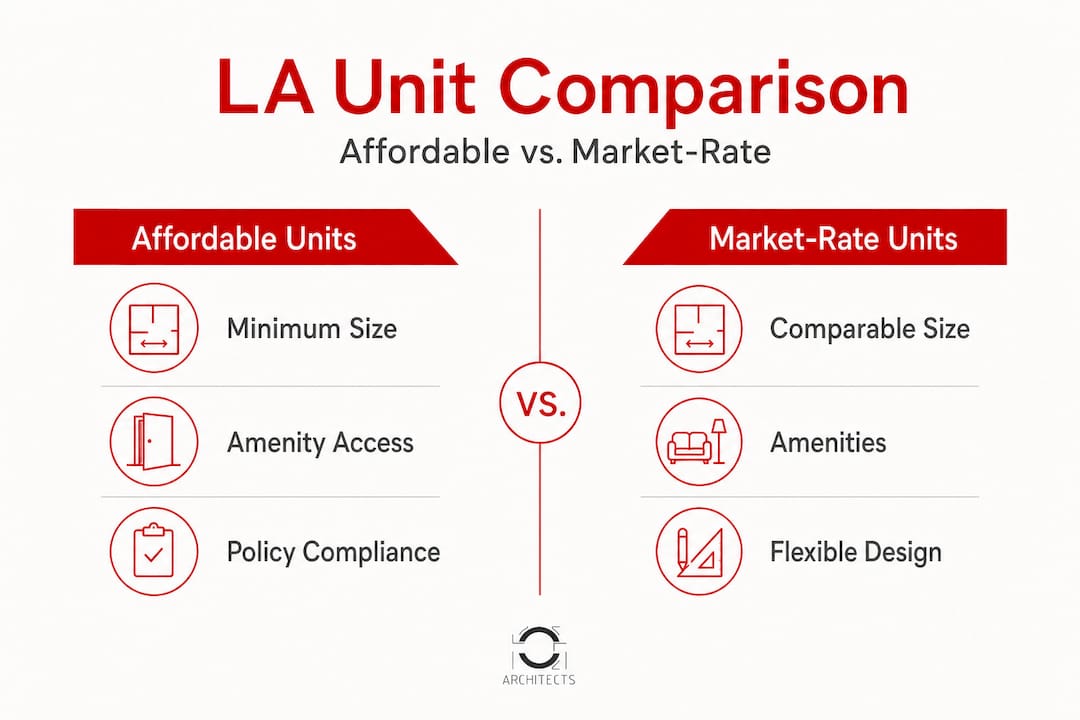
According to LA City fair housing requirements, affordable units in a mixed-income building must meet specific comparability standards. These include unit sizing, bedroom mix proportionality, and access to common amenities.
Key comparability requirements in Los Angeles:
- Unit size: Affordable units must be at least 90% of the square footage of comparable market-rate units. You cannot shrink affordable units to meet cost targets while market-rate units remain generous.
- Bedroom mix: The proportion of one, two, and three-bedroom units among affordable units must reasonably reflect the overall bedroom mix in the project, preventing developers from concentrating affordable units in the smallest unit type.
- Amenity access: Affordable residents must have access to the same amenities as market-rate residents, including fitness rooms, rooftop decks, laundry facilities, and community rooms. Separate entrances or restricted amenity access for affordable residents is not permitted.
- Finish differences: The primary area where affordable and market-rate units may differ is interior finishes. Affordable units may use standard-grade cabinetry, appliances, and flooring while market-rate units include upgrades, but the gap cannot compromise durability or basic function.
| Feature | Affordable units | Market-rate units |
|---|---|---|
| Minimum unit size | 90% of comparable market-rate unit | Baseline |
| Amenity access | Full access required | Full access |
| Bedroom mix | Must reflect project-wide proportions | Developer discretion |
| Interior finishes | Standard grade permitted | Upgraded finishes common |
| Entry and lobbies | Must be equivalent or shared | Equivalent or upgraded |
Reviewing current residential architecture trends in LA shows that many developers are actually choosing to minimize the finish difference between affordable and market-rate units, recognizing that a visually cohesive building performs better in the community and reduces stigma for residents.
Innovative delivery approaches: Prefab, modular, and small-lot solutions
One of the most exciting shifts happening in Los Angeles affordable housing right now is in how projects are actually built, not just designed. LOHA's modular affordable housing projects demonstrate how prefab and modular delivery methods are solving some of the city's toughest site and cost challenges, including the Berkeley Station project where units were installed in approximately three days each.
Prefab and modular construction works particularly well for affordable housing because:
- Consistency: Factory-built components maintain tighter tolerances than on-site framing, reducing the variation that leads to callbacks, punch list items, and post-occupancy issues.
- Speed: Modules can be fabricated while site preparation is underway, compressing the overall schedule significantly.
- Cost predictability: Factory production reduces exposure to labor cost fluctuations and weather delays.
- Quality control: Inspections happen in a controlled environment before units leave the factory.
Small-lot typologies and "kit-of-parts" systems represent another layer of innovation suited to LA's challenging urban sites. These approaches use standardized structural and architectural components that can be configured differently for each site, preserving design flexibility while capturing the efficiency of repetition.
Key advantages of modular and kit-of-parts approaches:
- Shortened construction timelines by 20 to 40% compared to conventional stick-frame construction
- Reduced on-site labor needs, which matter in LA's high-cost construction labor market
- Lower waste generation, contributing to sustainability goals
- Easier phasing for multi-building affordable housing campuses
Staying current with modern ADU design inspirations shows how the same modular thinking that works for large affordable housing projects is scaling down to single-lot ADU solutions, opening new options for homeowners who want to add affordable units to their properties. Understanding residential development best practices in LA reinforces how delivery method decisions made early in the process shape project outcomes from budget to resident satisfaction.
What most people miss about affordable housing design
Based on our experience working on residential and multi-family projects across Los Angeles, the most common mistake we see is treating affordability as a single dial to turn down. In reality, successful affordable housing balances two distinct levers: optimizing unit cost directly through compact typologies and finish strategies on one side, and investing in higher-performance systems that lower operating costs for residents on the other. Projects that pull only one of those levers tend to underperform.
When a project focuses exclusively on shrinking unit sizes and cheapening finishes to hit a cost target, residents often end up in spaces that feel diminished, difficult to maintain, and costly to operate due to utility bills. When a project focuses only on high-performance systems without attention to unit design and amenity quality, it can overshoot the construction budget without meaningfully improving the resident experience.
The projects we find most compelling in Los Angeles are the ones that treat design quality and cost discipline as compatible goals. That requires early decisions, integrated teams, and a willingness to push back when value engineering comes for the wrong line items. It also means understanding that the ADU plan check process and broader affordable housing permitting share the same underlying lesson: the more clearly you understand the requirements before design begins, the fewer expensive corrections you face at the end.
Los Angeles, with its mix of ambitious local policy, state mandates, federal funding programs, and genuinely innovative local firms, is doing something worth paying attention to nationally. The city is not just building more affordable housing. It is rethinking how affordable housing gets designed and delivered at every scale.
Next steps: Explore affordable housing design solutions with FO Studio
If you are a homeowner or developer in Los Angeles thinking about your next affordable housing project, the design decisions you make at the very start will shape everything that follows: your budget, your timeline, your community relationships, and the quality of life for residents.
At FO Studio, we work with clients across LA to design housing that is both financially viable and genuinely livable. Our ADU Store offers ready-to-customize plans built specifically for the LA market, including the Blue ADU for homeowners looking for an efficient, affordable starter unit, and the Gold ADU plan for those ready to maximize space and performance. Whether you are adding a single affordable unit to your property or planning a larger multi-family development, we are ready to help you navigate the process with confidence.
Frequently asked questions
What makes affordable housing design different from standard home design?
Affordable housing design prioritizes cost controls and compliance with specific program requirements while aiming to deliver comparable quality, safety, and accessibility for residents. The key difference is the added layer of regulatory requirements and income restrictions that shape every design decision from unit size to finish selection.
How do LA requirements shape affordable housing unit designs?
In Los Angeles, affordable units must be comparable in size and amenity access to market-rate units in the same project, with only limited differences permitted in interior finishes. This means developers cannot offset affordability by delivering significantly smaller or lower-quality units for income-restricted residents.
Are modular or prefab solutions truly more cost-effective for affordable housing?
Yes, modular and prefab approaches have demonstrated measurably faster build times and stronger cost predictability, with LA projects like Berkeley Station showing how rapid unit installation is achievable without sacrificing livability or design quality.
Why is early planning for accessibility so important in affordable housing design?
Late-stage accessibility redesigns are among the most avoidable and expensive problems in affordable housing development. Integrating accessibility requirements from schematic design onward prevents structural conflicts that become extremely costly to correct once construction documents are underway.