

TL;DR:
- Flexible floor plans enhance space efficiency and adaptability, reducing environmental impact.
- Low-tech solutions like sliding doors are cost-effective and easier to maintain long-term.
- Proper testing and local code knowledge are essential for successful flexible designs in Los Angeles.
Most homeowners assume that a well-designed home is one with defined rooms, clear boundaries, and a fixed purpose for every space. That assumption is costly. Traditional static layouts often leave 15 to 20 percent of square footage underused at any given time, and they make it nearly impossible to adapt when life circumstances shift. Flexible floor plans offer a direct solution, and research backs this up: flexible designs reduce environmental impact by up to 20 percent overall and by as much as 60 percent during construction and end-of-life phases, largely because adaptable buildings simply last longer and require less intervention over time. If you're a homeowner or developer in Los Angeles, understanding how flexible planning works could be one of the most important decisions you make for your property.
Table of Contents
- What are flexible floor plans?
- Top benefits of flexible layouts for Los Angeles homes
- Common pitfalls and design considerations
- How to apply flexible floor plans in your project
- Our take: flexible doesn't mean complicated or expensive
- Ready to unlock your home's full potential?
- Frequently asked questions
Key Takeaways
| Point | Details |
|---|---|
| Adapt to changing needs | Flexible plans allow your home or property to evolve as family or business demands shift. |
| Maximize usable space | Designs that eliminate unused or underutilized areas offer more value per square foot. |
| Lower environmental impact | Empirical studies show flexible homes use less material and energy over time compared to static layouts. |
| Prioritize simple solutions | Low-tech features often offer greater longevity, cost-efficiency, and ease of use in flexible design. |
What are flexible floor plans?
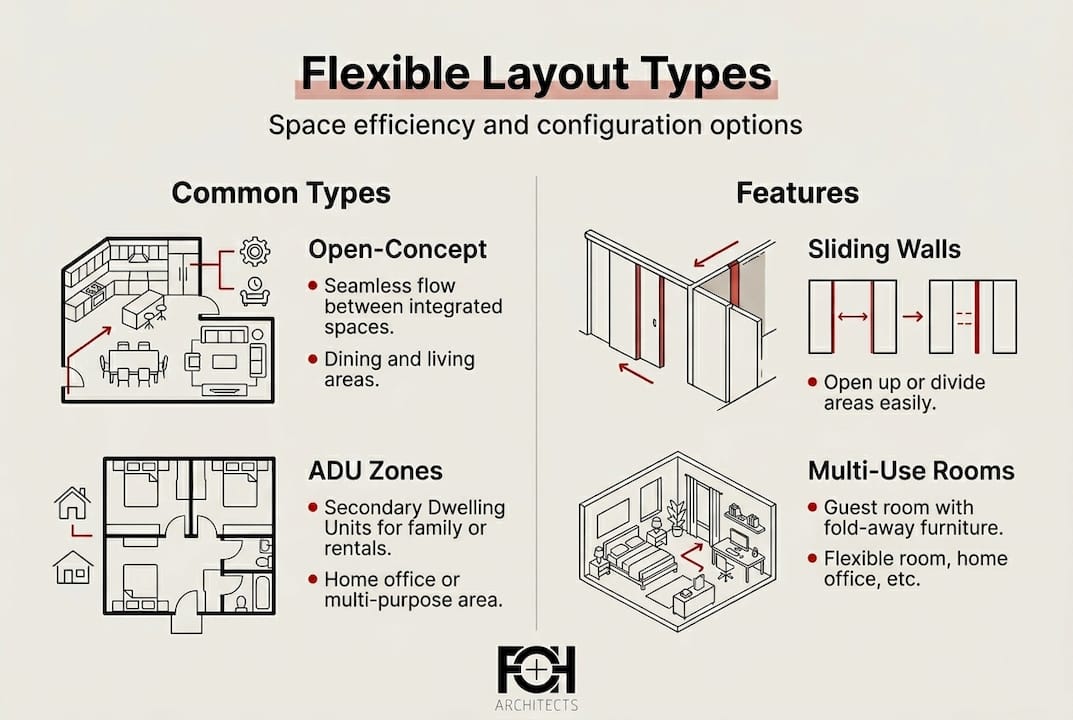
Flexible floor plans are residential or mixed-use layouts specifically designed to allow spaces to be reconfigured, repurposed, or expanded over time without major structural changes. The key distinction from conventional static layouts is intentional. Where traditional designs lock in the function of each room at the point of construction, flexible layouts treat function as something that will evolve.
The core design elements that make this possible include:
- Minimal load-bearing interior walls, which eliminates structural barriers to reconfiguration
- Sliding or folding partitions, allowing rooms to expand or contract depending on the occasion
- Integrated and concealed storage, which keeps multipurpose rooms from feeling cluttered
- Wide doorway openings and corridor-free zones, improving circulation flexibility
- Convertible built-ins, such as murphy beds, fold-down desks, or retractable kitchen islands
When architects optimize LA home layouts with these principles in mind, the results are spaces that can transition from a home office to a guest room, or from an open living area to a defined dining zone, without a single nail being driven.
Common types of flexible layouts include open-concept living areas, ADUs with convertible interior zones, and multi-use rooms that serve double or even triple duty. Each of these approaches applies the same underlying principle: design the space to serve people across multiple life stages, not just the first year of occupancy.
Space efficiency by layout type
| Layout type | Typical efficiency range | Key driver |
|---|---|---|
| Open-concept residential | 80% to 88% | Reduced corridor area |
| Traditional compartmentalized | 70% to 78% | Fixed wall allocation |
| ADU with flexible zones | 82% to 90% | Dual-function design |
| Multi-family flexible | 77% to 85% | Shared circulation zones |
Research on space efficiency in residential buildings shows that well-designed residential units achieve efficiency ratios between 77.8 and 87.9 percent, with an average of around 83 percent depending on structure type and circulation design. Flexible layouts consistently sit at the upper end of that range when done correctly.
Top benefits of flexible layouts for Los Angeles homes
Now that you understand the basics, let's look at why flexible layouts are gaining traction so quickly across Los Angeles. The city's housing market is unlike most others in the country. Lot sizes are constrained, construction costs are high, and the demand for multi-generational living, rental income, and adaptable space is stronger here than almost anywhere else in the United States.
The main benefits for LA homeowners and developers include:
- Higher value per square foot. When every room can serve more than one purpose, you effectively get more functional space without adding more square footage. In a market where land and construction costs are premium, that efficiency translates directly to property value.
- Adaptability across life stages. A spare bedroom becomes a home office, which later becomes a nursery, and eventually a rental suite. Flexible layouts accommodate all of those shifts without costly renovations.
- Environmental performance. Flexible designs reduce environmental impact by up to 20 percent compared to static layouts, largely because they extend the functional lifespan of the building and reduce the need for demolition or gut renovations.
- Strong rental and investment potential. Developers in LA are increasingly building convertible units that can function as single-family homes or be subdivided into income-generating spaces.
- Multi-generational compatibility. LA has one of the highest rates of multi-generational households in the country. A flexible layout can accommodate an aging parent today and a returning adult child tomorrow.
Space efficiency stat: Flexible residential units consistently achieve space efficiency ratios of 82 to 90 percent, compared to 70 to 78 percent for traditional compartmentalized layouts. That gap represents significant functional gain in any market.
Comparison: flexible vs. static layouts
| Feature | Flexible layout | Static layout |
|---|---|---|
| Reconfiguration without renovation | Yes | No |
| Space efficiency | 82% to 90% | 70% to 78% |
| Environmental impact reduction | Up to 20% lower | Baseline |
| Long-term maintenance cost | Lower with low-tech options | Higher over decades |
| Rental conversion potential | High | Low to moderate |
Pro Tip: When evaluating a property or a new build in LA, calculate not just the square footage but the usable and reconfigurable square footage. That number tells you far more about the long-term value you're getting.
Exploring sustainable community home designs alongside flexible planning can amplify both the efficiency gains and the environmental benefits, particularly for developments that aim for long-term community integration.
Common pitfalls and design considerations
Despite their benefits, flexible layouts require a thoughtful approach. Here's what you should keep in mind before making decisions, because getting this wrong can erase all the benefits you're hoping to gain.
1. High-tech solutions are not always the best answer. Motorized walls, sensor-controlled partitions, and automated room systems sound appealing on paper. In practice, high-tech sensor systems increase ongoing maintenance burdens and energy consumption, and they are not always durable or code-compliant over a full building lifespan. A sliding barn door or a well-placed folding partition will often outlast and outperform a motorized alternative by decades.
2. Fire codes and building regulations in California impose real limits. Not all movable or modular partition systems meet the fire separation requirements mandated under California's Title 24 or local LA building codes. This is especially relevant for ADUs or multi-family units where fire ratings between dwelling units are strictly regulated. Before designing around a specific partition system, confirm its fire-rating certification with your architect.
3. Flexibility doesn't mean no privacy. One of the most common complaints from homeowners who move into open-plan layouts is the lack of acoustic and visual privacy. An open floor plan that can't be properly zoned when needed creates frustration rather than freedom. Good flexible design includes options for closing off spaces, not just opening them.
4. Think about long-term maintenance costs upfront. Specialized modular systems and complex mechanical components add maintenance costs that compound over years. A sliding panel requires minimal upkeep. A motorized glass partition with integrated smart-home connectivity requires ongoing software updates, mechanical servicing, and eventual replacement of electronic components.
"Flexibility in residential architecture is most effective when it serves real, documented needs, not speculative ones. Designing for imagined future scenarios often leads to costly systems that real users never fully utilize." — Building Design World
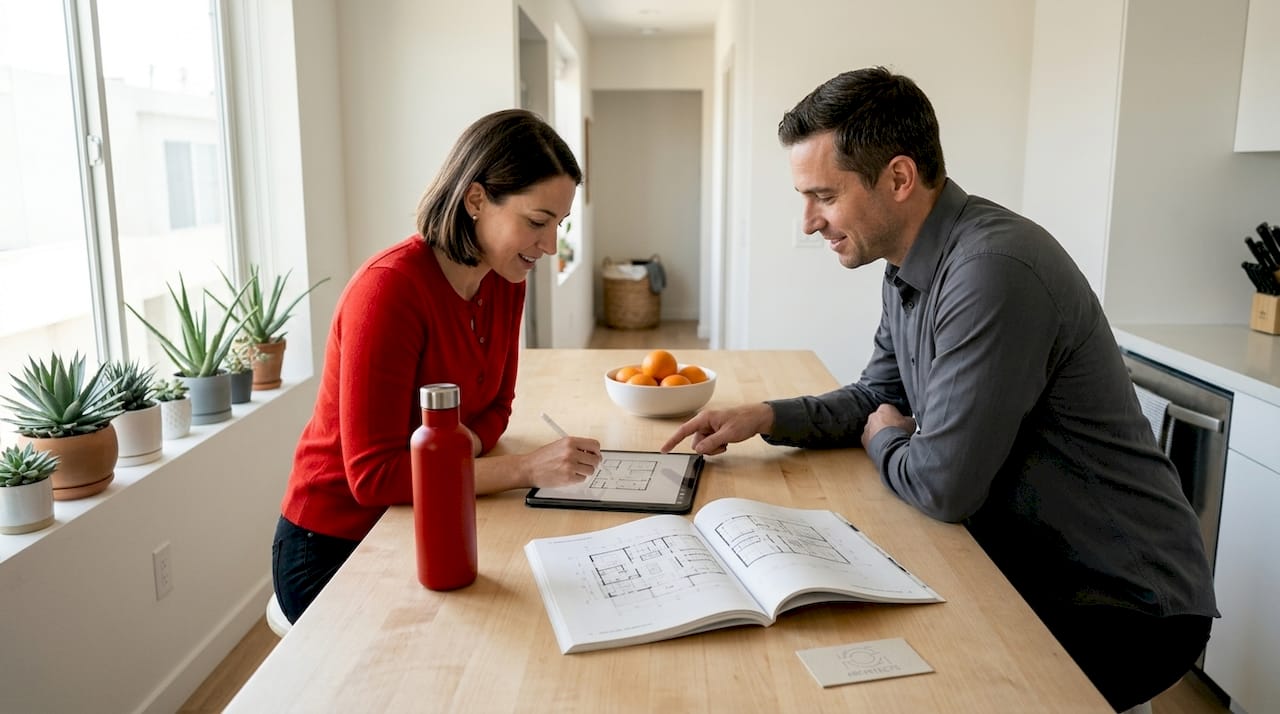
- User satisfaction depends on testing the design before building. Based on experience working with homeowners in LA, the designs that earn the highest satisfaction scores are the ones that were tested through 3D renderings and walkthrough simulations before a single permit was pulled. Clients who can actually see how a room transitions from one use to another are far better positioned to give meaningful feedback.
Pro Tip: Before finalizing any flexible partition or wall system, ask your architect to provide at least two or three rendered scenarios showing the space in each of its intended configurations. This simple step catches problems that floor plans alone never reveal.
When customizing LA floor plans for flexibility, the most successful projects are those that start with code compliance and user behavior first, and work backward from there to select the right design tools.
How to apply flexible floor plans in your project
Understanding the best practices and potential drawbacks, here's how you can put flexible floor planning into action for your next project in Los Angeles.
Step 1: Define your real functional requirements. Write down every use case you need your home to support, not just today but over the next ten years. That might include a dedicated home office, a guest room, a rental space, a home gym, or a live-in care suite. Being specific here prevents over-designing for scenarios that will never happen.
Step 2: Work with architects who know LA regulations. Flexible floor planning in Los Angeles isn't just a design exercise. It involves navigating zoning codes, ADU ordinances, Title 24 energy compliance, and fire separation requirements. An architect with local experience will know which flexible design approaches are pre-cleared for your zone and which ones will trigger lengthy plan check reviews.
Step 3: Test the design with 3D models before committing. Families may prefer zoned spaces over fully open layouts, and testing via 3D renderings showing how a room transforms is one of the most reliable ways to validate a design before construction begins. Virtual walkthroughs in each configuration help identify privacy issues, circulation problems, and furniture conflicts that drawings alone won't catch.
Step 4: Prioritize low-tech flexibility first. Sliding walls, operable panels, dual-purpose rooms with built-in storage, and open-concept zones with clearly defined structural limits give you most of the adaptability you need with very little ongoing maintenance. Reserve high-tech systems for situations where they genuinely solve a problem that low-tech options cannot.
Step 5: Balance openness with sound separation. Open layouts are excellent for daily living but problematic when one occupant is on a video call and another is watching television. Acoustic planning, including insulated sliding doors, ceiling-height partitions, and strategic room placement, ensures that flexibility doesn't come at the cost of day-to-day livability.
Step 6: Plan for future expansion at the structural level. Many LA properties have ADU potential, roof deck potential, or basement conversion potential that goes unrealized because the original structure wasn't designed with those possibilities in mind. Working custom architecture solutions into your initial project can pre-position your property for future growth without requiring structural rework later.
Pro Tip: Ask your architect to identify at least two "phase two" opportunities during the design process. Even if you don't pursue them now, knowing where the building can grow means you won't accidentally design out those options during the initial build.
Our take: flexible doesn't mean complicated or expensive
Beyond practical steps, here's our perspective from years of hands-on design in Los Angeles. Many clients arrive at the initial consultation with the assumption that flexible design is synonymous with complexity, technology, or high cost. That's rarely true, and in many cases it's the opposite.
The projects we've worked on where flexibility added the most long-term value were almost never the ones with motorized walls or smart-home-integrated partition systems. They were the ones with wide, open living zones, thoughtfully positioned sliding doors, and dual-purpose rooms with excellent built-in storage. Simple, clear, low-maintenance solutions.
The empirical case for this approach is strong. Research consistently shows that low-tech flexible strategies outperform high-tech alternatives on lifecycle assessment metrics, because a building that doesn't need frequent system replacements or major renovations carries a far lower environmental and financial burden over its full lifespan.
In our experience, the real enemy of good flexible design isn't budget constraints. It's overcomplication. Designs that look impressive in a presentation but require extensive ongoing maintenance or specialized repair eventually frustrate owners and reduce the practical value of the flexibility you paid to build in.
The question we encourage every client to ask is: "Will I, or a future owner, actually be able to use and maintain this ten years from now?" If the answer requires a service contract or a software subscription, that's usually a signal to simplify.
For LA properties specifically, where resale value and rental income potential are consistently among the top priorities, designs that are easy to understand, adapt, and operate consistently outperform technically complex alternatives. You can find more on this practical approach in our collection of architecture tips for LA homes.
Ready to unlock your home's full potential?
With clear benefits and practical steps laid out, here's how FO Studio can help you realize the potential of adaptable living spaces.
At FO+H Architects, we've spent years designing flexible, future-ready homes and ADUs specifically for the Los Angeles market. Whether you're planning a new build, a renovation, or an investment property, our team can help you identify the right level of adaptability for your goals and budget. You can view Blue ADU flexible plans to see what thoughtful, code-compliant flexible design looks like in practice. Or if you'd prefer to start with a broader look at what's available, browse ADU floor plan options across our full catalog. We're ready to help you build something that works today and keeps working for decades.
Frequently asked questions
Are flexible floor plans more expensive to build?
Not always. Many cost-effective, low-tech flexible options like sliding partitions and open-concept layouts can be just as affordable as traditional fixed designs, and they often reduce long-term renovation costs significantly.
Can flexible floor plans help with energy and environmental savings?
Yes. Research confirms that flexible designs reduce environmental impact by up to 20 percent overall and by up to 60 percent during construction and end-of-life phases, primarily because adaptable buildings remain functional longer and require fewer major interventions.
Are there code or safety issues with flexible layouts in Los Angeles?
There can be. High-tech movable wall systems may not meet California fire separation requirements, particularly in ADUs or multi-family units, which is why working with an architect familiar with local code is essential before selecting any partition system.
How can I test if a flexible layout is right for my family?
The most reliable method is to use 3D renderings showing transformations between each intended configuration, since families often realize they prefer more zoned spaces once they can see how an open layout actually feels in daily use.