

TL;DR:
- Micro-housing in Los Angeles involves intentionally designed, compact units averaging around 200 square feet that maximize functionality. These units, often converted from vacant office buildings, offer affordable living options and support urban density while requiring careful navigation of complex local regulations. Thoughtful design and community engagement are essential for successful micro-housing projects that enhance neighborhood vitality and resident dignity.
Los Angeles renters already know the squeeze: average monthly rents in the city routinely exceed $2,200 for a standard one-bedroom, yet a converted micro-apartment in the same city can run around $1,000 per month, furniture and utilities included. That price gap is not a typo. It reflects a growing movement reshaping how we think about residential space, density, and community in one of the nation's most expensive housing markets. Whether you're a homeowner exploring your property's potential or an urban planner looking for scalable solutions, micro-housing deserves a serious look.
Table of Contents
- Defining micro-housing: What is it and why does it matter?
- How micro-housing works: Design features and community spaces
- Regulation and roadblocks: Micro-housing under LA's building codes
- Why micro-housing matters for LA's future: Benefits and trade-offs
- Perspective: What most people miss about micro-housing in Los Angeles
- Explore micro-housing solutions with expert ADU plans
- Frequently asked questions
Key Takeaways
| Point | Details |
|---|---|
| Micro-housing defined | Micro-housing in Los Angeles means small, efficient private apartments, generally under 450 square feet, with features for livable compactness. |
| Shared and private spaces | Successful micro-housing combines well-designed small units with flexible communal amenities to enhance affordability and social connection. |
| Code and regulations matter | Feasibility depends on local LA zoning, ADU/JADU definitions, and building codes—not just on design or intent. |
| Adaptive urban benefit | Repurposing vacant offices and other buildings into micro-housing helps address affordability, sustainability, and urban vibrancy. |
Defining micro-housing: What is it and why does it matter?
With the urgency of LA's housing shortage in mind, it's critical to start with a clear definition and address the misconceptions that cloud micro-housing discussions.
Micro-housing refers to self-contained residential units that are intentionally compact, typically under 450 square feet, and designed to maximize every function within a limited footprint. In Los Angeles specifically, many micro-apartments average just 190 to 200 square feet, particularly when they are converted from vacant office buildings. Academic researchers use the 450 sq ft threshold consistently to allow comparisons across cities and study types.
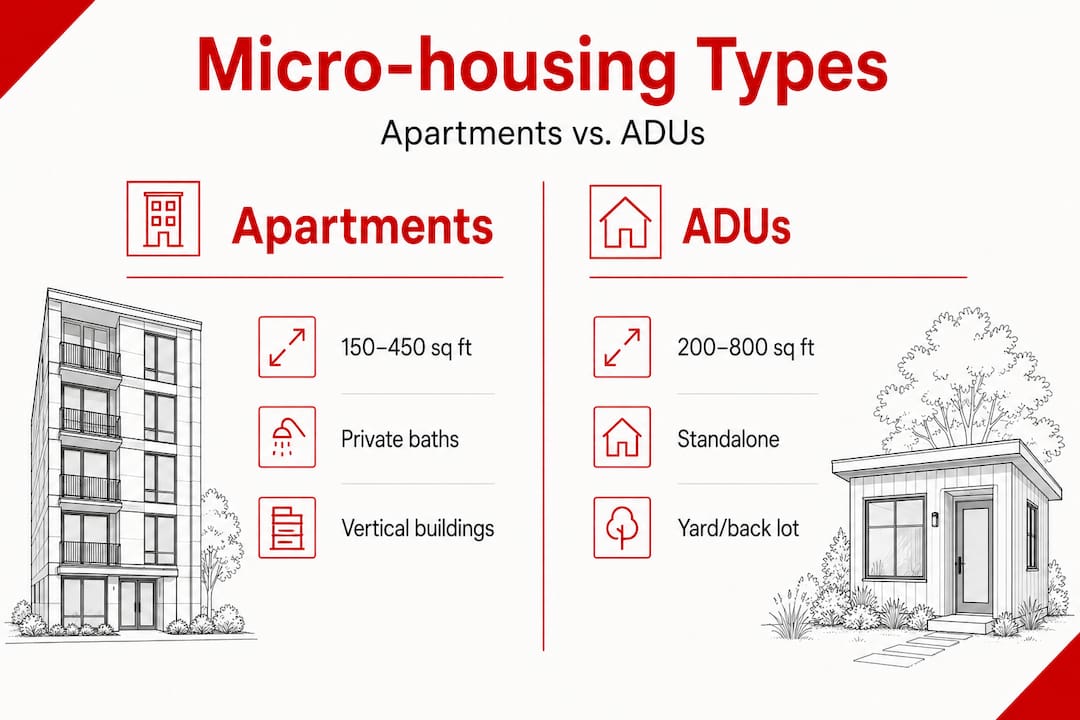
The term gets misused often. Many people hear "micro-housing" and picture an unlivable closet. That assumption misses the point entirely. Micro-housing is not about shrinking a standard apartment and removing features. It's about intentional design that makes every square inch functional. A well-designed unit of 250 square feet with built-in storage, a convertible bed, and shared amenities can feel far more livable than a poorly planned 500 sq ft apartment.
It's also worth noting that reported micro housing sizes range broadly from about 300 to 800 square feet depending on how different cities and jurisdictions define the category. That variability matters because it shapes local zoning rules, building codes, and what qualifies for certain housing programs.
"Micro-housing is not a last resort. It's an intentional choice rooted in efficiency, affordability, and a commitment to community living." This distinction is what separates thoughtfully designed projects from units that simply happen to be small.
Here's a quick reference to understand where micro-housing fits among common residential unit types:
| Unit type | Typical size range | Key defining features |
|---|---|---|
| Micro-apartment | 150 to 450 sq ft | Self-contained, intentional design, often shared amenities |
| Studio apartment | 300 to 600 sq ft | Private kitchen and bath, no shared building amenities |
| Junior ADU (JADU) | Up to 500 sq ft | Attached to primary residence, limited kitchen required |
| ADU (standard) | 150 to 1,200 sq ft | Detached or attached, full kitchen and bath required |
| Tiny home | 100 to 400 sq ft | Often on wheels or on foundation, different code pathways |
How LA is reshaping its vertical urban landscape plays directly into how micro-housing is being positioned as a viable answer to the city's density needs.
How micro-housing works: Design features and community spaces
Now that the definitions are clear, let's step inside real-world micro-housing to see how these spaces actually work for residents.
The private unit in a micro-housing development is engineered for efficiency. Murphy beds fold up to reveal workspaces. Kitchen counters double as dining tables. Under-bed drawers replace full closets. Built-in shelving runs floor to ceiling. None of this is accidental. These decisions happen at the design stage, long before construction begins, and they are what separate a functional micro-unit from a cramped studio.
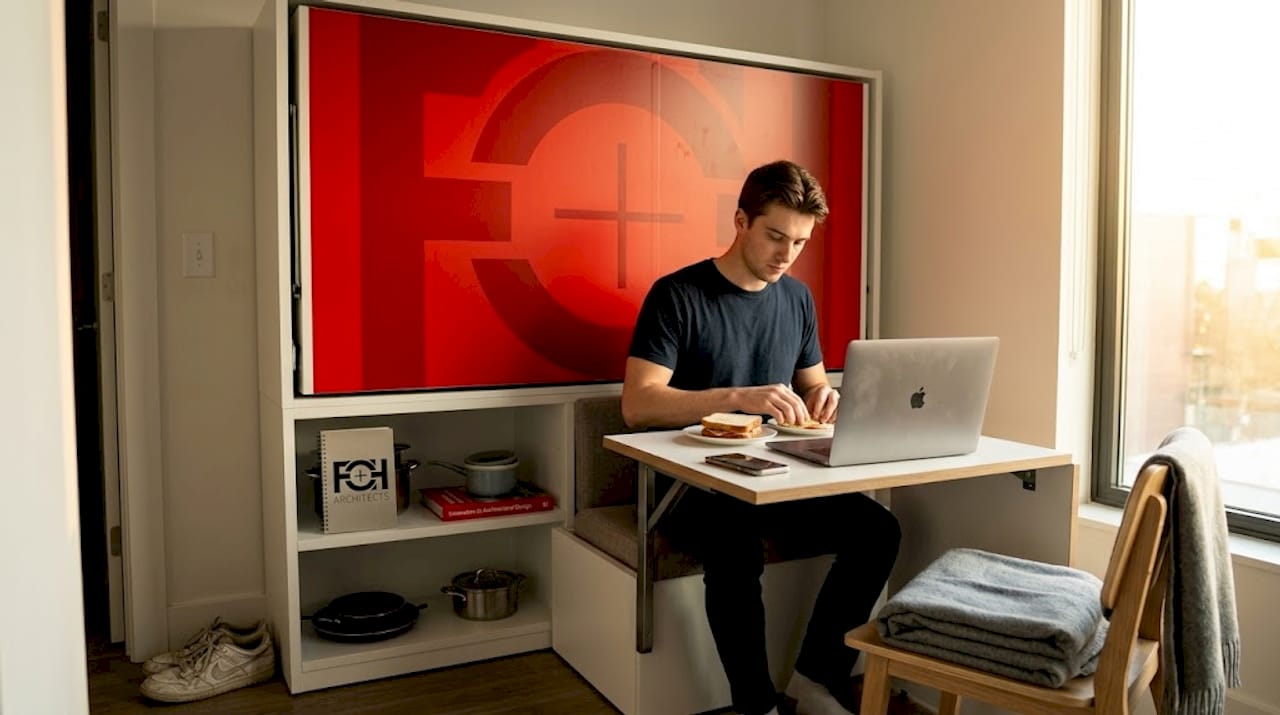
Micro-apartments paired with shared services and spaces within the building are a tested model for supporting both affordability and livability. Shared amenities allow the private unit to be smaller without sacrificing quality of life. Residents gain access to a full kitchen, a lounge or coworking space, a laundry room, and sometimes rooftop areas, all of which offset what they give up in private square footage.
Pro Tip: When evaluating or designing a micro-unit, prioritize natural light over square footage. A 200 sq ft unit with large east-facing windows and operable ventilation will feel significantly more comfortable than a 300 sq ft unit with one small window. Light and airflow are the most cost-effective quality-of-life upgrades available at the design stage.
Here's how micro-housing typically compares to a conventional small apartment:
| Feature | Micro-housing unit | Conventional small apartment |
|---|---|---|
| Private square footage | 150 to 300 sq ft | 400 to 700 sq ft |
| Kitchen setup | Compact or shared | Full private kitchen |
| Laundry | Typically shared | In-unit or shared |
| Common spaces | Lounge, coworking, gym | Rare or none |
| Monthly cost in LA | Around $1,000 | $1,800 to $2,500+ |
| Furniture | Often built-in or included | Tenant supplied |
Key design elements that separate successful micro-housing from simply "small" housing include:
- Convertible furniture: Murphy beds, fold-down desks, and nesting tables that serve multiple purposes throughout the day
- Vertical storage: Floor-to-ceiling shelving, loft sleeping areas, and stacked cabinetry reclaim unused wall space
- Zoned layouts: Even in 250 sq ft, distinct zones for sleeping, working, and dining reduce the feeling of confinement
- Natural light strategy: Clerestory windows, skylights, and open sightlines make compact spaces feel larger
- Shared amenity programming: Community kitchens, meeting rooms, and outdoor space that genuinely get used by residents
Learning how to maximize space in ADU design applies directly to micro-housing projects, especially when it comes to spatial efficiency and built-in storage strategy. Similarly, integrating sustainable design principles from the start helps micro-units perform better for both residents and the environment over the long term.
Regulation and roadblocks: Micro-housing under LA's building codes
Fascinated by the clever design? Figuring out if and where you can actually build micro-housing in LA means wrestling with the city's complex regulations.
This is where many homeowners and developers hit unexpected walls. Micro-housing does not exist as a single, clearly defined category in Los Angeles building or zoning code. Instead, projects fall into different regulatory buckets depending on structure type, location, ownership, and intended occupancy. Understanding which bucket your project falls into determines everything from minimum unit size to required parking and utility connections.
Here are the key regulatory steps for a typical micro-housing or micro-unit project in Los Angeles:
- Confirm zoning eligibility. Check whether the parcel is zoned for the proposed use. Commercial-to-residential conversions, for example, require specific zone overlays or conditional use permits.
- Identify the unit type. Determine whether the project qualifies as an ADU, JADU, micro-unit, or another category. Each carries different rules on size, kitchen requirements, and occupancy limits.
- Review building code minimums. Los Angeles building codes set minimum habitable room sizes, ventilation requirements, and egress standards that apply regardless of how small a unit is intended to be.
- Submit for plan check. All projects require architectural drawings, site plans, and supporting documentation for plan check review. ADU plan check in Los Angeles follows a defined sequence, and micro-unit projects in residential contexts often follow a similar path.
- Address utilities and parking. Micro-units in converted buildings may require separate utility metering. ADU and JADU rules have specific exemptions for parking near transit, which can be an advantage.
- Obtain permits and inspections. Construction cannot begin until permits are issued, and all work must pass inspection at defined milestones.
Micro-housing feasibility in Los Angeles is frequently tied to zoning and secondary-unit frameworks like ADUs and JADUs, not solely to architectural compactness. That means your 200 sq ft unit may be perfectly designed, but if the zoning doesn't support it or the building type doesn't qualify, the project cannot move forward without additional approvals.
"A common mistake is assuming that because a space is small, it's easier to permit. In reality, micro-housing often requires more regulatory navigation, not less."
Different regulatory categories apply to different structure types, including ADUs, JADUs, manufactured homes, mobile units, and site-built structures, and each category carries unique rules about where it's allowed and how it must be built. Using a detailed ADU design checklist early in the process helps you catch regulatory conflicts before they become expensive surprises during plan check.
Why micro-housing matters for LA's future: Benefits and trade-offs
With the rules and process understood, it's time to consider why so many planners and residents see micro-housing as an essential tool for a more affordable, inclusive city.
28%. That is LA's office vacancy rate as reported by Pew. Nearly a third of the city's office stock sits underused while thousands of Angelenos struggle to find affordable housing within city limits. The overlap between those two problems is exactly where micro-housing offers a practical solution.
Benefits of micro-housing development in Los Angeles include:
- Affordability at scale: Smaller units cost less to build and less to rent. A well-designed micro-unit at $1,000 per month puts housing within reach for a much broader segment of the workforce.
- Density without displacement: Micro-housing in infill locations or converted buildings adds units to existing neighborhoods without requiring residents to leave the area.
- Lower environmental footprint: Smaller units use less energy for heating, cooling, and lighting. Combined with shared mechanical systems, micro-housing developments typically achieve better energy performance per capita than conventional multifamily buildings.
- Activation of underused space: Converting vacant offices, warehouses, or commercial buildings into housing creates community value where none currently exists.
- Faster development cycles: In many cases, adaptive reuse projects move faster through permitting than new ground-up construction, especially in jurisdictions with streamlined conversion policies.
Pro Tip: Don't measure a micro-housing project's success purely by unit count. A development with 30 thoughtfully designed units and well-programmed shared spaces will outperform a 50-unit project where residents feel isolated and underserved by poor amenities.
The trade-offs are real and worth acknowledging. Privacy is reduced when shared spaces are central to the living experience. Storage is limited and requires residents to adjust their habits and possessions. Not every neighborhood or demographic is well-suited for micro-housing without careful planning and community input. Compatibility with surrounding scale and character matters to both residents and neighbors.
Staying current on LA architecture trends helps designers and planners anticipate how micro-housing fits into the broader residential landscape. Applying residential development best practices ensures that micro-housing projects are not just compliant, but genuinely beneficial to the communities they serve.
Perspective: What most people miss about micro-housing in Los Angeles
After years of working on residential and ADU projects across Los Angeles, we've noticed a consistent gap between how micro-housing is discussed nationally and how it actually plays out on the ground here.
The national conversation tends to celebrate micro-housing as a simple fix: small units, lower cost, more density. Problem solved. But in Los Angeles, every project travels its own regulatory path. There is no single process, no universal checklist, and no guarantee that what worked in one neighborhood or on one parcel will work on the next. That patchwork reality is something policy reports rarely capture, and it's something every homeowner and planner needs to understand before committing resources.
The second thing most people miss is how much community space quality determines whether a micro-housing project actually works for residents. In our experience, the projects that succeed long-term are the ones where shared amenities are thoughtfully programmed, not just provided. A lounge that no one uses doesn't justify a 180 sq ft private unit. A coworking space with good lighting, reliable internet, and comfortable seating absolutely does. The difference between those two outcomes is design intention, not square footage.
We also believe strongly in designing for dignity. That phrase means more than it might seem. It means that residents of micro-units deserve the same quality of light, ventilation, materials, and spatial care that any other resident receives. Cutting corners because a unit is small is both a design failure and a social one. The most compelling ADU transformation examples in LA we've seen share one quality: they make residents feel respected by the space, not just housed by it.
Finally, neighborhood engagement is not optional. Micro-housing projects that skip meaningful community input often face resistance at the permitting stage or social friction after occupancy. The cities and developers who treat neighborhood integration as a design challenge rather than a bureaucratic hurdle consistently produce better outcomes for everyone.
Explore micro-housing solutions with expert ADU plans
If you're exploring micro-housing for your property or project in Los Angeles, you don't have to figure out the path alone. At FO+H Architects, we bring experience in ADU design, permitting navigation, and community-centered housing to every project we take on.
Our ADU plans for LA are designed with the city's unique zoning landscape, building codes, and livability standards in mind. Whether you're considering a compact unit on an existing parcel or exploring a larger adaptive reuse opportunity, our team can help you match the right design approach to your goals. Take a look at options like our Blue ADU design as a starting point for what efficient, dignified, and code-compliant micro-scale residential design can look like in Los Angeles.
Frequently asked questions
What size is considered micro-housing in Los Angeles?
Micro-housing in LA often means private apartments of about 190 to 450 square feet, with many new builds and conversions landing in the 200 to 300 sq ft range. Academic research uses 450 sq ft as a consistent upper threshold for comparison purposes.
How is micro-housing different from a tiny home or ADU?
Micro-housing typically refers to compact apartments within multifamily or mixed-use buildings, while tiny homes and ADUs follow different codes and placement rules that vary by structure type and jurisdiction. ADUs and JADUs are defined pathways in LA's code, but they don't automatically qualify as micro-housing in the urban planning sense.
What types of buildings can be converted into micro-housing?
Vacant office buildings are a major target for micro-housing conversions in Los Angeles, particularly given that LA's office vacancy rate sits at 28%. Warehouses, underused commercial properties, and some ground-floor retail spaces are also candidates depending on zoning.
Are micro-housing units affordable compared to traditional apartments?
Converted micro-apartments in Los Angeles can rent for around $1,000 per month, often including furniture and utilities, which is substantially below market rate for standard one-bedroom apartments in most LA neighborhoods.