

TL;DR:
- Minimalism in architecture emphasizes removing non-essential elements to highlight form, clarity, and restraint, creating calming and purposeful spaces. In Los Angeles, minimalist strategies turn site constraints into design opportunities through carved voids, courtyards, and aligned openings, enhancing light and spatial experience. Successful minimalist homes require meticulous execution, authentic materials, and careful attention to daily living needs to avoid coldness and maintain warmth and usability.
Minimalism is one of the most misunderstood ideas in architecture. Many people hear "minimalist design" and picture bare walls, cold concrete, and rooms that feel more like empty boxes than places to actually live. That reading misses the point entirely. Minimalism in architecture is a design approach that removes non-essential elements to emphasize essential form, clarity, and restraint. It is about heightening the quality of every space by keeping only what genuinely matters. For homeowners and developers in Los Angeles, that philosophy carries real, practical weight across residential additions, ADUs, and commercial builds alike.
Table of Contents
- Defining minimalism in architecture
- How minimalist design functions in Los Angeles
- The architectural discipline: Why execution matters in minimalism
- Minimalism's benefits, trade-offs, and lived experience
- Minimalism's promise and pitfalls: What most guides won't tell you
- Ready to bring minimalism to your next LA project?
- Frequently asked questions
Key Takeaways
| Point | Details |
|---|---|
| Essence over excess | Minimalism emphasizes essential form, clarity, and restraint, not emptiness or blandness. |
| LA solutions | Minimalist architecture adapts to LA’s tight lots by prioritizing light, air, and openness through creative design moves. |
| Quality matters | Precision, material honesty, and detail are crucial for successful minimalism—especially in high-visibility spaces. |
| Liveable minimalism | The best minimalist designs feel calm and functional, not sterile, by balancing reduction with warmth and real needs. |
Defining minimalism in architecture
Let's start by unpacking what architects and designers really mean by minimalism, because the word gets misused constantly.
Minimalism is not about removing personality from a space. It is about sharpening focus. When you strip away decorative excess, the things that remain, such as natural light, material texture, spatial proportion, and the flow between rooms, become the experience. That shift changes how a building feels to inhabit. Rooms feel larger, calmer, and more purposeful.
Core principles of minimalist architecture:
- Simplicity of form: Clean geometry, few intersecting planes, and a coherent visual language throughout.
- Material honesty: Using materials for what they genuinely are. Exposed concrete looks like concrete; wood grain is left visible, not concealed behind paint.
- Light as a design medium: Windows, voids, and openings are positioned to carry light deep into a space and animate surfaces across the day.
- Spatial clarity: Rooms and volumes connect logically without unnecessary transitions, corridors, or layered surfaces.
- Restraint in detail: Joints, edges, and transitions are resolved with precision rather than covered with trim or molding.
Minimalism is commonly implemented through strategies such as boundary dissolution (glass to blur inside and outside), material honesty, and light used as a primary spatial medium. These are not stylistic choices alone. They are functional decisions that affect how comfortable a home is to live in every day.
"The ability to simplify means to eliminate the unnecessary so that the necessary may speak." — Hans Hofmann
One common misconception is that minimalism requires a large budget or a lot of square footage. Neither is true. What it requires is discipline and intentionality at every stage of design and construction. The table below shows how minimalist principles compare to conventional architectural approaches.
| Principle | Conventional approach | Minimalist approach |
|---|---|---|
| Ornament | Decorative moldings, trim layers | Resolved joints, flush surfaces |
| Material palette | Mixed finishes, varied textures | Limited, honest material selection |
| Light | Windows placed for code compliance | Openings positioned for spatial experience |
| Spatial transitions | Corridors, threshold spaces | Direct, deliberate room connections |
| Detail | Covered with trim or casing | Exposed and resolved with precision |
For Los Angeles projects specifically, custom minimalist solutions need to account for site conditions, local code requirements, and the lifestyle priorities of the people who will actually use the space. Minimalism is a tool that serves those goals, not an aesthetic imposed on top of them.
How minimalist design functions in Los Angeles
Now, how does this purposeful reduction play out for homeowners and developers in LA's dense neighborhoods?
Los Angeles presents a specific set of site constraints that shape almost every residential project: narrow lots, required setbacks, height limitations, and lot coverage maximums. In conventional design, these constraints are often treated as obstacles to work around. Minimalist thinking reframes them as design opportunities.
In Los Angeles specifically, minimalist design is commonly realized via "subtractive" moves on constrained sites, including carved voids, interior courtyards, and aligned openings, to achieve openness, light, and air within tight footprints. Rather than adding rooms or features to fill every allowable square foot, the architect removes mass strategically. The result is a home that breathes.
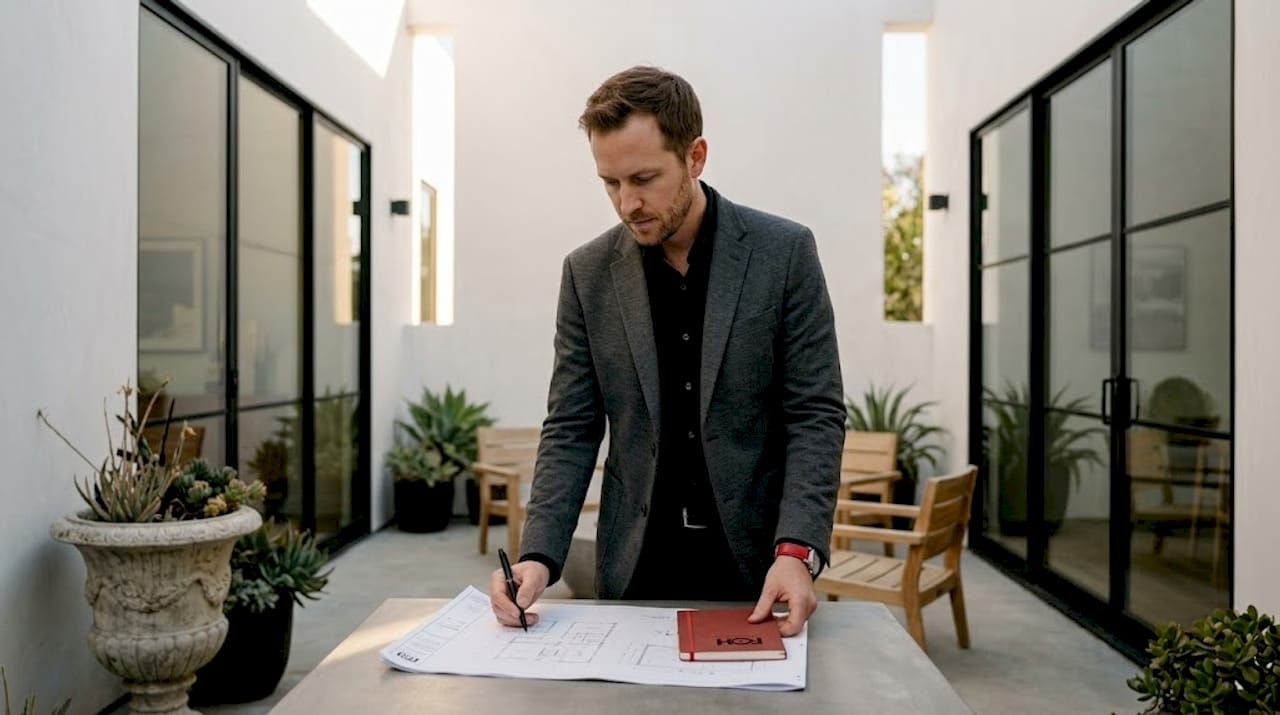
A concrete example is the Mar Vista house, where the design team carved voids and courtyards into the building mass to dissolve the boundary between interior and exterior. The courtyard becomes a light source for multiple rooms simultaneously. Aligned openings create sightlines from the front of the lot to the back, making the home feel much larger than its actual footprint. These are direct applications of minimalist principles to real LA site conditions.
Comparing conventional and minimalist approaches to site constraints:
| Site constraint | Conventional response | Minimalist response |
|---|---|---|
| Required side setbacks | Treat as wasted space | Use as light wells or landscape voids |
| Low height limit | Compress ceiling heights | Lower ceilings at edges, raise at center |
| Small rear yard | Build deck to fill it | Frame yard as a visual extension of interior |
| Narrow lot | Lay out rooms in a single loaded corridor | Offset volumes to create courtyard connections |
Step-by-step: Applying minimalism to a typical LA lot
- Step 1: Map light and views. Before placing a single wall, document where sunlight enters the lot across the day and identify any valuable sightlines to trees, sky, or street. These become the organizing logic for the plan.
- Step 2: Define the essential program. List only the spaces the client actually needs. Resist padding the program with "bonus" rooms that add square footage but reduce spatial quality.
- Step 3: Use constraints as generators. Let setbacks, easements, and height limits determine where voids, courtyards, and openings go. Treat the "no-build" zones as part of the design.
- Step 4: Limit the material palette. Select two or three primary materials and commit to them throughout. Consistency builds the visual calm that makes a space feel resolved.
- Step 5: Detail relentlessly. Every joint, edge, and threshold needs to be worked out in drawings before construction begins. Minimalism has no tolerance for improvised details on site.
Pro Tip: Before adding any feature to a design, ask whether it increases the quality of light or the strength of a sightline. If it does neither, it probably does not belong in the project.
Staying informed about modern architecture trends in LA helps both homeowners and developers understand which minimalist moves are gaining traction locally and why they work in the Southern California climate. You can also find practical direction in innovative LA home design ideas that translate these principles into real project applications.
The architectural discipline: Why execution matters in minimalism
Appreciating form and simplicity is just one side. Let's see why execution makes or breaks minimalism.
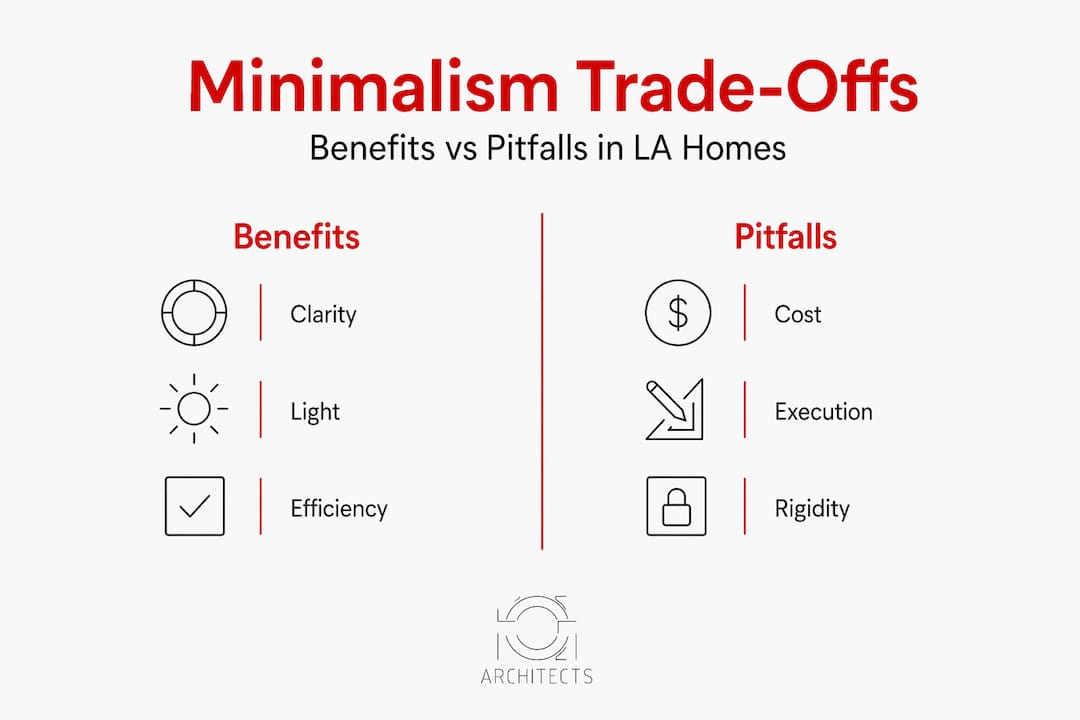
Here is something many people do not fully grasp until they are deep into a minimalist project: simplicity is harder to build than complexity. When a wall is covered in layered trim, decorative tile, and paint, small imperfections disappear into the visual noise. In a minimalist space, there is no visual noise to hide behind. Every surface is exposed. Every joint is visible. Every material transition is scrutinized.
In practice, minimalist architecture places heavy emphasis on execution. With fewer visible finishes and ornaments, tolerances, flush joints, and material transitions become more consequential. A grout joint that runs 1/16 of an inch off alignment in a tile-heavy bathroom might go unnoticed. In a minimalist room with a single large concrete floor panel, that deviation is the focal point.
Common execution pitfalls in minimalist projects:
- Misaligned joints: Any gap, seam, or transition that is not perfectly resolved will read immediately against clean surfaces.
- Inconsistent light quality: Poor window sizing or placement that creates glare instead of diffuse ambient light defeats the spatial intent.
- Cheap material substitutions: Swapping a specified natural stone for a lookalike composite midway through construction changes the entire feel of a room.
- Improvised details: Decisions made in the field rather than in drawings lead to mismatched edges, unpredicted shadows, and visual clutter.
- Underfunded finishing: Rushing the final phases of work to cut costs leaves the rough texture of construction visible in a setting where only the precise final result is acceptable.
Pro Tip: When selecting a contractor for a minimalist project, ask to see examples of their flush joint work, particularly at door frames, window reveals, and floor-to-wall transitions. This craft is not universal, and it matters more in minimalist builds than in almost any other project type.
Budgeting is also a genuine issue. Many clients initially assume that fewer materials means lower cost. In reality, the cost of precision labor and higher quality materials in a minimalist project often equals or exceeds the cost of a more conventionally finished home of the same size. Factor this into your project budget early. The principles of modern sustainable architecture align well with minimalism here, because investing in durable, honest materials reduces long-term replacement and maintenance costs over the life of the building.
Minimalism's benefits, trade-offs, and lived experience
Perfection is not everything. What is the user experience of living with minimalist design?
The case for minimalism in residential spaces is rooted in how people actually feel day to day. Spaciousness, calm, and a sense of order are not abstract architectural values. They affect mood, focus, and comfort in measurable ways. A room with clean sight lines, consistent natural light, and a simple material palette is genuinely easier to relax in. That is not a marketing claim. It is feedback we hear consistently from residents in well-executed minimalist homes.
Real benefits for LA residents and developers:
- Perceived spaciousness: Removing visual clutter makes a 900-square-foot home feel closer to 1,200 square feet in actual use.
- Lower cognitive load: Fewer visual competing elements reduces the low-level mental effort of processing a complex space.
- Durability of design: A minimalist interior does not feel "dated" in the same way that trend-driven ornament does. The investment holds value longer.
- Energy efficiency alignment: Fewer interior partitions and strategic glazing support passive ventilation and daylighting, both of which reduce energy demand.
- Resale appeal: Clean, resolved spaces photograph well and present well to a wide range of buyers.
That said, there are real trade-offs to acknowledge honestly. Minimalism can become sterile or hard to maintain if precision and material honesty are missing from the execution. A minimalist home that was built quickly, with budget-driven substitutions and inattentive detailing, does not feel calm. It feels cold and unfinished.
"Digital culture has amplified minimalism's visual appeal through photography and social media, but living in a space is very different from looking at a photo of it. The two experiences require different things."
The most successful minimalist homes we have seen in Los Angeles share one quality: they were designed around the specific lives of the people who would use them. Natural textures, integrated storage, warm light sources, and carefully chosen personal objects give these spaces the human quality that prevents them from tipping into sterility. If you are trying to optimize LA home layouts for how your household actually lives, minimalism is a strong framework, but only when it is grounded in your real daily patterns.
Minimalism's promise and pitfalls: What most guides won't tell you
Having worked through minimalism's concepts and real-world trade-offs, here is an honest take on making it work for you in Los Angeles.
Most guides on minimalist architecture focus on the visual result: the clean photographs, the seamless surfaces, the pools of light. What they tend to gloss over is how demanding minimalism is to achieve correctly, and how quickly it fails when it is pursued as a style rather than a philosophy.
We have seen this play out in LA projects more than once. A client comes in with a collection of reference images, all of them clean and spare and beautiful. They want that look. What they have not fully considered is that the spaces in those images were designed from the ground up around minimalist principles, with material budgets, contractor selection, and site orientation all aligned toward the same goal. Retrofitting a "minimalist look" onto a conventionally planned home usually produces something that looks stripped rather than resolved.
The honest reality is that minimalism in Los Angeles is not automatically simpler or less expensive than other approaches. The city's climate, its lot constraints, and the lifestyle expectations of its residents actually set a high bar for what a minimalist space needs to deliver. Southern California light is intense and directional. That quality can make a thoughtfully designed minimalist interior extraordinary. It can also make a poorly resolved one look harsh and flat all day long.
The most practical lesson we can offer is this: pursue reduction at every stage of design, but never let it come at the cost of atmosphere or real usability. A home that is uncomfortable to live in has failed regardless of how good it looks in photographs. The best modern architecture tips for LA projects consistently point back to the same idea: design for the actual life of the building, not for an abstract aesthetic ideal.
Ready to bring minimalism to your next LA project?
If you are curious how minimalism could translate to your own property or project, these resources can help.
At FO+H Architects, we design homes and ADUs in Los Angeles that are shaped by the principles of purposeful reduction, material authenticity, and spatial clarity. We understand how LA's site constraints, code requirements, and lifestyle patterns factor into every design decision.
Whether you are planning a new home, an addition, or an ADU on your lot, our ADU plans for LA projects reflect the kind of disciplined, light-forward design that minimalism demands. You can start by exploring specific options such as the Blue ADU for Los Angeles homes or the Gold ADU design plans, both of which are designed with the quality of space and construction precision that makes minimalism work in real Los Angeles conditions. Reach out to our team to discuss how we can tailor these ideas to your specific lot and goals.
Frequently asked questions
Is minimalism more expensive than other architectural styles?
Minimalism often requires higher quality finishes and more precise construction, which can increase upfront costs despite the reduced material palette. As noted in practice, flush joints and material transitions become significantly more consequential when there is no ornament to absorb visual imperfections.
Can minimalist homes feel warm and personal?
Yes, by focusing on natural light, authentic materials, and careful layout, minimalist designs in LA can feel welcoming and customized for residents. The key is that light, material honesty, and openness create a lived experience rather than a sterile one when executed with care.
How does minimalism handle small or narrow LA lots?
Minimalism adapts by carving courtyards, aligning openings, and leveraging constraints to maximize light and space. Subtractive moves on constrained sites such as voids and courtyards are a direct response to the kind of tight urban lots common throughout Los Angeles.
What are the main pitfalls of minimalism for Los Angeles homes?
Minimalism can become sterile or hard to maintain if detailing, authentic material use, and comfort are not prioritized from the start. Precision and material honesty are the two factors most likely to determine whether a minimalist interior feels calm or cold in actual daily use.