

TL;DR:
- Urban residential design connects homes to neighborhoods, focusing on function, sustainability, and community.
- Principles like livability, sustainability, and integration improve quality of life and reduce costs.
- Thoughtful design in LA influences neighborhood character, safety, and community pride.
The most innovative Los Angeles homes aren't just about interiors. They're designed to reshape neighborhoods, maximize small lots, and cut energy bills by more than half. Yet many homeowners still think of residential design as purely an aesthetic exercise, choosing finishes and furniture while missing the bigger picture. Urban residential design is a discipline that connects your home to the street, the neighborhood, and the city itself. This guide breaks down what it really means, why it matters specifically in LA, and how you can use it to improve your lifestyle, reduce costs, and strengthen the community around you.
Table of Contents
- Defining urban residential design: More than architecture
- Key principles: Livability, sustainability, and integration
- How urban residential design transforms LA living
- Practical strategies for homeowners: Making urban design work for you
- A fresh take: Why urban residential design is LA's best-kept secret
- Discover standout urban residential designs for your LA home
- Frequently asked questions
Key Takeaways
| Point | Details |
|---|---|
| Space optimization | Urban residential design makes even small LA lots feel open, bright, and livable. |
| Sustainability impact | Energy-smart design can lower bills by up to 90 percent compared to traditional homes. |
| Community value | Thoughtful urban design helps you shape the character and connections of your neighborhood. |
| LA-specific solutions | Innovative strategies and ADU options reflect both your lifestyle and LA’s unique zoning needs. |
Defining urban residential design: More than architecture
Many homeowners assume that good design stops at the front door. In reality, urban residential design is the application of urban design principles to residential buildings and spaces in dense urban contexts, focusing on creating livable, sustainable homes that integrate with city fabric, optimize space, enhance community, and address urban challenges like density and limited land. That definition matters because it shifts the conversation from "what does my home look like" to "how does my home function within the city."
This distinction is especially important in Los Angeles, where lots are often small, neighborhoods are layered with history and culture, and the demand for housing keeps growing. A home designed with urban principles in mind doesn't just serve its occupants. It contributes to the block, the neighborhood, and ultimately the city.
So what does this look like in practice? Urban residential design considers:
- Context: How your home relates to the street, setbacks, neighboring buildings, and pedestrian experience
- Space optimization: Layouts that make every square foot count, especially on constrained urban lots
- Sustainability: Materials, systems, and orientations that reduce environmental impact
- Community integration: Design choices that support social interaction and reflect local identity
- Adaptability: Spaces that can evolve as your needs and the city change
"The best urban homes don't compete with their neighborhoods. They complete them."
Understanding why design matters for residential homes goes beyond curb appeal. It's about creating a living environment that genuinely fits your life, your values, and the urban context you're part of. That's the foundation of everything we do at FO+H Architects.
Key principles: Livability, sustainability, and integration
Understanding the definition leads naturally into what makes this approach distinctive: its guiding principles. These aren't abstract ideals. They're measurable, practical, and directly tied to your quality of life and your home's long-term value.
1. Livability
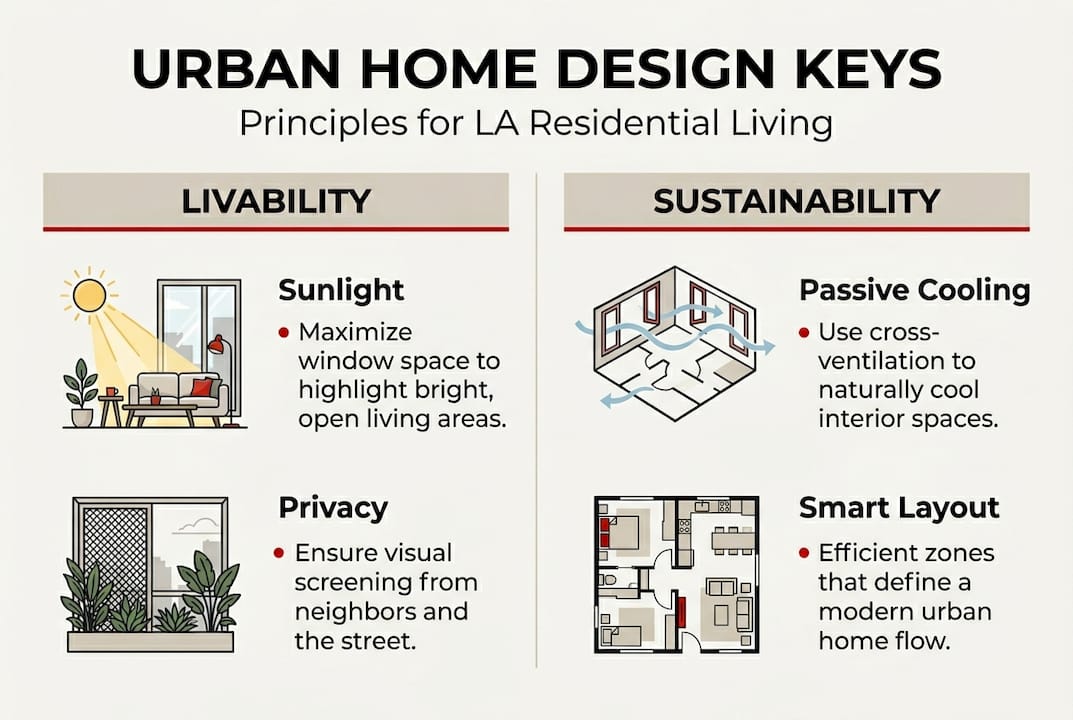
Livability means your home provides adequate sunlight, privacy, ventilation, and usable space, even in a dense neighborhood. It's about how a home feels to live in day to day, not just how it photographs. Good urban design ensures that even compact homes have a sense of openness and calm.
2. Sustainability
Sustainability in urban residential design means more than solar panels. It includes passive design strategies (orientation, shading, natural ventilation), energy-efficient systems, and responsible material choices. Passive houses achieve 90% less heating and cooling energy use compared to conventional homes, translating to roughly $15,000 in annual savings. That's not a marginal improvement. That's a transformation in how your home operates.
3. Integration
Integration means your home strengthens social ties rather than isolating itself. Front porches, shared courtyards, permeable fencing, and street-facing windows all contribute to a sense of neighborhood cohesion. Homes built with this principle in mind tend to hold their value better and attract stronger community investment over time.
Exploring sustainable community living and modern living architecture can help you see how these principles come together in real projects.
Pro Tip: When evaluating a design proposal, ask your architect how the home performs on all three dimensions: livability, sustainability, and integration. If any one of them is missing, the design isn't fully urban in the best sense of the word.
How urban residential design transforms LA living
With principles in mind, see how they play out in the real world, especially in a city as diverse as Los Angeles.
LA is a fascinating case study. The city has one of the most complex housing markets in the country, with intense demand, limited land, and neighborhoods that range from historic bungalow districts to high-density corridors. Pro-density approaches favor affordability and housing supply, while preservation advocates push back to protect neighborhood character. Los Angeles navigates this tension through objective design standards that ensure quality even as density increases.
This balance has produced some genuinely impressive results. Consider how the city's zoning reforms have enabled more thoughtful infill development, where new homes fit into existing blocks without overwhelming them. The table below shows how urban design metrics compare across different project types:
| Design approach | Energy use intensity (EUI) | Space efficiency | Community integration score |
|---|---|---|---|
| Conventional suburban build | High (baseline) | Low | Minimal |
| Standard urban infill | Moderate | Moderate | Moderate |
| Passive house urban design | 51% below baseline | High | High |
| ADU on existing lot | Low | Very high | Strong |
Key stat: Projects applying passive house principles in urban contexts have achieved an EUI of 23, which is 51% below the standard baseline. That's a measurable, significant outcome for homeowners who want to reduce operating costs.
Pro Tip: Before starting any project, review LA's current zoning rules for your specific lot. Many homeowners are surprised to learn they qualify for ADUs, lot splits, or other density options that can dramatically increase their property's utility and value. Resources like custom solutions for LA homes and LA residential architecture tips are good starting points.
LA's design culture is also evolving. Architects and planners are paying closer attention to architecture trends shaping LA, including biophilic design, flexible multi-use spaces, and climate-responsive construction. These aren't trends for trend's sake. They're responses to real conditions: heat, drought, density, and community need.
Practical strategies for homeowners: Making urban design work for you
These transformations aren't the sole domain of architects. There are practical strategies every LA homeowner can use to bring urban residential design principles into their own property.
Optimize your layout first
Before adding square footage, look at how your existing space is organized. Many LA homes waste usable area through poor circulation, oversized hallways, or rooms that don't serve a clear purpose. A layout audit with a qualified architect can reveal surprising opportunities to optimize LA home layouts for both comfort and efficiency.
Apply passive design strategies
Passive design uses the building itself, its orientation, window placement, shading, and insulation, to regulate temperature without mechanical systems. In LA's climate, this is especially effective. South-facing windows with proper overhangs can reduce cooling loads significantly, and well-insulated walls keep interiors comfortable year-round.
Consider an ADU
Accessory Dwelling Units (ADUs) are one of the most powerful tools available to LA homeowners. They add flexible living space, can generate rental income, and support multi-generational living. Exploring innovative ADU design concepts shows how even small lots can accommodate well-designed secondary units that feel spacious and complete.
- Detached ADUs work well on lots with rear yard space
- Attached ADUs are efficient for homes with unused garage or side yard area
- Junior ADUs (JADUs) convert existing interior space with minimal construction
| Strategy | Upfront cost range | Annual benefit | Best for |
|---|---|---|---|
| Passive design upgrades | $5,000 to $20,000 | $2,000 to $15,000 saved | All homeowners |
| ADU construction | $150,000 to $300,000+ | Rental income + value | Lot with rear yard |
| Layout optimization | $3,000 to $10,000 | Improved livability | Existing homes |
Pro Tip: Passive house benchmarks show up to $15,000 in annual energy savings. Even partial application of these principles, like improved insulation or strategic window placement, can yield meaningful returns over time.
Knowing when to engage a local architect is also key. For projects involving permits, zoning variances, or structural changes, professional guidance saves time, money, and stress. An architect familiar with LA's specific regulations can identify opportunities you'd likely miss on your own.
A fresh take: Why urban residential design is LA's best-kept secret
Beyond practical steps, it's time for a closer look at what most guides miss about the power of urban residential design.
Conventional wisdom focuses on aesthetics and energy efficiency. Those matter. But in our experience working with LA homeowners, the greatest value of thoughtful urban design is something harder to quantify: the ability to shape your community. Most homeowners don't realize how much influence a single well-designed home has on a block. When your home addresses the street thoughtfully, when it creates a welcoming presence rather than a blank wall, it changes how neighbors interact, how safe a street feels, and how much pride a community takes in its shared environment.
LA homeowners have more agency here than they think. You don't need a massive budget or a landmark project. A carefully designed front yard, a well-placed ADU, or a thoughtful addition can shift the character of an entire block over time. Inclusive design in architecture shows how these choices ripple outward in ways that benefit everyone.
The real secret is that urban residential design isn't just about your home. It's about the neighborhood you want to live in.
Discover standout urban residential designs for your LA home
If you're ready to move from ideas to action, FO+H Architects offers LA-centered design solutions built specifically for urban lots, community values, and the lifestyle you want to create.
Our ADU store features pre-designed plans that fit a range of lot sizes and budgets, including options like the Blue ADU, a standout design that balances modern aesthetics with practical urban living. Whether you're exploring a full custom project or looking for a starting point, our house plans and ADU solutions are designed to reflect your lifestyle and strengthen your community. Reach out to our team to start the conversation.
Frequently asked questions
How does urban residential design improve energy efficiency in LA homes?
By emphasizing passive design and smart layouts, urban homes can reduce energy use by up to 90% compared to conventional builds, delivering thousands in annual savings.
What makes LA's approach to urban residential design unique?
Los Angeles balances density with quality through objective design standards, allowing more housing while protecting neighborhood character in ways few other cities have managed.
What are the main benefits of integrating ADUs into urban residential properties?
ADUs increase space flexibility, generate rental income, boost property value, and support multi-generational and community-diverse living on existing lots.
Is urban residential design expensive to implement?
Some sustainable upgrades have upfront costs, but efficient urban designs can save $15,000 annually in energy and operational costs, making them strong long-term investments.
Recommended
- 🏘️ The ADU Revolution: How Accessory Dwelling Units are Transforming Los Angeles Neighborhoods — Fo+H Architects
- Los Angeles: A Vertical Oasis – Reimagining the Urban Landscape — Fo+H Architects
- Modern urban housing: sustainable designs for community living
- Modern residential architecture trends shaping LA living