

TL;DR:
- Open concept layouts maximize natural light and social interaction but can lead to noise and privacy issues.
- Hybrids or broken plans are gaining favor for offering balance between openness and functional separation.
- Proper structural assessment is crucial before removing walls in LA homes due to seismic and building code requirements.
Open concept layouts have dominated residential design for years, but a quiet shift is underway in Los Angeles. Many homeowners who removed walls expecting a better quality of life are now asking whether they made the right call. The truth is that open concept design is not universally superior. It works exceptionally well in some households and creates real problems in others. This guide examines the practical benefits, overlooked drawbacks, and the emerging hybrid alternatives that are reshaping how LA homeowners and developers think about interior space in 2026.
Table of Contents
- What open concept layouts are and why they're so popular
- Major benefits of open concept layouts for modern living
- Drawbacks and risks: What most homeowners overlook
- Hybrid and 'broken plan' layouts: The evolving LA trend
- Our take: How to choose the right layout in 2026 (beyond trends))
- Ready to create your ideal LA layout?
- Frequently asked questions
Key Takeaways
| Point | Details |
|---|---|
| Open concept’s appeal | Open layouts offer light, social flow, and flexible spaces for modern LA living. |
| Real drawbacks | Noise, energy costs, and privacy loss are common pitfalls missed by many homeowners. |
| Hybrid plans rising | Broken and hybrid layouts now bridge openness with privacy, suiting today’s lifestyles. |
| Tailor for value | The best design balances resale, daily function, and future flexibility for your household. |
What open concept layouts are and why they're so popular
An open concept layout (also called an open floor plan) removes walls between two or more primary living spaces, most commonly the kitchen, dining area, and living room. The result is one continuous, shared zone rather than a series of enclosed rooms. This approach became mainstream in American residential design through the mid-20th century and has remained a dominant preference ever since.
In Los Angeles specifically, the appeal goes beyond aesthetics. The city's modern LA residential design culture is shaped by year-round indoor-outdoor living, strong entertaining traditions, and a premium on natural light. Removing interior walls allows sunlight to travel deeper into a home's footprint, which is particularly valuable in smaller bungalows or infill properties where window access is limited.
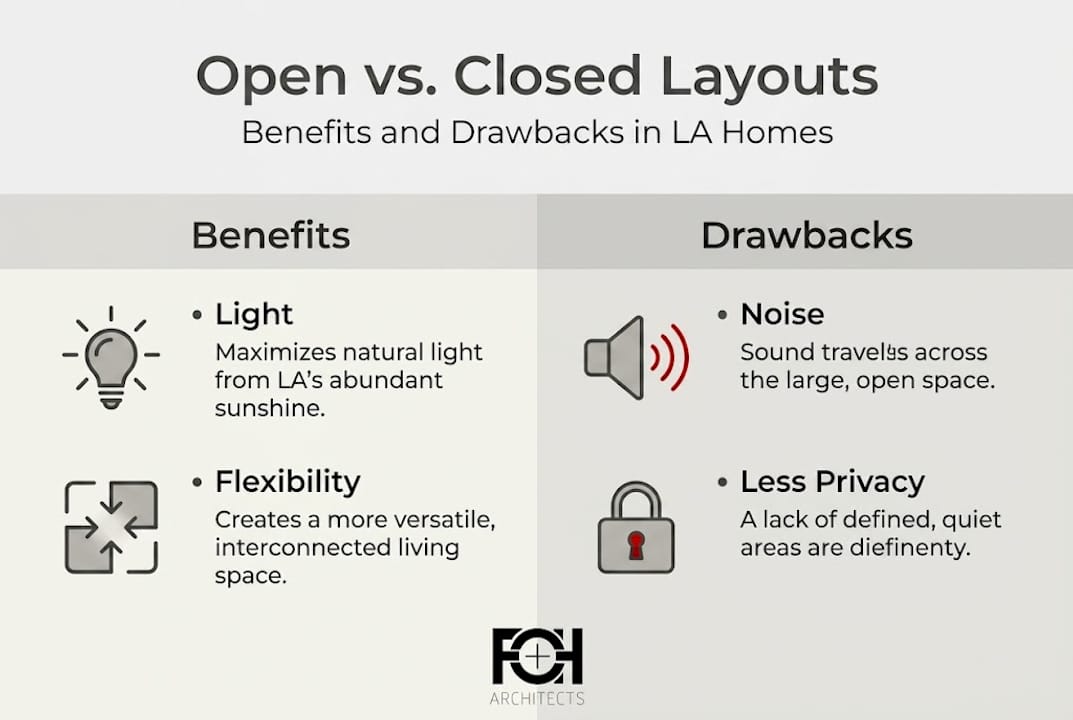
Here is a general overview of how open concept configurations typically look in LA residential projects:
| Spaces combined | Average square footage affected | Relative popularity in LA |
|---|---|---|
| Kitchen + dining | 300 to 450 sq ft | Very high |
| Kitchen + living + dining | 500 to 800 sq ft | High |
| Living + dining only | 250 to 400 sq ft | Moderate |
| Full ground floor open | 800 to 1,200 sq ft | Lower, but growing in new builds |
Several specific factors drove the surge in open concept adoption across the LA market:
- Entertaining culture. LA households frequently host gatherings, and open plans allow hosts to interact with guests across multiple functional zones without physical barriers.
- Natural light maximization. Removing walls lets daylight from south or west-facing windows distribute across a wider area, reducing reliance on artificial lighting.
- Perceived spaciousness. Even modestly sized homes feel larger when sightlines extend across the full ground floor rather than stopping at a wall.
- Real estate marketability. For decades, listing photos of open, airy interiors have performed better, driving seller preferences toward open configurations.
"Open floor plans became synonymous with modern living because they matched how people actually wanted to spend time together at home," notes design commentary on open concept popularity. The connection between LA's social lifestyle and the practicality of open space made this trend particularly sticky in Southern California.
The open concept format also aligned well with Los Angeles construction realities. Many older Craftsman and ranch-style homes in LA had compartmentalized layouts that felt cramped relative to their actual square footage. Removing non-load-bearing walls was often a cost-effective way to dramatically improve how a home felt without adding square footage.
Major benefits of open concept layouts for modern living
Having established what open concepts are and why they caught on, it's worth detailing the concrete advantages they provide, particularly for the way many LA families actually live.
The most consistent benefit is social connectivity. When the kitchen opens directly into the living and dining areas, a parent preparing meals can supervise children, maintain a conversation with guests, or follow along with what's happening in the room. This is not a minor convenience. For households where daily life overlaps across multiple functions simultaneously, eliminating walls actively reduces friction.
Open layouts also offer strong flexibility for furniture arrangement and room use. Without fixed walls dictating zones, you can reconfigure your space as your household evolves. A dining area can double as a homework station or workspace. A living zone can expand to accommodate larger gatherings by simply moving furniture. This adaptability is increasingly valued in a city like Los Angeles where square footage is expensive and households need spaces to serve multiple purposes.
According to home resale value research, open floor plans continue to command buyer interest in urban markets, which matters significantly for LA property owners thinking long term. Urban buyers generally prioritize light, flow, and adaptability, all of which open concepts deliver well.
Key advantages for LA homeowners include:
- Improved natural light distribution, reducing electricity costs for daytime lighting
- Stronger social flow during gatherings and everyday family routines
- Greater furniture flexibility as household needs shift over time
- Higher perceived value in listing photos and buyer walk-throughs
- Compatibility with indoor-outdoor living, especially when the open zone connects to a patio or yard
Optimizing LA home layouts for lifestyle fit often starts with understanding how your household actually moves through space on a typical day. The open plan shines when that movement is social and multidirectional.
Notably, 84% of builders continued incorporating open concept layouts in recent years, which signals that demand remains strong even as the conversation around alternatives grows louder. That said, popularity does not equal suitability for every household.
Pro Tip: If you want more openness without full wall removal, consider replacing a solid wall with a wide cased opening or a partial wall topped with a counter-height ledge. This creates visual and social connection while still defining the spaces and providing a surface for barstools, plants, or decor.
Drawbacks and risks: What most homeowners overlook
Many homeowners walk into an open concept renovation focused entirely on the benefits and are genuinely surprised by the challenges that emerge after the walls come down. We see this regularly with clients in LA who expected a better home and instead found themselves dealing with issues that significantly affect daily comfort.
Noise is the most common complaint. In a closed floor plan, sound is contained by walls. In an open plan, it travels freely across the entire shared zone. A blender in the kitchen is heard clearly in the living room. A television on in the evening reaches the dining table. For households with remote workers, this becomes a practical problem. Conference calls and focused work sessions are consistently disrupted in fully open ground floors.

Privacy is a related issue. An open plan offers no visual separation between zones. Every dish left in the sink, every pile of mail on the counter, and every piece of laundry draped over a chair is visible from the couch or the front door. This level of exposure requires either exceptional tidiness or acceptance that your home will always look lived-in from multiple vantage points.
Here is a direct comparison of how open and closed plans differ across key dimensions:
| Feature | Open concept | Closed/broken plan |
|---|---|---|
| Privacy | Low | High |
| Natural light (main zones) | High | Moderate |
| Noise containment | Poor | Good |
| HVAC efficiency | Lower | Higher |
| Flexibility | High | Moderate |
| Clutter visibility | High | Low |
| Remote work suitability | Low | High |
Energy use in open floor plans is a genuine concern in Los Angeles, where summer temperatures regularly push HVAC systems hard. Open layouts can cost 10 to 15% more to heat and cool because conditioned air disperses across a larger, undivided volume. Walls act as barriers that help HVAC systems maintain temperature in specific zones efficiently. Without them, the system works harder and runs longer.
The four most commonly overlooked risks of open concept layouts include:
- Noise amplification across cooking, entertainment, and work activities occurring simultaneously
- HVAC inefficiency, leading to higher monthly utility costs and greater energy draw
- Constant clutter visibility, which increases perceived disorder even in clean homes
- Structural complexity in seismic zones, where removing walls in LA homes requires careful engineering review to ensure lateral stability
"Open concept homes consistently rank higher for noise complaints and energy costs," according to comparative layout research. These are not minor annoyances. For households with children, multiple work-from-home occupants, or varying daily schedules, these factors significantly affect quality of life over time.
The seismic point deserves emphasis for LA homeowners specifically. Many walls in Southern California homes are load-bearing or provide lateral bracing required under California's seismic building codes. Removing them without proper structural assessment can compromise a home's safety. This is not a DIY decision, and the permit process exists for good reason.
Hybrid and 'broken plan' layouts: The evolving LA trend
Given the real drawbacks of fully open layouts, a growing number of LA architects and developers are moving toward what designers call a "broken plan" or hybrid layout. This approach offers the best elements of both open and closed configurations without fully committing to either.
A broken plan maintains visual and social connection across spaces while introducing partial walls, low dividers, built-in shelving, glass panels, or level changes to define distinct zones. Think of a kitchen that opens to a dining area but is separated from the living room by a half-wall or an island. Each space feels connected but has its own identity and some degree of acoustic separation.
Emerging trends in residential design consistently show that broken plans are gaining traction as a more functional alternative to fully open configurations. This is especially true in the post-pandemic landscape, where homes need to accommodate remote work, learning, exercise, and entertainment simultaneously within the same footprint.
Key advantages of hybrid and broken plan layouts for LA households:
- Acoustic separation between work and living zones without closing off the space entirely
- Defined areas that allow different household members to use different zones simultaneously
- Energy efficiency gains from partial compartmentalization without the dark, closed feeling of traditional floor plans
- Design flexibility through the use of glass, open shelving, or sliding panels that can be adjusted based on need
- Better resale positioning for buyers who want both openness and functionality
Hybrid design solutions for ADUs and residential properties are increasingly where we see the most creative problem-solving happening in the LA market. Accessory dwelling units, in particular, benefit from broken plans because their compact footprints need every square foot to work hard across multiple functions.
Pro Tip: If you are renovating an existing home, consider installing a steel-framed glass partition or a sliding barn-style door between your kitchen and living areas. This gives you the option to open the space completely for gatherings or close it for privacy and acoustic separation during work hours, all without structural wall removal.
In 2026, the conversations we are having with LA clients have shifted noticeably. Rather than "should we open everything up," the question is now "where do we need openness and where do we need separation." That nuance is driving better, more livable outcomes.
Our take: How to choose the right layout in 2026 (beyond trends)
In our experience working with homeowners and developers across Los Angeles, the biggest mistake people make is choosing a layout based on what looks good in photos rather than how they actually live. Open concept images photograph beautifully. They feel aspirational. But a beautiful floor plan that does not match your household's daily rhythms will frustrate you within a year.
Open concept is not a universal upgrade. For a couple who entertains frequently and works outside the home, it often makes perfect sense. For a family with two remote workers, school-aged children, and varying schedules, a broken plan will almost certainly outperform a fully open layout in terms of day-to-day satisfaction.
We also want to be direct about the structural reality in LA. Before removing any wall in a Southern California home, you need a proper structural assessment that accounts for seismic loads and lateral bracing requirements. This is not optional. The permit process is your protection, not a bureaucratic hurdle.
Trend cycles move quickly in residential design. What photographs well on social media this year may feel dated in five. The layouts that hold their value are the ones built around real lifestyle assessment, not aesthetic momentum. Considering future LA home design with that lens will serve you far better than chasing whatever style is currently trending on design platforms.
Ready to create your ideal LA layout?
Whether you are considering a fully open layout, exploring a hybrid broken plan, or evaluating how to configure a new ADU on your property, the decisions you make at the design stage have lasting consequences for livability, energy costs, and resale value.
At FO+H Architects, we work with LA homeowners and developers to design spaces that match how you actually live, not just how you want your home to look in photos. Browse our ready-to-permit LA ADU plans to see how we approach layout design for compact, functional living. For a detailed example of a well-executed open and hybrid concept in a compact footprint, explore our Blue ADU design. We are here to help you make informed decisions grounded in both design expertise and practical reality.
Frequently asked questions
Will open concept layouts increase the resale value of my LA home?
Open concept layouts can support higher resale value in urban markets, but buyer preferences are shifting toward flexible and hybrid spaces that offer both openness and functional separation.
Are open concept homes noisy compared to closed floor plans?
Yes. Open concept homes allow more noise travel between cooking, entertainment, and work zones, making them less suitable for households with multiple simultaneous activities.
How much more do open concepts cost to heat or cool?
Homes with fully open layouts typically use 10 to 15% more energy for heating and cooling because conditioned air disperses across a larger undivided volume, requiring HVAC systems to work harder.
Is the open concept trend going out of style in 2026?
Open concepts remain popular, but broken and hybrid plans are increasingly favored by buyers and designers who want both social connectivity and defined, functional zones within the same home.