

TL;DR:
- Architectural planning in Los Angeles involves strategic processes that ensure buildings function well, integrate with neighborhoods, and retain long-term value. Proper steps include site assessment, zoning review, conceptual design, stakeholder engagement, and iterative refinements, all while navigating unique LA regulations like FAR limits and density bonuses. Emphasizing livability, community input, and adaptive design from the start results in successful projects that are compliant, desirable, and resilient over time.
Many homeowners and developers in Los Angeles assume architectural planning is just the act of producing blueprints, technical drawings that show where walls go and how rooms connect. That assumption leads to costly surprises later. Architectural planning is actually a layered, strategic process that determines how well a building functions for its residents, how it fits into its neighborhood, and whether it will hold long-term value. This guide breaks down what that process really involves, why it matters specifically in Los Angeles, and how you can leverage it to build something that works for you and your community.
Table of Contents
- The basics: What is architectural planning?
- Key steps in the architectural planning process
- LA regulations: What makes planning unique in Los Angeles?
- Designing for livability and community
- From blueprint to breakthrough: Practical tips for LA projects
- Beyond checklists: What most guides miss about architectural planning
- Bring your vision to life with expert LA planning support
- Frequently asked questions
Key Takeaways
| Point | Details |
|---|---|
| Planning shapes community | Architectural planning sets the foundation for vibrant, comfortable, and valuable neighborhoods. |
| LA regulations impact design | Local codes like density bonuses and FAR rules can double your buildable units if used strategically. |
| Livability drives value | Projects that focus on light, privacy, and community connections create lasting appeal. |
| Adaptive planning works best | Flexible, people-centered processes lead to better buildings than rigid masterplans. |
| Expert help saves time | Professional guidance streamlines approvals and turns visions into reality in the LA market. |
The basics: What is architectural planning?
With an understanding that architectural planning is more than a drawing, let's break down exactly what the process covers.
Architectural planning is the process of designing and organizing the physical layout and functionality of buildings, harmonizing environmental, functional, and economic demands. That definition from Britannica captures it well, but in practice, it means sitting down and asking a series of layered questions before a single wall is drawn: Who will live here? How will they move through the space? What does the city require? What does the community need?
At its core, architectural planning balances four elements:
- Function: How spaces support daily activities, from cooking and working to gathering and resting.
- Aesthetics: How the design reflects the residents' lifestyle and fits the neighborhood character.
- Code compliance: How the design satisfies zoning, building codes, Title 24 energy requirements, and fire safety standards.
- Long-term flexibility: How the layout can adapt as families grow, neighborhoods change, or uses evolve.
"Good architectural planning does not just ask what a building looks like today. It asks whether the design will still serve residents well in ten or twenty years, as needs and communities shift."
This forward-thinking approach is especially important in a city like Los Angeles, where neighborhoods transform quickly and regulations get updated frequently. Treating planning as a one-time checklist misses the point entirely.
Key steps in the architectural planning process
Understanding the definition leads directly to the process. Here's how architectural planning unfolds, especially in LA.
The architectural planning process includes site assessment, zoning analysis, conceptual design, detailed drawings such as floor plans, elevations, and sections, collaboration with structural and MEP engineers, and iterative revisions based on codes and feedback. Each step builds on the previous one, and skipping ahead creates gaps that show up later as expensive change orders or permit delays.
Here is the sequence most LA residential and multi-family projects follow:
- Site assessment: Survey the property, analyze topography, identify easements, assess sun exposure and prevailing winds, and note any environmental constraints.
- Zoning review: Confirm the zone designation, allowable Floor Area Ratio (FAR), setbacks, height limits, and applicable overlays such as Hillside Grading or Transit Oriented Communities.
- Conceptual design: Develop massing studies and layout options that respond to the site conditions and your program requirements.
- Stakeholder and community meetings: Present concepts to neighbors, future residents, or community boards where required or beneficial.
- Design development: Refine the selected concept into detailed floor plans, elevations, and sections, incorporating engineer input.
- Permit submittal and iterative revisions: Submit to the Department of Building and Safety (LADBS) or City Planning, respond to corrections, and update drawings until approval is granted.
Following development best practices from the start reduces the number of correction cycles and keeps your project on schedule. The table below shows what documents are typically required at each phase in Los Angeles.
| Planning phase | Common required documents |
|---|---|
| Site assessment | Survey, soils report, environmental review |
| Zoning review | Zoning confirmation letter, TOC eligibility check |
| Conceptual design | Massing diagrams, site plan, program summary |
| Design development | Floor plans, elevations, sections, Title 24 |
| Permit submittal | Full construction document set, structural calcs, energy documentation |
Pro Tip: Request a pre-application conference with LADBS before submitting your full permit package. This meeting often surfaces issues you can resolve in design rather than during the correction process, saving weeks on your timeline.
LA regulations: What makes planning unique in Los Angeles?
While every project follows similar steps, Los Angeles has unique planning rules and incentives that shape outcomes in ways you won't find elsewhere.

Los Angeles planning adheres to zoning regulations including FAR limits, setbacks, height restrictions, Housing Element policies, density bonuses for affordable units, and the Small Lot Ordinance for subdivisions. These rules create both constraints and real opportunities if you know how to work with them.
Here's what LA property owners and developers need to know:
- Floor Area Ratio (FAR): Controls how much total square footage you can build relative to your lot size. A 7,500 square foot lot in an R3 zone might have an FAR of 3:1, allowing up to 22,500 square feet of building.
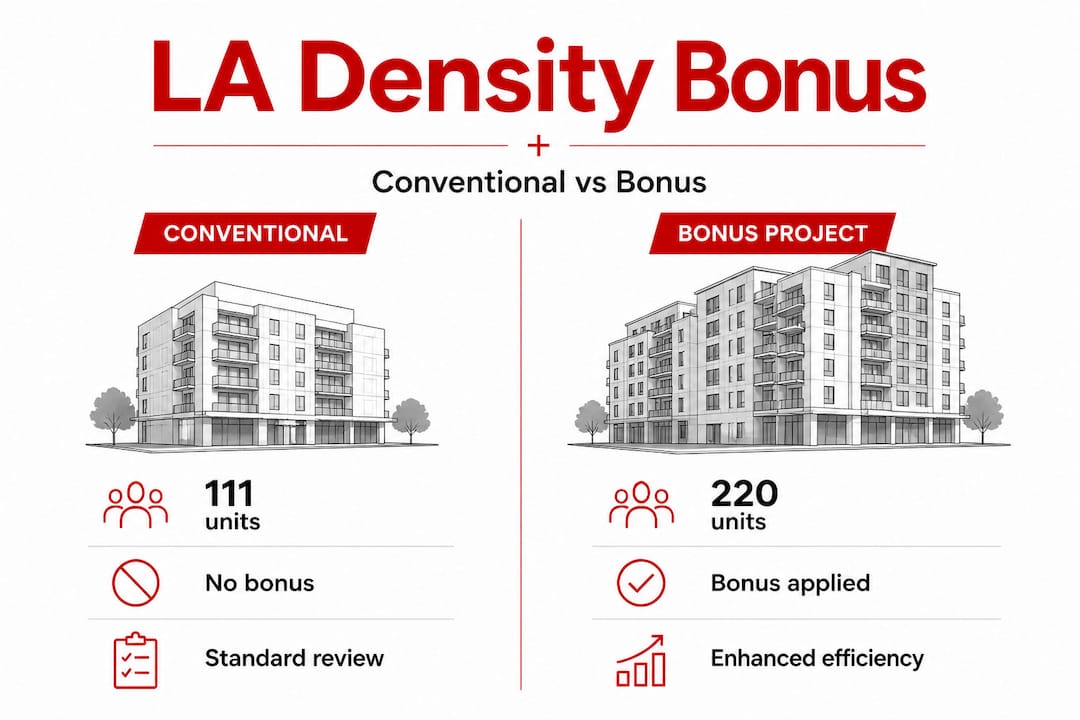
- Density bonus: A state and local program that allows increased unit counts in exchange for reserving a percentage of units as affordable housing. Projects can achieve up to a 100% unit count increase when structured correctly.
- Housing Element policies: LA's state-mandated Housing Element commits the city to specific production targets, which drives favorable treatment for qualifying projects.
- Small Lot Ordinance: Allows subdivision of larger lots into individual smaller lots with attached or detached homes, making infill development in dense neighborhoods more viable.
The density bonus is particularly powerful. Multifamily projects commonly achieve 80 to 85 percent net-to-gross efficiency, and LA density bonus projects have been documented achieving FAR above 1.5 through incentives, as seen in projects along Pico Boulevard. That efficiency directly affects project economics and the number of households you can serve.
The table below compares conventional and density bonus project outcomes side by side.
| Factor | Conventional project | Density bonus project |
|---|---|---|
| Base unit count | 111 units | 111 units |
| Units after bonus | 111 units | Up to 220 units |
| Affordable units required | None | ~35 units |
| Site efficiency | Standard FAR | Up to 50% FAR increase via incentives |
| Community amenity space | Per code minimum | Often expanded to meet bonus criteria |
Understanding multi-family housing options in Los Angeles helps you decide early whether a density bonus strategy makes sense for your site. If you are adding an ADU, understanding how ADU additions affect property value is equally important before you finalize your planning approach.
Designing for livability and community
With regulations in mind, successful LA projects depend on planning that goes beyond rules to enhance how people actually live and connect.
Site massing, which describes the overall three-dimensional form and placement of a building on a site, directly affects how much daylight reaches each unit, how much privacy residents enjoy, and how noise travels through the project. Getting massing right early in design is one of the highest-leverage decisions in the entire process.
Key priorities in livability-focused planning include:
- Daylight and ventilation: Orient units to maximize natural light and cross-ventilation, reducing energy costs and improving resident wellbeing.
- Privacy buffers: Use building setbacks, landscaping, and strategic window placement to separate private spaces from shared areas and neighboring properties.
- Pedestrian access and green space: Design entries, pathways, and outdoor areas that encourage walking and informal interaction, which research consistently links to stronger community health.
- Sustainability integration: Incorporate drought-tolerant landscaping, cool roofing, and solar-ready conduit to meet LA's sustainability goals and attract quality tenants.
"Integrating pedestrian design, open spaces, and sustainability into LA residential projects isn't optional anymore. It's what separates projects that get approved and leased quickly from those that stall."
The shift in how architects approach planning is significant. Adaptive frameworks that balance density with livability through community outreach and iterative design are replacing the rigid masterplanning approach that once dominated large residential projects. This matters because neighborhoods change, and a plan locked in stone in 2026 may be a liability by 2036. Sustainable community designs in Los Angeles reflect this shift, incorporating flexibility from the ground up.
Pro Tip: Use 3D visualization software to show clients and community stakeholders what a project will look and feel like before any permit is filed. Early buy-in reduces objections during the public comment period and often results in design improvements that strengthen the final project.
From blueprint to breakthrough: Practical tips for LA projects
Now that you see why livability counts, here's how to put that knowledge to work on your own project.
Starting with a clear checklist prevents the most common and most expensive planning mistakes. Here is a practical sequence we recommend to LA homeowners and developers before breaking ground:
- Complete a site feasibility assessment before purchasing or committing to a design direction. Confirm zoning, FAR, any deed restrictions, and whether the lot qualifies for density bonus or ADU additions.
- Engage a licensed architect early in the process, not after you have settled on a layout. Early architectural input shapes the project in ways that are easy to adjust in design but very costly to change in construction.
- Run a zoning and code analysis that accounts for setbacks, height limits, parking requirements, and any applicable overlays such as Hillside, Historic Preservation, or Transit Oriented Communities tiers.
- Commission 3D visualizations of your concept massing before finalizing the design. These models surface daylighting issues, privacy conflicts, and community concerns early.
- Schedule stakeholder feedback sessions before submitting for permits. Neighbor concerns raised during a community meeting are far easier to address than appeals filed after permit approval.
- Sequence your permit submittals correctly. In Los Angeles, some projects require discretionary approvals from the City Planning Commission before the building permit application is accepted by LADBS. Submitting out of sequence wastes months.
Flexible frameworks that adapt to community input and changing site conditions are consistently outperforming rigid plans in today's LA market. Understanding the ADU plan check process is essential if your project includes an ADU, and knowing how to maximize ADU design value can significantly improve your return on investment.
Pro Tip: Avoid locking in final unit layouts before your structural engineer has reviewed the concept. Structural requirements in Los Angeles, particularly for projects in Seismic Design Category D, can shift column and shear wall locations in ways that reshape floor plans significantly.
Beyond checklists: What most guides miss about architectural planning
Let's put all of this in perspective. Here is what most articles don't tell you about why planning succeeds or fails in Los Angeles.
Most planning guides focus on compliance. They walk you through zoning codes, permit sequences, and document checklists, and those things absolutely matter. But in our experience, the projects that end up truly successful, where residents want to live for years and communities welcome the building, are the ones where the human dimension was treated as seriously as the regulatory dimension.
Traditional masterplanning tends to fix decisions early and defend them through politics and changing climate conditions. Adaptive, iterative processes treat density as an opportunity rather than a burden, updating designs as new information arrives, as residents' needs become clearer, and as neighborhoods evolve. That approach delivers buildings that people actually want to live in, not just buildings that cleared the permit counter.
Density itself is not a problem. Los Angeles needs more housing, and higher-density projects are a significant part of the solution. The challenge is making sure density gains don't come at the cost of livability. When planning accounts for daylight, privacy, access to outdoor space, and acoustic separation from the start, higher-density projects can feel just as livable as lower-density ones, sometimes more so, because they tend to offer better amenities and more active street frontage.
Our honest advice: involve community members and potential residents as early as the conceptual design phase, not as a box-checking exercise, but as a genuine source of insight. Future residents know things about how they want to live that no code document captures. Architects shaping community value in multi-family projects are the ones who treat that feedback as a design input, not an obstacle. The result is a project that earns approval faster, leases up more quickly, and holds its value longer.
Bring your vision to life with expert LA planning support
If you want support turning these insights into a successful project, here's how to get started.
Professional architectural guidance in Los Angeles ensures your project aligns zoning strategy, livability goals, and community values from day one. At FO+H Architects, we work with homeowners and developers to navigate the full planning process, from feasibility analysis and ADU design to multi-family permitting and community-focused residential architecture.
Whether you're planning a new ADU, a small lot subdivision, or a multi-unit residential building, our team brings local expertise and a design philosophy rooted in social equity and cultural context. Explore our residential planning resources and multi-family design services to find the right fit for your project. We're here to help you build something that works, for your family, your tenants, and your neighborhood.
Frequently asked questions
What are the main stages of architectural planning?
The stages include site assessment, zoning analysis, conceptual design, detailed drawings and revisions based on regulations and engineer collaboration, and iterative feedback cycles before final permit approval.
How does LA's density bonus affect residential projects?
LA's density bonus program can allow developers to double unit counts, for example from 111 to 220 units, when a set number of affordable units, typically around 35, are reserved within the project.
Why is community engagement important in planning?
Community engagement surfaces design concerns early, improves livability decisions, and reduces opposition during public review periods, all of which lead to faster approvals and stronger project outcomes.
What's the difference between a masterplan and adaptive planning?
Masterplans lock in decisions early and resist change, while adaptive planning evolves with resident input, updated codes, and shifting community needs to produce better long-term results.
What should I prioritize to maximize livability and value in my LA project?
Focus on flexible layouts, ample natural light, access to green space, and compliance with LA zoning and density policies to build a project that holds strong value and attracts quality residents.