

TL;DR:
- Effective LA home planning requires understanding zoning, site constraints, and clear goal-setting.
- Assembling a knowledgeable local team early helps navigate LA's complex permitting process smoothly.
- Designing with community, sustainability, and local context in mind leads to more successful and enduring homes.
Planning a home in Los Angeles means balancing personal vision against a layered system of zoning codes, permitting requirements, and site-specific constraints that can derail even the most thoughtful projects. Many homeowners start with design ideas and discover too late that their lot's zoning, slope, or overlay district rules out the very features they wanted most. A phased, methodical approach prevents that frustration. This guide walks you through each stage of residential planning in LA, from goal-setting and feasibility through permits and personalization, so you can move forward with confidence and avoid costly redesigns.
Table of Contents
- Define your goals, budget, and site feasibility
- Assemble your team and refine your vision
- Navigate the permitting process and approvals
- Overcome common challenges and focus on personalization
- Why the official planning process misses the heart of LA home design
- Get expert guidance for your LA residential project
- Frequently asked questions
Key Takeaways
| Point | Details |
|---|---|
| Start with feasibility | Begin your residential project by checking site zoning and setting a realistic budget to avoid costly redesigns. |
| Build your expert team early | Engage your architect and collaborators before design starts to streamline approvals and meet LA’s strict codes. |
| Plan for permits and compliance | Expect 2-6 weeks to several months for permit approvals, with special attention to Title 24 and site-specific challenges. |
| Personalization pays off | Homes that balance your lifestyle needs and community values with LA regulations are more comfortable and more likely to be approved. |
Define your goals, budget, and site feasibility
Every successful residential project in Los Angeles starts with three things: a clear vision of what you need, a realistic budget, and a solid understanding of what your site actually allows. Skipping any one of these early steps is the most common reason projects stall or require expensive redesigns later.
Start with your goals. Write down how you plan to use the space. Are you adding an ADU (accessory dwelling unit) to generate rental income? Expanding your kitchen and living area for a growing family? Building a new home from the ground up? Your goals directly shape the design scope, the team you'll need, and the permits required. Exploring innovative home design ideas early can help you articulate what you want before you meet with an architect.
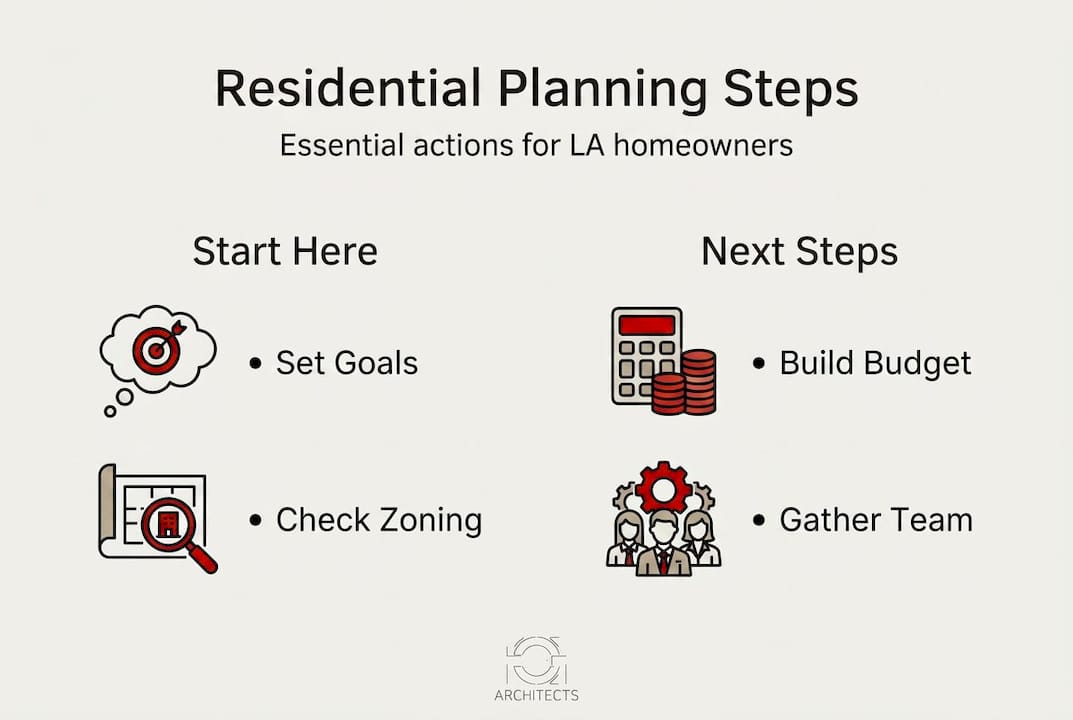
Check your site feasibility before anything else. Zoning review with ZIMAS is the essential first step in residential planning in Los Angeles, giving you instant access to your parcel's zoning designation, floor area ratio (FAR), height limits, setbacks, and any overlay districts that apply. FAR determines the maximum square footage you can build relative to your lot size. If you're zoned R1 with a 0.5 FAR on a 6,000 sq ft lot, you're capped at 3,000 sq ft of living space. Knowing this before you sketch a single floor plan saves weeks of wasted effort.
Pro Tip: Run your address through ZIMAS before your first design conversation. Zoning and FAR restrictions will define your project's ceiling, and early feasibility over aesthetics prevents the painful experience of falling in love with a design your lot can't legally support.
Build a realistic budget with contingency built in. LA construction costs are among the highest in the country. Below is a sample budget framework to help you plan:
| Project type | Estimated cost range | Soft costs (design, permits) | Contingency |
|---|---|---|---|
| ADU (new detached) | $200,000 to $400,000 | 10 to 15% | 10 to 20% |
| Home remodel | $150,000 to $500,000+ | 8 to 12% | 10 to 20% |
| New construction | $500,000 to $1.5M+ | 12 to 18% | 15 to 20% |
Soft costs include architectural fees, engineering, permit fees, and consultant charges. The contingency line is not optional. Unexpected soil conditions, utility conflicts, and agency correction cycles are common in LA, and a 10 to 20% buffer protects your project from going over budget before construction even completes.
Key budget components to account for from the start:
- Architectural and engineering fees
- Permit and plan check fees (LADBS, Fire, DWP, and others)
- Geotechnical or soils report (required on hillside and sloped lots)
- Utility connections and upgrades
- Landscaping and site work
- Construction hard costs (labor and materials)
Once your vision is clear and your site feasibility checked, it's time to assemble your residential planning team.
Assemble your team and refine your vision
The right team makes or breaks a residential project in Los Angeles. This city has some of the most complex local building regulations in the country, including hillside grading rules, seismic requirements, and strict Title 24 energy standards. You need professionals who know these rules from daily practice, not just from reading the code.
Who belongs on your team:
- Architect: Leads design, coordinates drawings, and ensures code compliance. The role of architects in LA design is central to both creative and regulatory success.
- Structural engineer: Required for new construction, additions, and any work on hillside or soft-soil sites. Seismic design is non-negotiable in LA.
- Civil engineer: Handles grading plans, drainage, and site utilities, especially important on sloped lots.
- Permit expediter: A local specialist who knows LADBS (Los Angeles Department of Building and Safety) processes, tracks your application, and responds to correction notices quickly.
- General contractor: Brings constructability knowledge to the design phase, which prevents costly field changes during construction.
LA's strict regulations around hillside development, seismic design, and energy compliance demand an integrated team from the very beginning. Delays in LA permitting most often trace back to incomplete plan sets or missing clearances, both of which are preventable when your team is coordinating from day one.

Refine your vision with lifestyle in mind. This is the phase where design gets personal. Work with your architect to identify how you actually live. Do you cook and entertain frequently? A connected indoor/outdoor kitchen and dining area may be your priority. Do you work from home? A dedicated flex space with acoustic separation matters more than square footage. Custom solutions for LA homes are most effective when lifestyle priorities are documented early and carried through every design decision.
Title 24 energy compliance is not something to address at the end of design. California's Title 24 energy code sets mandatory standards for insulation, glazing, HVAC systems, and lighting. Your architect and mechanical engineer need to integrate energy compliance into the design from the start, not retrofit it after the floor plan is set. Buildings designed with passive solar orientation, high-performance windows, and efficient mechanical systems often achieve compliance more easily and perform better long-term.
Pro Tip: When interviewing architects and contractors, ask specifically about their recent LA residential projects. Local code knowledge, familiarity with LADBS correction cycles, and relationships with city plan checkers are worth more than a polished portfolio alone.
With your team assembled and your vision clarified, the next focus is navigating the Los Angeles permitting process.
Navigate the permitting process and approvals
Permitting is where many LA residential projects slow down. Understanding the process in advance, including what documents are required, which agencies are involved, and how long each stage takes, gives you realistic expectations and helps you plan your project timeline accurately.
The permitting journey in Los Angeles follows this sequence:
- Zoning review: Confirm your project complies with the applicable zoning code, including use, FAR, setbacks, and height. This happens before plan check.
- Plan check: Submit your full drawing set to LADBS for review. Plan checkers verify structural, architectural, mechanical, electrical, and plumbing compliance. Corrections are common and may require one or more resubmittal cycles.
- Agency clearances: Depending on your project, you may need sign-off from the LA Fire Department, Department of Water and Power (DWP), Bureau of Engineering, and others. Each agency has its own timeline.
- Permit issuance: Once all clearances are secured and plan check is approved, LADBS issues your building permit. Construction can begin.
Expected timelines vary by project type. The LADBS homeowners guide outlines that residential remodels typically take 2 to 6 weeks, ADUs run 6 to 12 weeks, and new home construction commonly requires 3 to 6 months for permit issuance. For more detail on the ADU-specific process, the ADU plan check process guide covers each stage in depth.
"Permits for new homes in Los Angeles average 111 to 116 days from submission to issuance, and that timeline assumes a complete, well-coordinated plan set with no major correction cycles."
Building permits in LA average 4 to 6 months for new construction, which is why your budget contingency and project schedule both need to account for this reality. Rushing the plan set to submit early almost always backfires, because incomplete submissions trigger correction notices that add weeks to the process.
Common bottlenecks to watch for:
- Missing Title 24 energy documentation or mechanical calculations
- Incomplete structural details or missing soils report on hillside sites
- Fire Department clearance delays on projects near brush hazard zones
- DWP capacity or service upgrade requirements that weren't anticipated
Understanding the residential design workflow before you submit helps your team anticipate these issues and address them proactively in the drawing set.
After understanding approvals, you'll want to prepare for LA's unique design and compliance challenges, especially for hillside, coastal, and community-focused homes.
Overcome common challenges and focus on personalization
Los Angeles is not a uniform city. Your project's location, whether it's on a hillside in Silver Lake, near the coast in Venice, or in a flat neighborhood with an active HOA, shapes the specific challenges you'll face. Knowing these challenges in advance lets you plan around them rather than react to them.
Top design challenges and how to address them:
- Hillside and sloped sites: These require a geotechnical (soils) investigation and grading permit in addition to your building permit. Hillside sites need geotech and grading permits, plus a soils report before structural design can be finalized. Budget extra time and cost for this phase.
- Coastal overlay districts: Projects near the coast fall under California Coastal Commission jurisdiction, adding a separate approval layer with its own timeline and design standards.
- HOA requirements: Many LA neighborhoods have homeowners associations with design review boards. Their approval process runs parallel to city permitting and can add months if your design doesn't align with their guidelines.
- Drought and water efficiency: LA's climate and ongoing water restrictions mean native and drought-tolerant landscaping is increasingly expected, and in some cases required, as part of project approvals.
- Title 24 compliance on existing buildings: Remodels that exceed a certain scope trigger whole-building energy upgrades, which can significantly affect your budget.
Personalization within these constraints is absolutely achievable. Custom home design for LA homeowners works best when lifestyle priorities, like flex spaces that adapt to remote work or multigenerational living, and outdoor living areas that connect to interior spaces, are integrated into the design from the beginning rather than added as afterthoughts.
Staying current with modern architecture trends in LA can also help you make design choices that hold their value over time. Passive cooling strategies, solar-ready roofs, and indoor/outdoor flow are not just aesthetic preferences in Los Angeles; they're practical responses to the climate and energy costs that make your home more comfortable and more marketable.
Pro Tip: If your site has a slope greater than 15%, is near a hillside designated area, or is located within an HOA, engage a geotechnical consultant and your HOA's design review contact before finalizing your design. Early input from these parties prevents redesign at the worst possible moment. For more practical guidance, tips for modern LA homes covers design decisions that hold up well through the approval process.
All these steps bring us to a finished, compliant, and comfortable home, so what does success actually look like?
Why the official planning process misses the heart of LA home design
In our experience working on residential projects across Los Angeles, the official planning sequence, goals, then team, then permits, then construction, is a useful framework but not a complete picture of how the best projects actually come together.
The homeowners who end up most satisfied with their homes are the ones who treated feasibility and design as parallel conversations, not sequential ones. They brought their architect into early zoning discussions. They shared neighborhood context with their engineer. They asked their contractor to review the design before plan check submission. This concurrent approach consistently shortens timelines and surfaces problems earlier, when they're cheaper and easier to solve.
City guidelines enforce structure, and we respect that. But the code tells you what you can build, not what you should build. The homes that age well in Los Angeles, the ones that feel right in their neighborhoods and serve their families for decades, are the ones where the design reflects something real about the people who live there and the community around them. That means thinking about cultural context, about how neighbors interact, about how the street feels from the front porch.
Sustainable LA community homes that integrate native planting, shared outdoor space, and energy-efficient systems don't just check boxes for approvals. They contribute to the neighborhood in a way that purely code-compliant buildings often don't. That's the standard we hold our own projects to, and it's the standard we'd encourage every LA homeowner to aim for.
Get expert guidance for your LA residential project
Navigating Los Angeles residential planning on your own is possible, but it's a lot easier with the right support from the start. At FO+H Architects, we've built our practice around helping homeowners like you move from vision to permitted, built reality without the guesswork.
Whether you're starting with an ADU or planning a full custom home, our team brings deep local knowledge of LA zoning, LADBS processes, and community-centered design. Browse our ADU Store for pre-designed, permit-ready ADU plans built specifically for Los Angeles lots, including our popular Gold ADU plans that give you a strong starting point without starting from scratch. Ready to talk through your specific lot and goals? Schedule a consultation and let's build something that fits your life and your neighborhood.
Frequently asked questions
How long does it take to get residential permits in Los Angeles?
Permitting timelines vary by project: remodels typically take 2 to 6 weeks, ADUs run 6 to 12 weeks, and new home construction averages 3 to 6 months, with LADBS data showing an average issuance time of 111 to 116 days for new homes.
What is the first step in residential planning for LA?
Start by defining your goals, setting a realistic budget, and running a zoning check via ZIMAS to confirm what your site actually allows before any design work begins.
Who should be on my residential project team?
You need an architect, structural engineer, permit expediter, and an experienced LA-based contractor; the construction process at LADBS outlines why each role is critical to a compliant, on-schedule project.
How do community values affect my home design in LA?
Native landscaping and energy efficiency are two of the most practical ways to align your design with LA community values, and they also support smoother approvals with local agencies and design review boards.