

TL;DR:
- The ideal LA floor plan depends on climate, privacy needs, zoning, and lifestyle preferences.
- Open plans maximize light and flow but can cause noise; semi-open offers a balance.
- Choosing the right layout should reflect how you live, with flexibility for future needs.
Choosing a floor plan for your Los Angeles home is one of the most consequential decisions you'll make during a renovation or new build. The layout you choose shapes how your family moves through the house every single day, whether you can host guests comfortably, how much natural light fills your rooms, and even how your property performs on the market. With so many modern options available, and with LA's unique climate, zoning rules, and lifestyle demands in the mix, it's easy to feel overwhelmed before you've even started. This guide breaks down the main modern floor plan types and helps you match the right layout to your actual life.
Table of Contents
- How to choose the right modern floor plan for your LA lifestyle
- Open floor plans: Maximizing light and flow
- Semi-open and broken plans: Best of both worlds?
- Split bedroom floor plans: Privacy for families and guests
- Single-story vs. two-story layouts: Accessibility, space, and LA considerations
- Summary comparison of modern floor plan types
- Why the best floor plan is personal to every LA homeowner
- Transform your LA home with the right floor plan
- Frequently asked questions
Key Takeaways
| Point | Details |
|---|---|
| Open layouts | Combine living, dining, and kitchen areas for seamless interaction and maximum light. |
| Semi-open solutions | Partial walls or furniture create adaptable zones, balancing openness with privacy. |
| Split bedroom design | Separating the main suite offers enhanced privacy, perfect for families or guests. |
| Single vs. two-story | Single-story homes offer accessibility; two-story homes maximize space and separation. |
| Customization matters | Tailoring your floor plan to lifestyle and LA needs delivers the best results. |
How to choose the right modern floor plan for your LA lifestyle
Now that you know why the right plan matters, here's how to approach your decision and what to consider before choosing a layout. In our experience working with homeowners across Los Angeles, the biggest mistake people make is selecting a plan based purely on how it looks in photos. A layout that photographs beautifully may not actually support the way you cook, entertain, or rest.
Before committing to any floor plan type, consider these key factors:
- Local climate and indoor-outdoor living. Los Angeles has mild weather year-round, which means your floor plan should support seamless transitions between interior and exterior spaces. Indoor-outdoor continuity via pocket doors and matching materials is standard for renovations, enhancing usability year-round under Title 24 codes. If your layout doesn't account for this, you're leaving one of LA's best assets untapped.
- Privacy needs. Are you a multigenerational household with grandparents living on-site? Do you share your home with roommates? These situations call for very different bedroom arrangements and sound separation strategies than a single-person household or a couple without children.
- Regulation and code compliance. Title 24 (California's energy efficiency standard) influences everything from window placement to insulation requirements. Zoning rules in LA also affect lot coverage, setbacks, and building height, which directly shape which plan types are even possible on your property.
- Flow, light, and entertaining. If you love hosting, an open layout gives you room to breathe. If you need a quiet home office or a space where kids can sleep while adults entertain, you'll want zones and separation built into the design.
Pro Tip: Before touring floor plans online, write down a typical Tuesday and a typical Saturday in your home. What spaces do you use? When? With whom? Those two days will tell you more about your real layout needs than any design magazine will.
Exploring innovative Los Angeles design ideas can also spark directions you hadn't considered. And if you want a technical foundation, reviewing architecture tips for LA homes gives you a solid grounding in local construction realities before your design process begins.
Open floor plans: Maximizing light and flow
With that selection framework in mind, let's explore what sets each modern plan type apart, starting with the ever-popular open layout.
Open floor plans have dominated residential design for the past two decades, and for good reason. In an open layout, the kitchen, dining area, and living room share one connected space without full walls dividing them. Open floor plans combine kitchen, dining, and living areas into seamless spaces, emphasizing flow and natural light. This makes the home feel larger than its square footage suggests and supports the kind of casual, connected living that many LA households prefer.
Key features of open floor plans include:
- Large, uninterrupted living zones that allow furniture to be rearranged to suit different occasions
- Natural light penetration across multiple functional areas without interior walls blocking it
- Easy supervision of children from the kitchen while cooking
- Ideal for entertaining since guests can move freely between spaces
- Strong visual continuity that pairs well with outdoor patios and decks via sliding or pocket doors
"Pure open plans excel in light and flow but can amplify noise; broken and semi-open hybrids offer nuance for family privacy, a growing 2026 trend per designers."
The trade-offs are real. Noise travels freely in an open plan. Cooking smells spread throughout the home. If one person is on a video call and another is watching TV, conflict is inevitable. For homeowners with children, home offices, or anyone who values sound separation, a pure open plan may create daily friction.
Pro Tip: If you love the look of an open plan but need some acoustic control, consider a partial kitchen partition or a slightly raised ceiling in one zone. These small architectural moves can dampen noise without closing off the visual connection between spaces.
For context on how these trends fit within Los Angeles specifically, LA modern architecture trends offers a useful overview of where residential design is heading in the city.
Semi-open and broken plans: Best of both worlds?
While open plans draw attention, many LA homeowners are turning to layouts that offer flexibility without sacrificing separation or comfort.
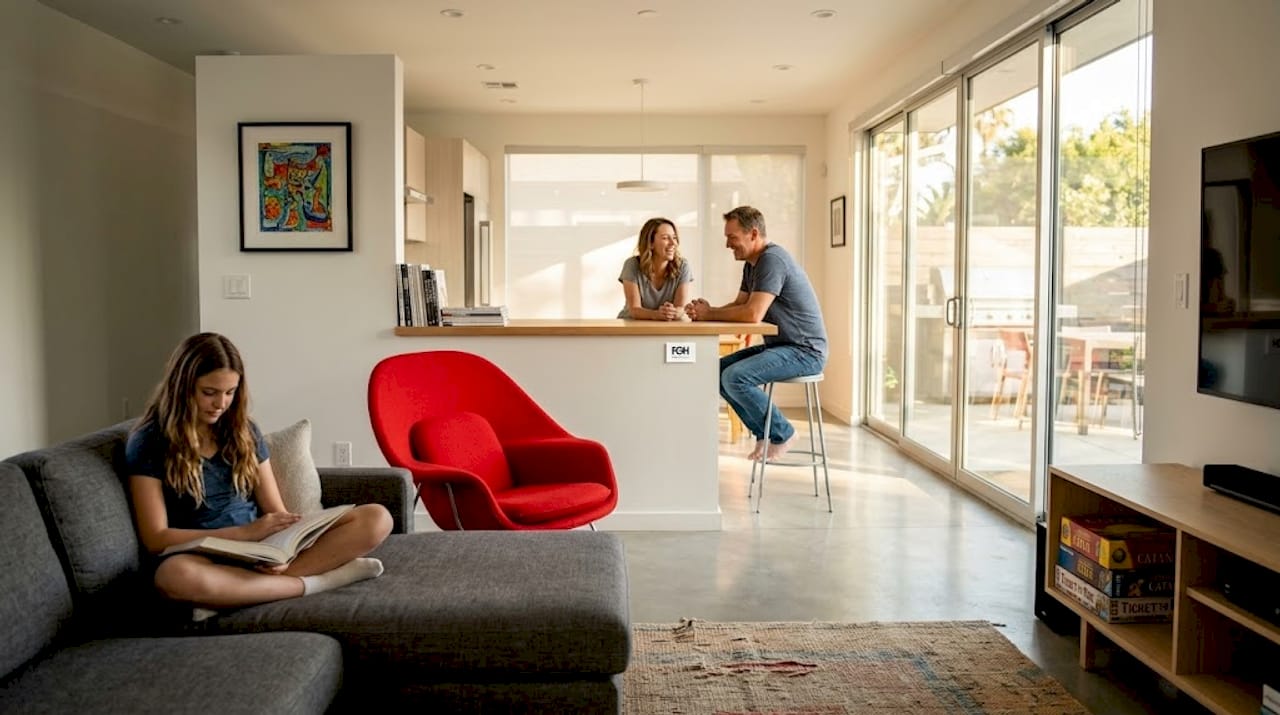
The semi-open or broken floor plan has become one of the most requested layouts in our practice. Rather than fully removing walls, this approach uses partial walls, level changes, built-in shelving, or strategic furniture placement to define distinct zones within a connected space. Semi-open or broken floor plans use partial walls, level changes, or furniture to define zones while maintaining openness, addressing noise and privacy issues in pure open concepts.
Here's why this layout works so well for LA households:
- Zones feel intentional. A half-wall between the kitchen and dining area signals "these are different spaces" without blocking light or sightlines.
- Noise stays contained. A small level change or a built-in bookshelf can absorb sound without requiring a full wall.
- Flexibility over time. As your household changes, zones can be redefined with furniture rather than requiring costly construction.
- Works across home sizes. Whether you have 900 square feet or 2,400, broken-plan zoning can be scaled to fit.
"Broken and semi-open hybrids offer nuance for family privacy, a growing 2026 trend per designers."
For LA families specifically, the semi-open plan often hits the sweet spot. You get the visual lightness and social connectivity of an open plan, but without the acoustic chaos. In renovations of older mid-century homes, we often recommend breaking down one or two full walls while keeping a structural element like a beam or a low partition in place. The result feels modern and open while still functioning practically.
If you want to explore how this works in real projects, optimizing LA layouts walks through several real-world scenarios. You can also learn more about customizing LA floor plans to see how this approach adapts to different lot types and family configurations.
Split bedroom floor plans: Privacy for families and guests
Beyond common living areas, the arrangement of bedrooms matters. A split plan can dramatically enhance comfort in your LA home.
A split bedroom floor plan places the primary suite on one side of the home and positions secondary bedrooms on the opposite side, with common areas in between. Split bedroom layouts separate the primary suite from secondary bedrooms for privacy, ideal for families. This simple arrangement has a surprisingly large impact on daily quality of life.
Consider these scenarios where a split bedroom plan delivers real value:
- Families with young children. Parents can have a quiet retreat at night while children's rooms are grouped together for easier supervision during the day.
- Multigenerational households. An aging parent or in-law can occupy the primary suite with greater privacy and independence, while the rest of the family clusters in a separate wing.
- Homeowners who frequently host guests. Placing guest bedrooms on the opposite end of the home from the primary suite means visitors don't interrupt your sleep schedule, and you don't interrupt theirs.
- Roommate situations. In shared living arrangements, a split plan creates natural separation that reduces friction and preserves personal space.
- Home offices near secondary bedrooms. Many homeowners position a home office adjacent to the secondary bedroom wing, away from the primary suite, so late-night work sessions don't disturb a sleeping partner.
The split bedroom plan integrates cleanly with both open and semi-open living layouts. Your common areas can remain fully connected and social, while the bedroom wings stay acoustically separated. This makes it one of the most practically versatile arrangements for modern LA households.
For more detail on how this fits into a broader residential design strategy, custom residential solutions in LA provides helpful context on how architects approach bedroom arrangement in custom homes.
Single-story vs. two-story layouts: Accessibility, space, and LA considerations
No matter which zone or bedroom arrangement you prefer, deciding between a single or two-story plan shapes both your home's footprint and how you'll use it day to day.
Single-story layouts offer accessibility and ease, suitable for all ages and LA's flat lots, while two-story plans separate public and private spaces. Both have genuine strengths, and the right choice depends heavily on your specific lot, household, and long-term goals.
| Factor | Single-story | Two-story |
|---|---|---|
| Accessibility | Excellent; no stairs | Requires stair navigation |
| Yard space | Larger footprint, less yard | Smaller footprint, more yard |
| Energy efficiency | Easier to condition; less HVAC complexity | Can zone heating and cooling by floor |
| Privacy | All spaces on one level, requires smart layout | Natural separation of sleeping and living areas |
| Cost per sq ft | Generally lower construction cost | Can be more cost-effective on small lots |
| Best for | Aging in place, flat lots, accessibility needs | Narrow lots, maximizing square footage |
| LA zoning note | Often simpler permitting on standard lots | Height and setback rules apply; check local codes |
Pro Tip: If your lot is narrow or you're trying to preserve yard space for outdoor living (a big priority in LA), a two-story plan often makes more financial and functional sense. But if you have family members with mobility concerns or expect to age in place, the single-story plan removes a category of daily risk entirely.
When you're also evaluating an ADU on the same property, story count matters even more. The ADU plan check process in LA explains how height and setback rules interact with your primary home's layout and can affect your ADU options.
Summary comparison of modern floor plan types
Unsure which option clicks for your project? This quick chart lays out the essentials so you can see the differences at a glance.
| Floor plan type | Key feature | Best for | Main trade-off |
|---|---|---|---|
| Open | No interior walls between living zones | Entertainers, smaller homes, light-focused design | Noise and privacy issues |
| Semi-open / broken | Partial walls or level changes to define zones | Families, hybrid lifestyle needs | Requires thoughtful design to avoid feeling incomplete |
| Split bedroom | Primary suite separated from other bedrooms | Families, multigenerational, roommates | Longer interior circulation paths |
| Single-story | All spaces on one level | Accessibility, flat lots, aging in place | Larger footprint, less yard |
| Two-story | Living areas below, sleeping above (typically) | Narrow lots, larger families, privacy by floor | Stair access, more complex HVAC |
No single plan type wins across all categories. The most effective modern homes in Los Angeles typically combine elements from two or more of these types, using an open or semi-open living zone paired with a split bedroom arrangement and a carefully chosen story count based on the lot.
Why the best floor plan is personal to every LA homeowner
Here's the real-world truth about selecting a floor plan in LA: the most popular or the most "modern" layout is not automatically the right one for you. We've worked with homeowners who came to us convinced they wanted a fully open plan after seeing it on social media, only to realize during design conversations that they actually needed quiet study spaces, sound separation for a home business, or a guest suite that wouldn't feel intrusive.
Conventional design advice often pushes toward what's trending. In 2026, that's the semi-open broken plan and the indoor-outdoor connection. These are genuinely excellent directions, but they work best when filtered through your specific household's daily rhythms, not imposed on top of them.
Based on our experience in Los Angeles specifically, three factors consistently outweigh headline trends: the legal constraints of your specific lot and zoning district, the cultural and social patterns of your household, and the practical reality of how you'll occupy the home over the next ten to twenty years. A floor plan that doesn't account for all three will create friction, even if it looks exceptional on paper.
The role of LA architects in this process is not just to draw a layout but to ask the right questions before a single line is put on paper. The best outcomes we've seen come from homeowners who treat the design process as iterative, starting with a clear brief about how they actually live, then testing plan options against that brief before committing to construction documents.
Transform your LA home with the right floor plan
If you're ready to take the next step, here's how to translate inspiration into a flawless Los Angeles home or ADU.
At FO+H Architects, we design floor plans that are built specifically for Los Angeles regulations, lot conditions, and the way real families live. Whether you're exploring a ground-up build, a whole-home renovation, or an ADU addition, our team combines local expertise with thoughtful design to deliver layouts that work on every level.
Browse our collection of pre-designed modern ADU plans that are already calibrated for LA zoning and Title 24 compliance. If you're looking for a specific starting point, the Gold ADU plan is a standout option for homeowners who want a high-quality, permitted unit without starting from scratch. And if your project calls for a fully custom approach, the Fo Studio design experts are ready to guide you from initial concept through permitted construction documents, with a collaborative process that keeps you informed and in control at every stage.
Frequently asked questions
What is the most popular modern floor plan for Los Angeles homes?
Open floor plans that blend living, dining, and kitchen areas are the most sought-after for LA's lifestyle and climate, offering seamless flow and natural light that suits the city's indoor-outdoor culture.
How does Title 24 impact modern floor plans?
Title 24 sets energy efficiency standards that influence material choices, window placement, and indoor-outdoor connections in LA homes. Indoor-outdoor continuity via pocket doors and matching materials is standard for renovations under these codes, affecting how transitions between spaces are designed.
Are single-story homes better for families?
Single-story layouts offer easy accessibility and are ideal for families with young children, elderly members, or anyone planning to age in place, since all rooms remain on one level without stair navigation.
What is a split bedroom floor plan?
A split bedroom plan separates the primary suite from other bedrooms to increase privacy for owners, guests, or roommates. Split bedroom layouts place common areas between the bedroom wings, so each side of the home functions independently for sound and privacy.