

TL;DR:
- Understanding architectural terms empowers homeowners to communicate confidently and avoid costly errors.
- Local LA codes and amendments modify general definitions, making knowledge of specific standards essential.
- Being familiar with key concepts helps clients actively participate and make informed decisions throughout their project.
Architectural jargon is not just for professionals. When you sit across the table from an architect or designer discussing your custom home in Los Angeles, the words used in that conversation shape every decision that follows. Misunderstanding a single term, like confusing a load-bearing wall with a partition wall, can result in costly change orders and delays. This guide covers the essential residential architecture terms you need, how LA codes define them, and how to use this vocabulary confidently so you stay in control of your project from the first meeting to the final walk-through.
Table of Contents
- Why architectural terminology matters for homeowners
- 10 essential residential architecture terms you need to know
- Standard codes and architectural frameworks in Los Angeles
- Applying your knowledge: Guiding your LA home project
- Our perspective: Why mastering the language is your smartest design move
- Continue your LA architecture journey with FO Studio
- Frequently asked questions
Key Takeaways
| Point | Details |
|---|---|
| Language is power | Knowing architectural terms gives you greater control and confidence in your LA home project. |
| Local codes matter | Understanding how LA’s building rules shape design helps you avoid surprises and plan wisely. |
| Prepare for meetings | Reference this guide before discussing plans with architects or contractors to get better results. |
| Apply knowledge early | Use your vocabulary from day one to catch issues and clarify expectations for your custom home. |
Why architectural terminology matters for homeowners
Many homeowners assume that architectural terms are something to leave to the professionals. In our experience, that assumption is exactly what causes the most expensive problems on custom home projects. When you understand the language, you become an active participant in every design decision, not just a bystander approving drawings you barely recognize.
Clear communication directly saves money. When a homeowner and architect use different definitions for the same word, that misalignment eventually shows up as a change order, a delay, or a design feature that does not match the original vision. Based on how we see projects unfold, a single misunderstood term during schematic design can cost thousands of dollars by the time it surfaces in construction.
Knowing the right words also helps you advocate for what you actually want. You might know exactly how you want your kitchen to feel, but being able to describe it with terms like "open plan," "clerestory windows," or "structural span" tells your architect far more than "bright and open." That precision protects your vision.
In Los Angeles, community homes face a specific layer of complexity because local code blends national standards with California-specific and city-level amendments. The Los Angeles County Residential Code 2025 is built on the IRC for residential dwellings, which governs one- and two-family homes and forms the backbone of LA residential standards. Understanding even a few of those terms puts you in a much stronger position.
Here are situations where a terminology gap created real problems:
- A homeowner approved "non-rated partitions" without knowing that meant the walls had no fire resistance, changing their open floor plan significantly.
- A client requested "a wider eave" but did not realize the setback rules in their zone limited roof overhangs, leading to a redesign.
- During framing, a contractor removed what the homeowner thought was a closet wall, but it was actually a shear wall, triggering a structural review.
The role of architects includes translating technical requirements into plain language, but you should not rely entirely on that translation. The more you know, the better the collaboration.
Pro Tip: Print a one-page glossary of common architectural terms before any design meeting and ask your architect to clarify every term that is new to you. Most architects welcome clients who ask good questions.
10 essential residential architecture terms you need to know
Armed with motivation, let's get into the language itself. These ten terms come up in almost every residential project in Los Angeles. Knowing them gives you a functional foundation for any design conversation.
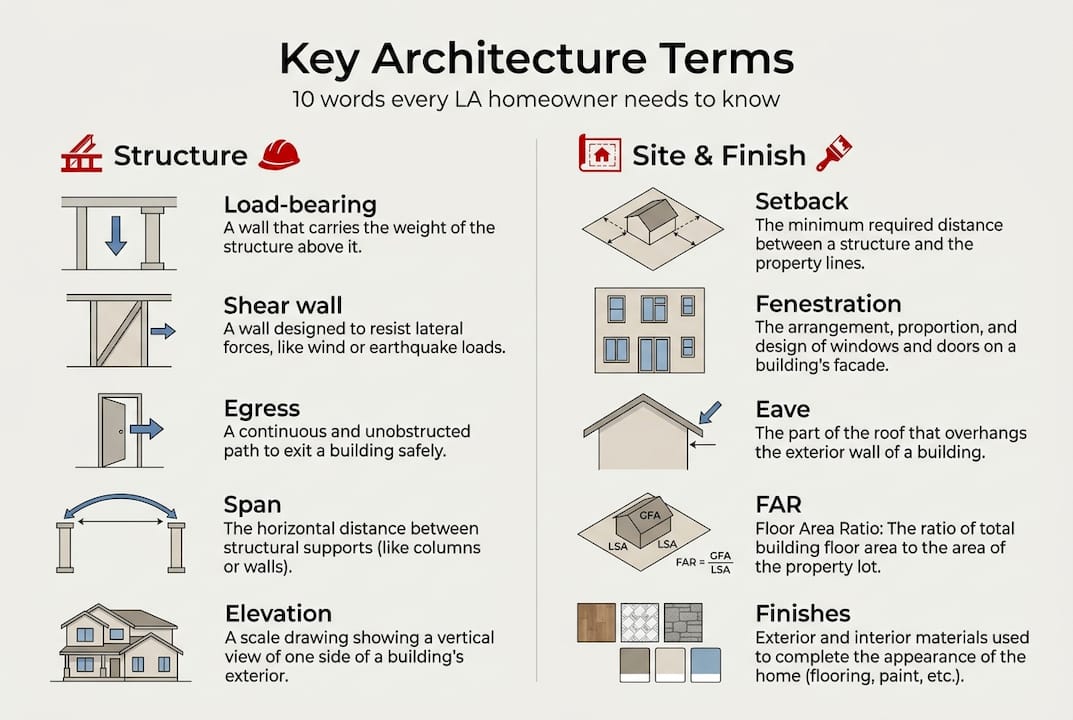
A load-bearing wall supports the weight of the structure above it, and its removal always requires review by an engineer or architect. This is one of the most misunderstood terms in residential renovation.
A setback is the required minimum distance between a structure and a property line, street, or other feature. LA zoning codes specify setbacks for front, rear, and side yards.
Fenestration refers to the arrangement and design of windows, doors, and other openings in a building. It directly affects natural light, ventilation, and energy performance.
An eave is the lower edge of a roof that overhangs beyond the exterior wall. Eave design affects drainage, shading, and wildfire compliance in LA.

Egress means any code-compliant exit point from a room or building. Bedrooms in LA must have egress windows that meet minimum size requirements.
A shear wall is a structural panel that resists lateral forces, especially important in LA's seismic zones.
Floor-area ratio (FAR) is the total floor area of a building divided by the lot size. It controls how large your home can be relative to your property.
Structural span refers to the distance a beam, joist, or other structural member must bridge without support.
Elevation in architecture means a flat, two-dimensional drawing showing one face of a building. It is how your home looks from the outside, as drawn.
Finish schedule is a document that lists every surface material and finish in a room, from flooring to paint.
| Term | What it means | Why it matters in LA |
|---|---|---|
| Load-bearing wall | Supports structure above | Removal needs engineer sign-off |
| Setback | Distance from property line | Zoning controls density and spacing |
| Fenestration | Window and door openings | Tied to Title 24 energy compliance |
| Shear wall | Lateral force resistance | Critical in seismic zones |
| FAR | Floor area to lot size ratio | Limits total buildable area |
| Egress | Code-compliant exit | Required in all sleeping rooms |
Three common pitfalls homeowners run into with these terms:
- Assuming any interior wall can be removed freely without checking if it is load-bearing or a shear wall.
- Confusing "setback" with "lot coverage," which are two separate zoning measurements.
- Thinking fenestration is only about aesthetics, when it is also a key factor in inclusive design and energy code compliance.
These terms also show up constantly in architecture trends shaping LA homes, so knowing them now gives you a head start on any future remodel or addition.
Standard codes and architectural frameworks in Los Angeles
Having defined the language, let's see how the rules and codes shape what those words mean in practice. Los Angeles does not simply adopt national standards word-for-word. The city and county layer local amendments on top of the International Residential Code standards for one- and two-family dwellings, which serves as the baseline for all residential work in the region.
This layering matters because a term like "egress" might have a national minimum size, but LA can set stricter requirements. The same is true for fire ratings, seismic bracing, and energy compliance under California's Title 24. When your architect references a code section, it is worth asking whether that is an IRC standard, a California amendment, or an LA-specific rule.
Here is a comparison of key terms as defined broadly and in the LA context:
| Term | General definition | LA/IRC context |
|---|---|---|
| Egress | Exit from a space | Minimum window size per IRC R310; stricter in some LA zones |
| Fire rating | Time a material resists fire | Stricter in wildfire zones under LA amendments |
| Setback | Distance to property line | Varies by zoning district; can be reduced by variance |
| Structural anchorage | Connection of structure to foundation | Enhanced seismic requirements in LA |
| Occupancy type | Classification of building use | Determines which code sections apply |
A common source of frustration we see is when homeowners begin a project believing their designer or contractor is following one version of the code, only to discover mid-project that a more recent amendment applies. The design workflow for your LA home should always include a clear step where your architect confirms which code version governs your permit.
Code misunderstandings are not rare. Contractors and even some designers sometimes reference outdated code editions. Knowing enough to ask the right question can prevent a costly correction.
Pro Tip: At your first meeting, ask your architect specifically which edition of the Los Angeles County Residential Code applies to your project and whether any local amendments affect your zoning district.
Applying your knowledge: Guiding your LA home project
Now that you know what the words mean and why, here is how to put it into practice. Learning vocabulary is only valuable when you use it to make better decisions. Here are concrete steps to apply your new knowledge from the first meeting through construction.
Step 1: Before your initial meeting with an architect, review the basic terms in this guide and write down two or three design priorities using those terms. For example, "I want to maximize fenestration on the south elevation" or "I need to confirm which walls are load-bearing before planning our kitchen renovation."
Step 2: When reviewing plans, look at the floor plan and elevations together. Ask your architect to walk you through any shear walls, load-bearing elements, and setback lines drawn on the site plan.
Step 3: Ask specific questions about anything labeled on the drawings that you do not recognize. Architects use abbreviations and shorthand constantly. Asking for clarification is always appropriate.
Step 4: During site visits, reference the finish schedule and approved drawings. If something looks different in person, use the correct term to flag it, which helps your contractor understand exactly what you are referring to.
Step 5: When change orders arise, ask which code section or structural requirement triggered the change. This helps you evaluate whether the change is truly necessary.
A real example from a project we guided:
"When we reviewed the structural drawings, the homeowner noticed a beam labeled with a span of 22 feet and asked what supported it at the midpoint. That question revealed a missing post that had been accidentally omitted from the framing plan. Because they understood what 'structural span' meant, they caught an error before it became a field problem."
This kind of informed participation pays off especially in ADU design concepts, where space constraints make every structural and zoning decision count. Understanding why design matters for your daily life makes it easier to advocate for the right choices at every stage. A load-bearing wall question asked early prevents an engineer call-out late in construction.
Our perspective: Why mastering the language is your smartest design move
Stepping back, here is our professional take. There is a persistent myth that architectural terminology is a professional tool, something clients should not need to worry about. We disagree with that directly.
In our work on residential projects across Los Angeles, the clients who get the best outcomes are the ones who show up prepared. Not because they have a degree in architecture, but because they understand enough of the language to ask the right questions at the right moments. That is where the real value lives.
Here is the part most articles skip: the vocabulary you learn for one project continues to serve you throughout ownership. Every remodel, every permit, every contractor conversation becomes clearer once you have a working knowledge of how architects and builders describe the built environment.
The uncomfortable truth is that preventable mistakes happen most often when clients are not engaged in the language of the process. You do not need to read blueprints like a professional. You need to know enough to recognize when something does not match your expectations and to say so clearly. Modern architecture tips for LA homes always start with that same foundation: informed clients get better buildings.
Pro Tip: Before any major remodel or new construction meeting, spend 20 minutes reviewing any terms that are new to you. That preparation will immediately change the quality of your conversations with your design team.
Continue your LA architecture journey with FO Studio
Ready to take the next step in your custom home journey? Understanding architecture terminology is the first move. Putting it to work with the right design team is the next one.

At FO+H Architects, we prioritize clear communication at every stage of your project. Whether you are planning a custom home, exploring options in the ADU Store, or comparing plans like the Blue ADU design or the Gold ADU plan, our team will walk you through every term, every code requirement, and every design decision in plain language. We believe informed clients and skilled architects build better homes together. Reach out to start a conversation about your project today.
Frequently asked questions
What is a load-bearing wall and why can't I remove it myself?
A load-bearing wall supports the weight of the structure above it, and removing one without an engineer or architect's review can compromise the structural integrity of your entire home.
Why does Los Angeles use the IRC for home building standards?
The IRC governs residential one- and two-family dwellings and provides a consistent safety and design framework that Los Angeles adapts with local amendments to address California-specific conditions like seismic activity and wildfire risk.
How does knowing architectural terminology help me during construction?
Understanding key terms lets you review plans accurately, flag discrepancies during site visits, and ask precise questions that help your team catch errors before they become expensive corrections.
What are setbacks and why do they matter in LA?
Setbacks are the required minimum distances between your structure and property lines, and in Los Angeles's dense neighborhoods they directly control how large and where on your lot you can build.