

TL;DR:
- In Los Angeles, practical and highly visible upgrades like kitchens, bathrooms, and curb appeal offer the best ROI. Sustainable improvements such as solar, efficient systems, and ADUs enhance long-term value, energy savings, and community impact. Aligning redesigns with personal values, cultural identity, and neighborhood context yields enduring benefits beyond immediate financial gain.
Not every dollar you put into your home comes back to you, and in a market as competitive and complex as Los Angeles, that reality matters. Project ROI in LA commonly favors upgrades that are both highly visible and highly functional, while over-customizing or pursuing full luxury gut renovations can actually reduce your percentage return. The good news is that strategic redesign, when aligned with LA's market conditions, sustainability culture, and community values, delivers payoffs that go well beyond a quick resale bump. This guide breaks down exactly what works, what doesn't, and why the most meaningful redesigns consider your lifestyle, your neighbors, and the environment alongside your property value.
Table of Contents
- What drives ROI in LA home redesign projects?
- Beyond aesthetics: Sustainable redesign as a smart investment
- Community connection and cultural identity through redesign
- Navigating trade-offs: Costs, incentives, and potential pitfalls
- The overlooked payoff: Alignment over trend-chasing in home redesign
- Ready to redesign? Explore tailored LA plans
- Frequently asked questions
Key Takeaways
| Point | Details |
|---|---|
| ROI priorities | Focus on kitchens, baths, curb appeal, and energy upgrades for highest returns. |
| Sustainability pays | High-efficiency upgrades can cut bills and boost value, but shortcuts hurt results. |
| Design for community | Frontage and shared spaces strengthen neighborhood ties and increase pride. |
| Avoid common traps | Don't chase lowest costs—invest in quality engineering and use incentives wisely. |
| Align with values | The most lasting payoff comes from designs that reflect your goals and identity. |
What drives ROI in LA home redesign projects?
Not all improvements yield equal returns. Many homeowners assume that a bigger investment automatically means a bigger payoff, but the data tells a different story. In Los Angeles, the upgrades that consistently perform best are those that are both practical and immediately visible to buyers and occupants alike.
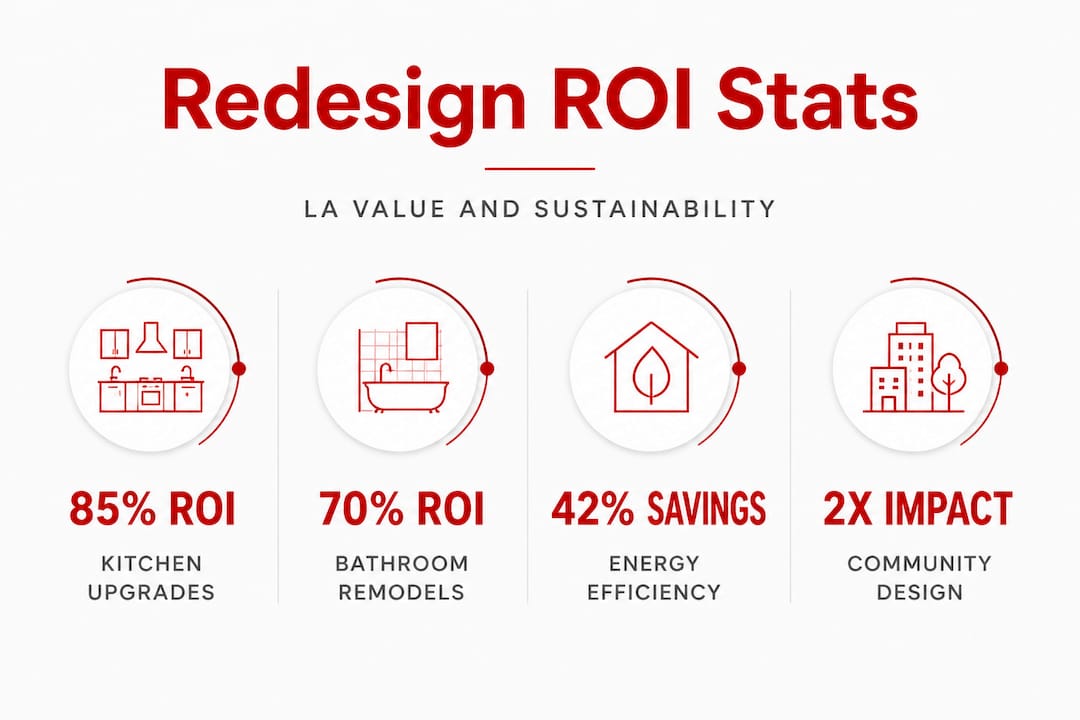
High-ROI upgrades in LA include kitchens, bathrooms, curb appeal improvements, and energy-conscious systems, while over-customized spaces and luxury gut projects tend to reduce the overall return percentage. A mid-range kitchen remodel, for example, regularly returns 70 to 85 percent of its cost at resale, while a high-end full kitchen gut can return under 60 percent in many LA neighborhoods.
| Upgrade type | ROI potential | Why it works or doesn't |
|---|---|---|
| Kitchen refresh | High (70–85%) | Visible, functional, broad buyer appeal |
| Bathroom update | High (65–80%) | Essential, visible, wide demand |
| ADU addition | High (varies by area) | Adds rental income and square footage |
| Curb appeal/landscaping | Very high in some cases | First impression, neighborhood context |
| Energy system upgrades | Moderate to high | Reduces operating costs, buyer demand |
| Luxury gut renovation | Lower percentage | Over-investment for most LA price points |
| Niche custom features | Low | Limits buyer pool, poor resale value |
The pattern here is clear. Upgrades that solve real problems for a wide range of people, and that buyers can see and feel immediately, win. Niche additions, like a highly specialized home theater, a wine cellar in a modest bungalow, or ultra-premium finishes in a mid-market neighborhood, often price you out of your buyer pool without proportional gains.
ADUs deserve special mention. Adding an accessory dwelling unit to your property in Los Angeles is one of the few upgrades that simultaneously increases square footage, generates potential rental income, and adds to assessed value in a way that the market strongly rewards. With LA's housing shortage, a well-designed ADU can be one of the smartest financial moves you make.
Key upgrades that consistently perform well in the LA market:
- Kitchen and bathroom refreshes that modernize without over-engineering
- Energy efficiency upgrades including insulation, smart HVAC, and solar
- ADU additions that create flexible living or income opportunities
- Exterior improvements that increase curb appeal and neighborhood fit
- Functional outdoor spaces that reflect LA's indoor-outdoor lifestyle
Pro Tip: Prioritize upgrades that solve practical, everyday problems and remain visible to anyone who walks through your front door. A buyer who immediately feels comfort and functionality will pay more than one who notices an extravagant feature buried in the design.
For more on how architecture tips for LA homes can guide your upgrade priorities, we recommend starting with function before form.
Beyond aesthetics: Sustainable redesign as a smart investment
With a clearer idea of value-driven upgrades, let's explore why LA's unique sustainability culture makes certain green investments doubly smart.
Sustainable redesign is an investable category in LA because it targets long-run operating costs and buyer-perceived quality, including comfort, air quality, and energy efficiency, rather than only surface aesthetics. That distinction is important. A homeowner who installs low-VOC paint and improved ventilation isn't just making the space look cleaner; they're building a healthier, more comfortable home that modern buyers actively seek out.
The most impactful sustainable upgrades for LA homeowners include:
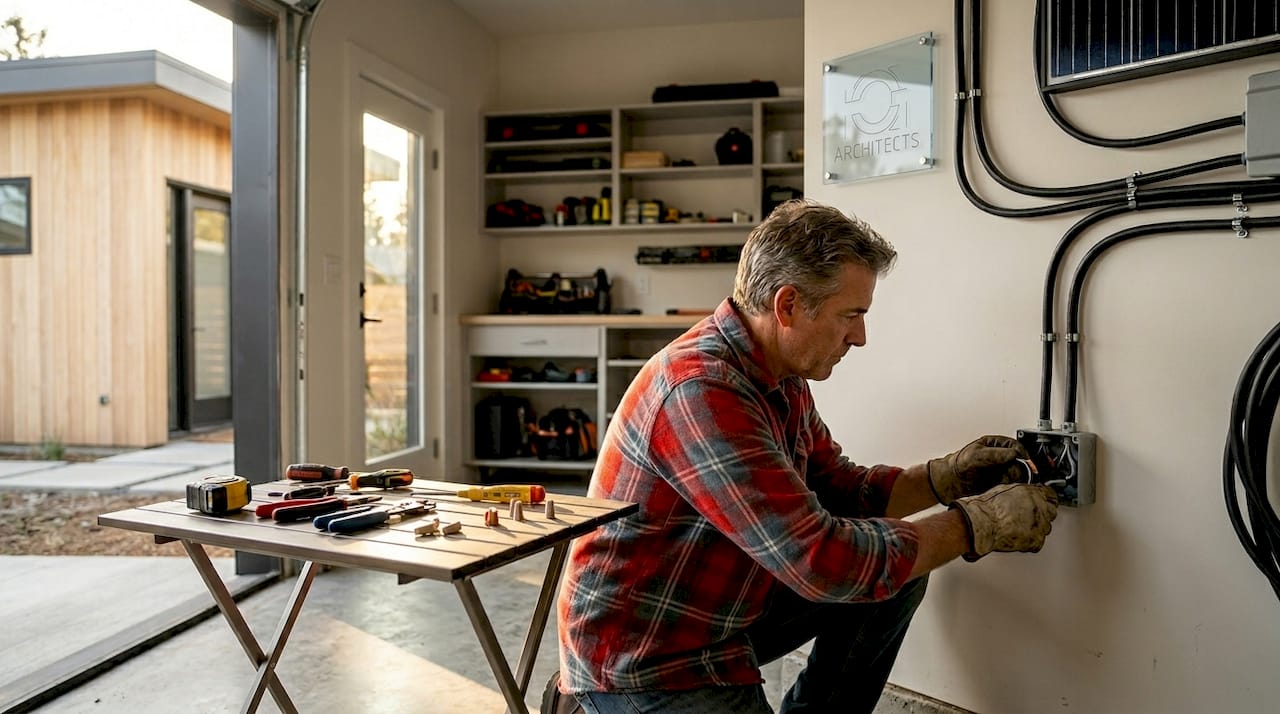
- Solar panels and battery storage, especially with available state and federal rebates
- High-efficiency heat pumps for heating, cooling, and water heating
- Improved insulation and air sealing to reduce energy loss
- Low-VOC paints, adhesives, and finishes for better indoor air quality
- Water-efficient landscaping adapted to LA's drought conditions
- Energy Recovery Ventilators (ERVs) for fresh air without energy waste
However, not every "green" upgrade delivers equal results. Research shows that lowest-efficiency electrification can actually increase costs and energy burden, while high-efficiency upgrades decrease bills, but only when the right systems and designs are chosen from the start.
| Efficiency level | Annual utility bill impact | Notes |
|---|---|---|
| High efficiency | Decrease of 20–40% | Best results with rebates and proper design |
| Moderate efficiency | Minimal change or small decrease | Depends heavily on system sizing |
| Low efficiency | Potential increase | Poor design or undersized upgrades undermine gains |
This table reinforces why cutting corners on energy upgrades is a real risk. The upfront cost savings of choosing a cheaper heat pump or skipping proper insulation often become long-term expenses in utility bills and reduced comfort.
Indoor air quality and energy savings are two of the most powerful drivers for today's LA buyers. Homes that breathe well and cost less to operate attract serious attention in a competitive market.
Pro Tip: Before starting any sustainable upgrade, research available incentives. California's TECH Clean California program, federal Inflation Reduction Act credits, and LA Department of Water and Power rebates can collectively offset 30 to 50 percent of eligible upgrade costs. Maximize these before deciding on system size or specification.
Sustainable ADU designs offer a compelling example of how sustainability and financial performance can align. A well-insulated, solar-ready ADU with a heat pump system can achieve near-zero operating costs while commanding premium rental rates in LA's tight housing market.
If you're thinking longer term, future-proofing your plans with built-in EV charging infrastructure, solar-ready electrical panels, and flexible room configurations keeps your home relevant as technology and regulations evolve.
Community connection and cultural identity through redesign
Economic return isn't the only motivator for redesign in LA. Let's consider how spaces can nurture community and reflect cultural roots.
Community-connected design and culturally resonant environments can be part of the core reason for redesign, because better-designed public-facing spaces, including parks, schoolyards, shared gardens, and adaptive reuse projects, build social capital, neighborhood pride, and identity. That principle applies directly to residential redesign. When you invest in your home's relationship to the street, the neighborhood, and the people who live nearby, you're doing something that ROI tables don't capture but that genuinely changes your quality of life.
In Los Angeles, a city shaped by dozens of distinct cultural communities, this matters more than in most places. A home that visually connects to its neighborhood, that uses materials, colors, or design elements rooted in the local cultural fabric, communicates something meaningful. It says: this home belongs here. That sense of belonging has real value, both personally and in terms of neighborhood cohesion.
Features that actively build community connection include:
- Front porches and street-facing patios that invite interaction with neighbors
- Shared gardens or edible landscapes in multi-family or adjacent properties
- Courtyards and threshold spaces that transition gracefully from public to private
- Culturally authentic materials and details, such as tile work, ironwork, or native plantings
- Adaptive reuse elements that honor the history of a site or structure
- Transparent or semi-open fencing that allows visual connection to the street
Design for gathering is design for identity. When your home creates space for people to meet, pause, and connect, it becomes more than a structure. It becomes part of the neighborhood's story.
The community-centric housing ideas we see working best in LA tend to start with a simple question: How does this home engage with the street? Even modest interventions, like a widened front path, a small seating area near the sidewalk, or a fruit tree that shades the public sidewalk, can shift a home's relationship to its context dramatically.
Pro Tip: Direct at least a portion of your redesign budget toward spaces that face outward. A beautiful interior that no one outside experiences has no community impact. A thoughtful exterior that invites interaction multiplies your home's social value.
Innovative LA home ideas increasingly reflect this dual focus on personal expression and community orientation. And how architects build community value in multi-family contexts offers useful lessons for single-family redesign as well.
Navigating trade-offs: Costs, incentives, and potential pitfalls
To get the most from your investment, whether in value, sustainability, or community, you'll need to navigate several key decisions and avoid common traps.
One of the most important things we've seen homeowners get wrong is assuming that any sustainable or electrification upgrade will automatically save money. Research is clear that household electrification benefits depend strongly on efficiency level and design choices. Lower-efficiency upgrades can increase costs and energy burden, while higher-efficiency electrification can reduce utility bills, but only when high capital costs and policy or utility barriers are properly addressed.
Here's a practical framework for approaching your redesign investment wisely:
Step 1: Set clear goals. Decide whether your primary goal is resale value, energy savings, community impact, or a combination. Different goals lead to different design priorities, and trying to optimize for everything at once often means doing none of it well.
Step 2: Research available incentives. Before committing to any contractor or product, understand what rebates, credits, and programs apply to your project. Federal, state, and utility-level incentives can significantly change the financial picture of an upgrade.
Step 3: Balance up-front costs with lifecycle savings. A cheaper system may save money today but cost more over ten years in energy bills, maintenance, and replacement. Run the numbers over a realistic time horizon before deciding.
Step 4: Evaluate context and site conditions. Your home's orientation, lot size, neighborhood character, and existing infrastructure all affect which upgrades will perform. An upgrade that works brilliantly for a home in Silverlake may underperform in a different context.
Step 5: Get professional input before committing. A qualified architect or energy consultant who knows LA's local codes, soil conditions, utility infrastructure, and market patterns can save you significant money and frustration. This is especially true for ADUs, where permitting complexity is high.
Common pitfalls to avoid:
- Settling for the lowest-bid contractor without checking qualifications or references
- Ignoring your home's site context when choosing upgrades
- Failing to apply for available incentives before the project starts
- Over-investing in one area while neglecting fundamentals like insulation or waterproofing
- Following design trends without evaluating their fit with your home and neighborhood
Current LA architecture trends provide useful context for understanding what buyers and renters value right now, but don't let trends override the fundamentals of good design and solid engineering. And when thinking long-term, building resilience in LA means designing for the next 20 to 30 years, not just the next sale.
Pro Tip: Consult local experts who specialize in LA's regulatory environment. Navigating LADBS permitting, Title 24 energy compliance, and utility rebate programs simultaneously requires experience. The cost of that expertise is almost always recovered in avoided mistakes and captured incentives.
The overlooked payoff: Alignment over trend-chasing in home redesign
Now that we've explored the practicalities, let's reconsider what makes an investment in redesign truly worthwhile.
In our experience working with homeowners across Los Angeles, the projects that create the most lasting satisfaction are rarely the ones that chased the highest ROI statistic or followed the most popular design trend. They're the ones that aligned with the owner's actual values, their sense of comfort, their cultural roots, and their connection to the place they call home.
We've seen homeowners invest heavily in features that scored well on resale guides, only to feel disconnected from the result. And we've seen modest investments in a front courtyard, a culturally meaningful material, or a shared garden transform how a family experiences their home every single day. The financial return matters, and we're not suggesting you ignore it. But it's one lens, not the only lens.
Innovative LA home design at its best integrates sustainability, community orientation, and personal authenticity into a coherent whole. Homes that mirror their owners' values tend to be better maintained, better loved, and better connected to their neighborhoods. That translates into real resilience and real social capital over time.
Great design is not just about what sells, but what endures and connects.
The homeowners who get the most from their redesign investments are those who ask the harder question first: What kind of home do I want to live in, and what kind of neighborhood do I want to help create? When the answer guides the project, the financial and experiential returns tend to follow.
Ready to redesign? Explore tailored LA plans
If this article has made you think more carefully about where your redesign investment will have the greatest impact, you're already ahead of most homeowners who start with a contractor and a wishlist.
At FO+H Architects, we help LA homeowners translate these priorities into real, buildable designs that balance value, sustainability, and community fit. Whether you're exploring an ADU to add income and flexibility or planning a broader residential redesign, our team brings local expertise and a culturally grounded design philosophy to every project. Browse our ready-to-adapt ADU plans, explore focused options like our Blue ADU plan for compact lots, or see how the Gold ADU design fits larger-scale visions. Start the conversation with a team that knows LA inside and out.
Frequently asked questions
Which home redesign projects give the best ROI in Los Angeles?
Kitchens, bathrooms, curb appeal upgrades, and energy-efficient improvements deliver the highest percentage returns in LA because they combine high visibility with broad buyer appeal.
How does sustainable redesign affect my home's value and utility bills?
High-efficiency upgrades lower energy costs and raise market value, but poorly designed or low-efficiency electrification can actually increase bills and reduce financial benefits.
Can home redesign really build stronger community connections?
Yes, redesigning front yards, shared spaces, and incorporating culturally resonant architecture can meaningfully foster social capital and strengthen neighborhood identity over time.
What are common pitfalls when investing in sustainable home redesign?
Choosing low-cost, low-efficiency systems or skipping available incentives are the most common traps, and efficiency level and design choices ultimately determine whether your sustainable upgrade saves or costs you money.
Recommended
- How Architects Shape Community and Value in Multi-Family Projects
- Why design matters: Create homes that truly fit your life
- Modern urban housing: sustainable designs for community living
- Modern residential architecture tips for LA homes 2026
- Why Remodel? Boost Value, Function & Home Enjoyment
- Role of design in renovation: maximize Illinois value