

TL;DR:
- Modern design is a principle-based approach emphasizing function, rational materials, and minimal ornamentation rooted in early 20th-century Europe. It features open spaces, large windows, flat or low-pitched roofs, and structural innovation that prioritizes spatial clarity and flexibility. In Los Angeles, modern architecture adapts these principles to climate, zoning, and site conditions, ensuring durable, sustainable, and thoughtfully designed homes.
Most people picture a cold, boxy glass cube when they hear "modern design," but that image barely scratches the surface of what modern architecture really means. Modern design is a principle-driven approach, grounded in function, rational material use, and the deliberate rejection of unnecessary ornament. It originated in early 20th-century Europe, spread across continents, and today shapes everything from a single-family home in Silver Lake to a multi-unit development in Culver City. Understanding what modern design actually is, how it differs from other styles, and how it applies to Los Angeles specifically, will help you make sharper, more confident decisions about your property.
Table of Contents
- Defining modern design: Movement, principles, and meaning
- Key features of modern architecture: What you really see and use
- Core materials and structure: What makes modern design possible?
- Modern design in Los Angeles: Real-world applications
- A fresh perspective: Why modern design is more mindset than style
- Modern design for your next Los Angeles project
- Frequently asked questions
Key Takeaways
| Point | Details |
|---|---|
| Principle-driven design | Modern design is guided by function, rational use of materials, and rejecting unnecessary ornament. |
| Key architectural features | Expect open plans, abundant light, clean lines, and minimal decorative details in true modern architecture. |
| Material and technical innovation | Industrial materials like steel, glass, and concrete enable the open, airy spaces modern design is known for. |
| LA adaptations | Modern design in Los Angeles blends core principles with climate, sustainability, and flexible living needs. |
| More than looks | Treating modern design as a mindset, not just a style, leads to more timeless and valuable spaces. |
Defining modern design: Movement, principles, and meaning
With the basics and misconceptions about modern design introduced, we can now dig into the foundational movements and how their values shape present-day projects.
Many homeowners and developers use "modern" and "contemporary" interchangeably. They are not the same thing. "Contemporary" simply describes what is happening right now in design. "Modern" refers to a specific architectural movement, one rooted in a defined set of principles that emerged in the early 20th century and produced a recognizable approach to how buildings are conceived, constructed, and used.
Modernism grew out of a broader cultural shift in Europe and North America. Architects including Walter Gropius, Ludwig Mies van der Rohe, and Le Corbusier argued that traditional ornamentation was dishonest and wasteful. They believed buildings should be shaped entirely by their function, built with new industrial materials, and stripped of decorative excess. This thinking gave rise to the International Style, which spread globally and still influences architectural education and practice today.
"Modernism is defined by its analytical approach to building function, rational and often new materials, structural innovation, and the elimination of ornament."
The difference between classic vs minimalist design is a useful reference point: classicism adds decoration to communicate status and meaning, while modernism removes everything that does not serve a clear purpose. That removal is not coldness. It is intentionality.
Core principles of modern design:
- Form follows function. Every element of a building should exist because it does something useful, not merely because it looks traditional.
- Analytical process. Decisions are made by analyzing how a space will be used, by whom, and under what conditions, not by copying historical precedent.
- New and rational materials. Steel, reinforced concrete, and glass are used because they perform well, not because they carry traditional associations.
- Structural innovation. Structural systems are designed to enable openness and flexibility rather than to conform to load-bearing wall traditions.
- Minimalism. Ornament is eliminated unless it serves a structural or functional role. Surfaces, edges, and details are clean and intentional.
These principles matter because they determine what decisions get made throughout the design and construction process. A truly modern building is not just one that looks a certain way. It is one where every design choice traces back to these values.
Key features of modern architecture: What you really see and use
Now that we have established the driving principles, let us look specifically at what actually defines the look and feel of modern buildings, both inside and out.
When you walk through a modern home, the experience is usually immediate and distinct. Spaces feel open and connected. Light moves through the building in a way that feels deliberate. Walls do not divide rooms arbitrarily. The exterior reads as a composition of planes and volumes rather than a stacked arrangement of moldings and decorative trim.
"Common modern architecture characteristics include form following function, flat or low-pitched roofs, geometry-led composition, horizontal emphasis, open-plan interiors, and minimal or no ornamentation."
Here is how modern design compares to traditional design across key features:
| Feature | Modern design | Traditional design |
|---|---|---|
| Roof form | Flat or low-pitched | Steeply pitched, often with dormers |
| Windows | Large, often floor-to-ceiling | Smaller, with decorative trim and grilles |
| Floor plan | Open plan, flexible zones | Compartmentalized rooms |
| Ornamentation | Minimal to none | Cornices, moldings, columns |
| Materials | Steel, glass, concrete | Wood, brick, stucco with applied detail |
| Ceiling height | Varies, often high | Standard, with decorative crown molding |
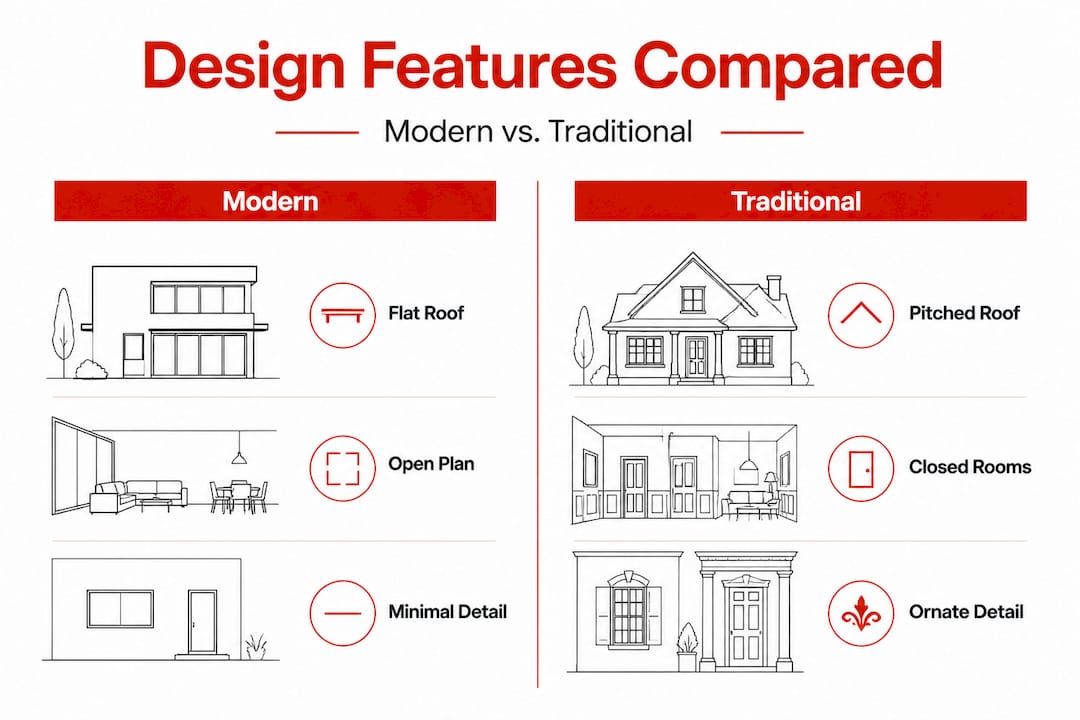
These differences are not just visual. They affect how a home feels to live in, how natural light moves through the day, and how flexible the space is as your household's needs change over time. Open concept layouts in modern homes, for example, are not simply a trend. They are a direct product of the principle that space should serve how people actually move and gather.
What you will notice when moving through a modern space:
- Natural light enters from multiple directions, reducing the need for artificial lighting during daytime.
- Transitions between indoor and outdoor spaces are intentional and often seamless, particularly through sliding glass walls or carefully positioned openings.
- Rooms connect visually and spatially even when separated by different floor levels or functions.
- Surfaces and edges are clean. Details like door frames, cabinet hardware, and transitions between materials are treated as design decisions rather than afterthoughts.
- Storage and utilities are integrated into the architecture so they do not interrupt the spatial experience.
You can explore how modern floor plan types are categorized and which layout options make the most sense for different household sizes and property configurations. Flexible floor plans are particularly valuable in Los Angeles, where property values make every square foot count.
Pro Tip: Most modern homes in Los Angeles incorporate adapted features rather than strict adherence to historic modernism. Climate considerations, local zoning codes, and hillside topography all influence how modern principles are expressed on any given site. Knowing this will help you evaluate proposals and avoid paying for aesthetics that do not fit your actual conditions.
Core materials and structure: What makes modern design possible?
With a sense of what defines the look and use of modern design, let us examine what makes these spaces physically possible and how smart material choices elevate both form and function today.
The reason modern homes can have open, column-free rooms, floor-to-ceiling glass, and long horizontal roof overhangs comes down to structural engineering and industrialized materials. Traditional construction relied on load-bearing walls placed at regular intervals. Modern architecture replaced that system with a structural frame, typically steel or reinforced concrete, that carries all the loads while the walls between become free to move, shrink, or disappear entirely.
This structural frame logic is what enables open plans and large windows. The infill between structural elements can be glass, lightweight panel systems, or other materials that perform specific functions such as thermal insulation or acoustic separation, without needing to carry any load.
| Material | Structural role | Performance benefits |
|---|---|---|
| Structural steel | Primary frame, long spans | High strength-to-weight ratio, enables open plans |
| Reinforced concrete | Frame, shear walls, slabs | Fire resistance, thermal mass, durability |
| Laminated glass | Infill, glazing | Transparency, daylight, visual connection to outdoors |
| Insulated glass units | Windows, curtain walls | Thermal performance, condensation control |
| Fiber cement panel | Cladding, infill | Low maintenance, moisture resistance, design flexibility |
| Mass timber (CLT) | Floor and wall systems | Carbon sequestration, warm aesthetic, structural efficiency |
Modern buildings in Los Angeles face specific performance challenges. Heat gain through large glass areas is a real concern in a Southern California climate. Older modernist buildings from the 1950s and 1960s sometimes suffer from poor thermal performance because single-pane glazing and minimal insulation were standard at the time. Today, architects address this through high-performance glazing, continuous insulation at exterior walls, and carefully designed shading from overhangs or louvers. You can read more about sustainable modern materials and how they apply to current residential projects in Los Angeles.
Key things to consider with modern materials:
- Thermal performance: Large glass areas can cause significant heat gain without proper glazing specifications and shading design. This affects both comfort and Title 24 energy compliance.
- Maintenance requirements: Some modern materials like exposed concrete and steel require periodic maintenance to prevent staining, corrosion, or cracking over time.
- Retrofitting existing buildings: Upgrading the building envelope on older modern homes, replacing windows, adding insulation, or improving air sealing, often yields significant improvements in comfort and energy costs.
- Interior material quality: Modern interiors often feature exposed materials like polished concrete floors, wood ceilings, or metal-framed partitions. These require careful specification to perform well long-term.
- Sustainability integration: Contemporary sustainable interior ideas and creative material options show how modern spaces can balance aesthetics with environmental responsibility.
Pro Tip: If you are renovating an older modern home in Los Angeles, the most impactful upgrade is almost always the building envelope: windows, insulation, and air sealing. Addressing these before investing in interior finishes will improve comfort, reduce energy bills, and protect the long-term value of the property.
Modern design in Los Angeles: Real-world applications
We have explored the theoretical and technical aspects of modernism. Now let us ground these principles in the unique context of Los Angeles architecture.

Los Angeles has a deep and layered relationship with modernism. The Case Study Houses of the 1940s and 1950s, commissioned by Arts and Architecture magazine, put Southern California on the global architectural map. Architects like Richard Neutra, Charles and Ray Eames, and Raphael Soriano used modern principles to design homes that responded directly to the LA climate, with cross-ventilation, indoor-outdoor connections, and shading strategies tailored to Southern California conditions.
That legacy continues today. Developers building multi-family housing in neighborhoods like Echo Park, Leimert Park, and Boyle Heights are applying modern principles to create modern urban housing that serves communities rather than just delivering units. Homeowners pursuing modern design for LA homes are finding that modern principles often align well with both their lifestyle preferences and the practical realities of California code requirements.
Practical tips for applying modern principles in Los Angeles:
- Site orientation: Position the primary glazing toward the north or east to reduce direct solar heat gain while still maximizing natural light. South-facing windows can work well with appropriately sized overhangs.
- Indoor-outdoor connection: LA's climate makes this a genuine quality-of-life issue, not just an aesthetic preference. Design transitions carefully with appropriate thresholds, weather sealing, and shading.
- Glazing specification: Invest in high-performance low-E glazing. The energy cost savings and comfort improvement in an LA climate are significant over the life of the building.
- Flexible spatial layout: Multi-generational living and remote work have changed how LA homeowners use their homes. A modern floor plan that anticipates multiple uses performs better over time.
- ADU integration: Modern principles apply directly to ADU (Accessory Dwelling Unit) design. Modern ADU inspirations show how small footprints can achieve high performance and spatial quality.
You can see how these principles translate into current local projects through a review of LA home design trends, which reflects how architects are adapting modernism to current codes, budgets, and community expectations.
One common mistake we see: homeowners and developers chase the look of modern design, specifying flat roofs and minimalist facades, without applying the underlying principles. The result is a building that appears modern but does not perform like one. Spaces feel disconnected. Lighting is inadequate. The structural system was not designed for flexibility. Getting the principles right from the start avoids these costly mismatches.
Pro Tip: Los Angeles building codes, including Title 24 energy standards, seismic requirements, and hillside grading regulations, all influence how modern design is expressed on any given site. Work with an architect who understands how these requirements interact with modern principles, not just how to satisfy them minimally.
A fresh perspective: Why modern design is more mindset than style
To wrap up, let us challenge the common wisdom with a professional take on what "modern" should really mean for anyone shaping spaces in Los Angeles.
In our experience working on residential, ADU, and multi-family projects across Los Angeles, the biggest source of confusion we see is treating modern design as a visual checklist. Clients sometimes arrive with images of flat roofs, white walls, and concrete floors and say "we want modern." That is a starting point, but it is not a design brief.
Modernism is not one single look. It spans the International Style, regional modernism, brutalism, and numerous other strands, all of which share underlying principles but produce very different visual results. Evaluating whether a design is truly modern should begin with the logic behind the decisions, not the surface appearance.
What we argue for, based on years of practice, is treating modern design as a flexible toolkit. The question is not "does this look modern?" The question is "does every decision here trace back to function, rational material use, and spatial clarity?" When you approach design that way, you get buildings that work well, age well, and hold their value. When you chase aesthetics without the underlying logic, you get a building that looks dated within a decade.
This matters for LA residential architecture trends because the market moves quickly. Homeowners who invest in principle-driven modern design tend to see stronger long-term returns than those who invest in trend-driven aesthetics.
Pro Tip: When evaluating architects or builders, ask them to explain the reasoning behind their design decisions. A designer who understands modern principles will answer in terms of function, structure, and spatial performance. A designer who is applying surface aesthetics will answer in terms of what things look like. The difference is significant when you are committing to a major construction project.
Modern design for your next Los Angeles project
Armed with this modern design knowledge, you are ready to move from inspiration to action in your own project.
Applying modern design principles to a real Los Angeles project takes more than a mood board. It requires understanding your site, your local zoning conditions, and how structural and material decisions interact with your lifestyle needs. That is exactly the kind of work we do at FO+H Architects.
Whether you are planning a new custom home, a renovation, or an ADU on your existing property, modern principles can guide you toward a space that performs better and feels more intentional. Our ADU plans offer pre-designed options that apply modern layout logic to the ADU format, including the Gold ADU plan, which balances spatial efficiency with high-quality material specifications. If you are ready to discuss a custom project, reach out to our team and let us talk through what modern design can look like for your specific property and goals.
Frequently asked questions
What is the difference between modern and contemporary design?
Modern design refers to a 20th-century architectural movement with specific principles rooted in function, new materials, and the rejection of ornament, while contemporary design simply describes what is currently popular or trending in design without a fixed set of principles.
What are the must-have features of a modern home?
The core features include open floor plans, large windows, flat or low-pitched roofs, minimal ornamentation, and a clear connection between indoor and outdoor spaces, all driven by the principle that form should follow function.
How does modern design support sustainable building in Los Angeles?
Modern design's structural frame logic enables large window areas for natural light and cross-ventilation, and contemporary modern buildings pair this with high-performance glazing and insulation to meet California's Title 24 energy standards while reducing mechanical system loads.
Can a home mix modern design with other styles?
Yes, because modernism spans variations rather than existing as a single fixed look. A home can blend influences from different periods or regions as long as the core principles of function, simplicity, and minimal ornament remain the foundation of the design decisions.
Recommended
- Modern residential architecture trends shaping LA living
- Why choose modern residential design for your LA home?
- Urban residential design: Transforming Los Angeles living
- Why design matters: Create homes that truly fit your life
- Modern Office Design Ideas for Illinois Workspaces 2026
- Modern Marble Uses for Luxury Interior Design– SurfacesGalore